GLP-1’s at low prices with free shipping. Get Started


" transform="translate(53.5 27.5)" width="0px"/><g d="M 164.013 0 C 206.437 0 240.828 33.597 240.828 75.04 C 240.828 116.484 206.437 150.08 164.013 150.08 C 121.589 150.08 87.198 116.484 87.198 75.04 C 87.198 33.597 121.589 0 164.013 0 Z M 164.52 30.422 C 140.298 30.422 120.662 50.398 120.662 75.04 C 120.662 99.682 140.298 119.659 164.52 119.659 C 188.742 119.659 208.377 99.682 208.377 75.04 C 208.377 50.398 188.742 30.422 164.52 30.422 Z M 49.689 117.004 L 49.724 117.026 C 50.148 121.056 54.397 124.222 59.576 124.222 C 60.05 124.222 60.516 124.195 60.973 124.143 L 61.097 124.222 L 83.406 120.926 C 83.406 120.926 73.956 127.316 67.688 131.067 C 60.617 135.299 49.689 141.207 49.689 141.207 C 49.689 141.207 39.295 147.961 27.633 149.827 C 27.576 149.836 27.52 149.844 27.463 149.853 C 26.591 150.023 25.702 150.098 24.814 150.077 C 24.739 150.079 24.665 150.08 24.591 150.08 L 24.577 150.069 C 19.359 149.854 15.211 146.423 15.211 142.221 L 15.211 29.154 C 15.211 28.755 15.022 28.379 14.702 28.139 C 14.383 27.9 13.968 27.826 13.585 27.939 L 0 29.915 L 35.746 8.366 L 49.689 0 Z M 260.136 98.048 C 260.234 98.048 260.33 98.052 260.427 98.058 L 287.219 98.517 L 287.219 98.612 C 295.722 98.712 302.586 105.638 302.586 114.166 C 302.586 121.454 297.574 127.571 290.811 129.259 L 304.648 146.964 L 304.644 146.964 C 304.889 147.252 305.023 147.617 305.023 147.995 C 305.023 148.839 304.365 149.536 303.523 149.585 L 303.523 149.588 L 291.341 149.588 L 291.341 149.582 C 289.373 149.504 287.613 148.618 286.384 147.245 L 286.374 147.245 L 286.328 147.182 C 286.064 146.88 285.827 146.557 285.619 146.215 L 273.443 129.628 L 273.463 129.625 C 272.779 128.705 272.41 127.589 272.412 126.442 C 272.412 123.684 274.502 121.414 277.187 121.13 L 277.191 121.101 L 281.783 120.351 L 281.783 120.348 C 285.214 120.264 287.968 117.864 287.968 114.916 C 287.968 111.968 285.214 109.568 281.783 109.483 L 281.783 109.481 L 270.538 109.481 L 270.538 146.777 L 270.536 146.777 C 270.538 146.808 270.538 146.839 270.538 146.871 C 270.538 148.34 269.371 149.537 267.913 149.586 L 267.913 149.588 L 258.168 149.588 L 258.168 149.573 C 256.799 149.433 255.731 148.277 255.731 146.871 C 255.731 146.839 255.733 146.808 255.733 146.777 L 255.731 146.777 L 255.731 102.359 L 255.733 102.359 C 255.781 100.064 257.585 98.201 259.856 98.058 L 259.856 98.048 L 259.998 98.051 C 260.044 98.049 260.09 98.048 260.136 98.048 Z M 324.515 110.615 C 326.064 110.719 327.396 111.676 328.101 113.049 L 332.884 119.45 L 338.302 112.809 C 339.033 111.565 340.298 110.713 341.756 110.615 L 341.756 110.605 L 352.44 110.605 C 353.577 110.605 354.5 111.528 354.5 112.667 C 354.5 113.003 354.42 113.321 354.276 113.601 L 354.314 113.604 L 354.176 113.776 C 354.1 113.896 354.011 114.008 353.912 114.109 L 342.693 128.222 C 342.693 128.222 342.413 128.627 342.413 128.972 C 342.413 129.318 342.693 129.722 342.693 129.722 L 355.241 146.116 C 355.722 146.507 356 147.094 356 147.714 C 356 148.852 355.077 149.775 353.938 149.775 C 353.876 149.775 353.814 149.772 353.751 149.766 L 353.751 149.775 L 341.756 149.775 L 341.756 149.749 C 340.252 149.58 338.973 148.605 338.31 147.237 L 333.228 140.405 C 333.228 140.405 333.042 140.217 332.76 140.217 C 332.48 140.217 332.291 140.405 332.291 140.405 L 332.289 140.402 L 327.078 147.492 C 326.891 147.825 326.664 148.134 326.401 148.411 L 326.295 148.557 L 326.263 148.553 C 325.588 149.207 324.723 149.641 323.764 149.749 L 323.764 149.775 L 312.331 149.775 C 311.194 149.775 310.271 148.852 310.271 147.714 C 310.271 147.02 310.613 146.407 311.138 146.033 L 323.015 130.659 C 323.015 130.659 323.295 130.255 323.295 129.909 C 323.295 129.564 323.015 129.16 323.015 129.16 L 311.458 114.146 C 311.058 113.758 310.833 113.224 310.833 112.667 C 310.833 111.528 311.756 110.605 312.894 110.605 L 324.515 110.605 Z" fill="transparent" height="150.08043079668755px" id="HpkDSJwpk" transform="translate(0 1)" width="356.0000118682049px"><path d="M 76.815 0 C 119.239 0 153.63 33.597 153.63 75.04 C 153.63 116.484 119.239 150.08 76.815 150.08 C 34.391 150.08 0 116.484 0 75.04 C 0 33.597 34.391 0 76.815 0 Z M 77.322 30.422 C 53.1 30.422 33.464 50.398 33.464 75.04 C 33.464 99.682 53.1 119.659 77.322 119.659 C 101.544 119.659 121.179 99.682 121.179 75.04 C 121.179 50.398 101.544 30.422 77.322 30.422 Z" fill="rgb(8, 9, 35)" height="150.08043079668755px" id="kvrqFybmK" transform="translate(87.198 0)" width="153.62981889920286px"/><path d="M 49.689 117.004 L 49.724 117.026 C 50.148 121.056 54.397 124.222 59.576 124.222 C 60.05 124.222 60.516 124.195 60.973 124.143 L 61.097 124.222 L 83.406 120.926 C 83.406 120.926 73.956 127.316 67.688 131.067 C 60.617 135.299 49.689 141.207 49.689 141.207 C 49.689 141.207 39.295 147.961 27.633 149.827 C 27.576 149.836 27.52 149.844 27.463 149.853 C 26.591 150.023 25.702 150.098 24.814 150.077 C 24.739 150.079 24.665 150.08 24.591 150.08 L 24.577 150.069 C 19.359 149.854 15.211 146.423 15.211 142.221 L 15.211 29.154 C 15.211 28.755 15.022 28.379 14.702 28.139 C 14.383 27.9 13.968 27.826 13.585 27.939 L 0 29.915 L 35.746 8.366 L 49.689 0 Z M 260.136 98.048 C 260.234 98.048 260.33 98.052 260.427 98.058 L 287.219 98.517 L 287.219 98.612 C 295.722 98.712 302.586 105.638 302.586 114.166 C 302.586 121.454 297.574 127.571 290.811 129.259 L 304.648 146.964 L 304.644 146.964 C 304.889 147.252 305.023 147.617 305.023 147.995 C 305.023 148.839 304.365 149.536 303.523 149.585 L 303.523 149.588 L 291.341 149.588 L 291.341 149.582 C 289.373 149.504 287.613 148.618 286.384 147.245 L 286.374 147.245 L 286.328 147.182 C 286.064 146.88 285.827 146.557 285.619 146.215 L 273.443 129.628 L 273.463 129.625 C 272.779 128.705 272.41 127.589 272.412 126.442 C 272.412 123.684 274.502 121.414 277.187 121.13 L 277.191 121.101 L 281.783 120.351 L 281.783 120.348 C 285.214 120.264 287.968 117.864 287.968 114.916 C 287.968 111.968 285.214 109.568 281.783 109.483 L 281.783 109.481 L 270.538 109.481 L 270.538 146.777 L 270.536 146.777 C 270.538 146.808 270.538 146.839 270.538 146.871 C 270.538 148.34 269.371 149.537 267.913 149.586 L 267.913 149.588 L 258.168 149.588 L 258.168 149.573 C 256.799 149.433 255.731 148.277 255.731 146.871 C 255.731 146.839 255.733 146.808 255.733 146.777 L 255.731 146.777 L 255.731 102.359 L 255.733 102.359 C 255.781 100.064 257.585 98.201 259.856 98.058 L 259.856 98.048 L 259.998 98.051 C 260.044 98.049 260.09 98.048 260.136 98.048 Z M 324.515 110.615 C 326.064 110.719 327.396 111.676 328.101 113.049 L 332.884 119.45 L 338.302 112.809 C 339.033 111.565 340.298 110.713 341.756 110.615 L 341.756 110.605 L 352.44 110.605 C 353.577 110.605 354.5 111.528 354.5 112.667 C 354.5 113.003 354.42 113.321 354.276 113.601 L 354.314 113.604 L 354.176 113.776 C 354.1 113.896 354.011 114.008 353.912 114.109 L 342.693 128.222 C 342.693 128.222 342.413 128.627 342.413 128.972 C 342.413 129.318 342.693 129.722 342.693 129.722 L 355.241 146.116 C 355.722 146.507 356 147.094 356 147.714 C 356 148.852 355.077 149.775 353.938 149.775 C 353.876 149.775 353.814 149.772 353.751 149.766 L 353.751 149.775 L 341.756 149.775 L 341.756 149.749 C 340.252 149.58 338.973 148.605 338.31 147.237 L 333.228 140.405 C 333.228 140.405 333.042 140.217 332.76 140.217 C 332.48 140.217 332.291 140.405 332.291 140.405 L 332.289 140.402 L 327.078 147.492 C 326.891 147.825 326.664 148.134 326.401 148.411 L 326.295 148.557 L 326.263 148.553 C 325.588 149.207 324.723 149.641 323.764 149.749 L 323.764 149.775 L 312.331 149.775 C 311.194 149.775 310.271 148.852 310.271 147.714 C 310.271 147.02 310.613 146.407 311.138 146.033 L 323.015 130.659 C 323.015 130.659 323.295 130.255 323.295 129.909 C 323.295 129.564 323.015 129.16 323.015 129.16 L 311.458 114.146 C 311.058 113.758 310.833 113.224 310.833 112.667 C 310.833 111.528 311.756 110.605 312.894 110.605 L 324.515 110.605 Z" fill="rgb(8, 9, 35)" height="150.08043079668755px" id="kdERGws7a" width="356.0000118682049px"/></g></svg>)
How to Get Approved for GLP-1 A 2026 Guide to Success
Getting approved for GLP-1 medication isn’t just about meeting a BMI requirement—it’s about presenting a clear, well-documented case. As outlined in , successful approvals often come down to strong medical records, documented lifestyle efforts, and choosing the right path—whether through insurance or telehealth. With the right preparation and strategy, what feels overwhelming can become a clear, actionable process toward getting the support your body needs.
Learn how to get approved for GLP-1 medications. Our guide covers eligibility, insurance PAs, and telehealth routes like 10 Rx Home for weight loss success.

How to Get Approved for GLP-1 A 2026 Guide to Success
You’ve probably already done the hard part. You’ve tried to eat better, move more, cut back, start over, and keep going even when the scale barely moved. Now you’re looking at GLP-1 medication and wondering whether this could finally be the tool that helps your body cooperate with your effort.
That question usually comes with another one right behind it. How do you get approved for GLP-1?
The answer isn’t just “meet the BMI requirement.” Approval often depends on how clearly your story is documented, how carefully your clinician submits it, and whether you choose the insurance route or a direct-pay telehealth option. Smooth navigation of this process frequently relies on thorough paperwork, a clear medical narrative, and a realistic plan, often more so than the severity of symptoms.
If you’re feeling hopeful and overwhelmed at the same time, that’s normal. A medication can open a door, but getting access takes strategy. If you’re also trying to build sustainable habits around treatment, it helps to see what a complete support plan can look like in daily life, not just on paper. This overview of wellness plan examples is a useful place to start.
Your Journey to a Healthier You Starts Now
A lot of people arrive at this point exhausted.
They’ve spent years blaming themselves for a problem that’s far more complicated than willpower. They’ve white-knuckled hunger, restarted programs on Mondays, avoided photos, postponed travel, and told themselves they’d deal with their health “once things calm down.” Then they hear about GLP-1s and feel something they haven’t felt in a while. Relief. Maybe this is a real medical tool, not another motivational speech.
That shift matters.
GLP-1 treatment isn’t a shortcut, and it isn’t magic. It’s a legitimate medical option that can support appetite regulation, consistency, and momentum when lifestyle effort alone hasn’t been enough. For many patients, the emotional change begins before the first dose. It starts when they realize they don’t have to keep fighting the same battle the same way.
You are not starting from zero. You’re starting from experience, and that experience can strengthen your approval case.
The next step is getting clear on what path you’re taking. Some people pursue insurance coverage and need a strong prior authorization file. Others decide they’d rather avoid insurance friction and look at a telehealth cash-pay route. Both can work. Both have trade-offs.
What doesn’t work is going in casually.
If you want to know how to get approved for glp-1, approach it like a healthcare navigator would. Know your eligibility. Gather the right records. Anticipate objections before the insurer raises them. If insurance becomes a dead end, know when to pivot instead of losing months to paperwork.
Hope is useful here. So is preparation.
Understanding Your Eligibility for GLP-1 Medication
Before any approval happens, you need to know whether you meet the baseline clinical criteria. Many people get tripped up with this. They assume a clinician or insurer will “figure it out later,” but the cleaner your eligibility picture is from the start, the better your odds of moving forward without delays.
The core benchmark is straightforward. For weight management, a patient typically needs a BMI of 30 kg/m² or greater, or a BMI of 27 kg/m² or greater with at least one weight-related comorbidity such as hypertension or type 2 diabetes, based on FDA-aligned benchmarks described here.
That sounds simple, but in practice there’s a difference between being clinically eligible and being easily approvable.
The basic checklist
Here’s a quick way to think about it.
Criteria | Requirement | Common Examples |
|---|---|---|
BMI only | BMI 30 kg/m² or greater | Obesity without an additional documented condition |
BMI plus comorbidity | BMI 27 kg/m² or greater with a weight-related comorbidity | Hypertension, type 2 diabetes |
Clinical review | Provider confirms the medication is appropriate and safe | Medication review, symptom history, medical history |
Documentation quality | Records must clearly support the diagnosis and treatment need | Recent weight, chart notes, diagnosis coding, prior attempts |
A BMI number by itself opens the conversation. It doesn’t finish it.
Insurers and prescribing clinicians usually want to see that excess weight is affecting health in a medically meaningful way, or that prior efforts haven’t produced sufficient results. That’s why a person with the same BMI as someone else can have a much smoother approval experience if their chart is more complete.
Which comorbidities matter most
The most commonly recognized comorbidities are the ones that show weight is not just a cosmetic concern. It’s tied to broader health risk.
That often includes:
High blood pressure: especially when it’s documented in recent visits or medication lists
Type 2 diabetes or prediabetes-related concern: often supported by lab work and problem lists
High cholesterol or dyslipidemia: if it appears in active diagnoses or treatment records
Sleep-related or metabolic complications: when documented by the treating clinician
The exact list accepted by a payer can vary, but the pattern is consistent. The more clearly your records connect body weight to ongoing medical risk, the stronger your case becomes.
Clinical reality: A patient may “have” a condition, but if it isn’t documented clearly in the chart, the insurer may act as though it doesn’t exist.
Eligibility isn’t only about BMI
Experienced navigation proves beneficial. A clinician doesn’t only ask, “Do you qualify on paper?” They also ask whether this medication is appropriate for you.
That review often includes prior weight-loss efforts, medication interactions, contraindications, and readiness for ongoing follow-up. If you’re early in the process, taking a free online health assessment can help organize the questions you’ll need answered before a formal visit.
Some patients also want to compare injectable options with oral therapies before deciding what to discuss with a clinician. If that’s you, this overview of the benefits of oral weight loss medication gives helpful context around how different treatment approaches may fit different preferences.
Common reasons people seem eligible but still stall
A few patterns come up again and again:
The BMI was never formally recorded: Home estimates don’t help much if the chart lacks a documented measurement.
A comorbidity is mentioned casually, not coded or assessed: Insurers often look for clean charting, not implied history.
The medical record doesn’t show prior lifestyle effort: Even when patients have tried for years, the chart may say almost nothing.
A contraindication needs review first: Safety always comes before approval speed.
If you want to know how to get approved for glp-1, start with brutal honesty about your file. Not your memory. Not your intention. Your actual documented record.
That’s the difference between “I should qualify” and “I submitted a case that can be approved.”
How to Build an Undeniable Case for Approval
The strongest GLP-1 approvals don’t happen because a patient asks for the medication convincingly. They happen because the chart tells a complete story.

This is the part many people underestimate. They assume the prescriber will write a note, send a form, and the insurer will fill in the blanks. That’s rarely how it works. Reviewers often see only what’s submitted. If your file is thin, your case looks weak even when your medical need is real.
One of the most important practical moves is documenting prior lifestyle work. For patients seeking insurance coverage, pre-documenting a 6-month log of lifestyle interventions, such as diet and exercise, can align with major payer criteria and raise first-pass approval likelihood to as high as 90% in compliant cases, according to this payer-focused review.
What belongs in your approval file
A useful approval packet usually includes more than one doctor’s note. It should show pattern, persistence, and medical necessity.
Start gathering:
Weight history: office weights, home logs if your clinician accepts them, and timing that shows the trend over time
Lifestyle efforts: food tracking, exercise logs, weight-loss program participation, nutrition visits, trainer notes, or written summaries of what you’ve consistently tried
Relevant labs: A1C, lipid panels, and any other clinician-requested labs that help show metabolic risk
Problem list support: diagnosed hypertension, type 2 diabetes, dyslipidemia, or other charted conditions connected to treatment need
Medication history: prior anti-obesity medications, intolerance, lack of response, or step-therapy attempts if your plan requires them
Notice what’s missing from that list. Passion. Frustration. Persuasive language.
Those feelings are real, but approvals move on documentation.
Build a timeline, not a pile
Many patients hand over screenshots, receipts, and scattered app logs. That’s better than nothing, but it still leaves the clinician doing detective work.
A cleaner approach is to organize your information into a one-page timeline. Include dates, what you tried, how long you stayed with it, and what happened. For example, note when you started a structured diet, how often you exercised, whether you saw a dietitian, and why the result wasn’t durable.
Practical rule: If a reviewer can understand your weight-loss history in two minutes, your file is much stronger than a folder full of unexplained documents.
What clinicians and insurers look for
They’re not only asking whether you want help losing weight. They’re asking whether this medication is medically justified and appropriately selected.
That means your record should make these points easy to see:
You meet the clinical threshold
Weight is affecting health in a documented way
Lifestyle intervention has been attempted
The requested medication fits the diagnosis and treatment plan
There are no major unaddressed safety concerns
Precise chart language is essential. “Patient wants to lose weight” is weak. “Patient has obesity with documented hypertension and prior sustained diet and exercise efforts without adequate response” is much stronger because it describes medical necessity.
The details that quietly improve approvals
Small administrative details often decide whether a request moves or stalls.
Use recent records: stale weights or old labs can trigger delays
Match the diagnosis to the request: coding and chart wording should point in the same direction
Document failed or insufficient response clearly: vague phrases like “tried diet” don’t help much
Prepare for renewal early: if ongoing treatment later requires proof of response, your follow-up notes should already capture progress
A good file doesn’t exaggerate. It clarifies.
When I see approvals fall apart, it’s usually not because the patient was a poor candidate. It’s because nobody translated the patient’s real history into the language insurers review. Once that happens, the process gets much less mysterious.
Navigating the Insurance Prior Authorization Maze
Insurance approval is where most frustration lives. Patients hear “we submitted the prior auth” and then wait in silence, not knowing whether the request is pending, incomplete, or already denied.

A prior authorization, or PA, is the insurer’s gatekeeping step. Before they agree to pay, they want documentation showing that the prescription meets plan rules. For GLP-1s, those rules can be strict, inconsistent, and highly dependent on the exact plan language.
The timeline is often longer than patients expect. The prior authorization process for GLP-1s averages 2 to 6 weeks, with initial denial rates for weight loss use hitting 30% to 50%. Appeals that include specific evidence like lab results and BMI trends are successful up to 60% of the time, according to this review of the authorization process.
Why denials happen so often
Most initial denials are not dramatic clinical rejections. They’re administrative or documentation failures.
Common problems include:
Incomplete paperwork: missing fields, unsigned forms, or omitted chart attachments
Weak evidence of medical necessity: the diagnosis is present, but the supporting history is thin
Missing comorbidity documentation: the condition may be in the patient’s history but not clearly included in the submission
No proof of prior lifestyle effort: many plans want evidence, not just a statement
Step therapy gaps: if the plan requires trying another option first, that requirement has to be addressed directly
Some patients also run into a coverage issue that has nothing to do with their health. Their employer plan may exclude anti-obesity medication coverage. That’s painful, but it’s better to learn that early than spend weeks resubmitting a request that the plan will never cover.
How to make the PA cleaner on the first pass
The first submission should be treated like your best shot, not a rough draft.
Here’s the practical sequence that tends to work:
Verify the plan benefit first
Confirm whether the plan covers GLP-1s for weight management at all. If the answer is no, you may need to pivot quickly.Read the criteria line by line
Look for required BMI thresholds, comorbidities, lifestyle documentation, diagnosis coding, and step therapy rules.Submit a packet, not just a form
Include chart notes, recent weight, relevant labs, medication history, and supporting diagnosis details together.Track the status actively
Don’t assume “submitted” means complete. Follow up until you know whether it’s pending review, needs more information, or has been denied.
A denial often means “your file didn’t prove enough,” not “you can never get this medication.”
Appeals are where strategy matters
An appeal should not repeat the original request with a new cover sheet. It should answer the reason for denial directly.
If the denial says there was no evidence of sustained lifestyle effort, send the log. If the insurer says the BMI threshold wasn’t established, include the documented measurement. If they claim the comorbidity wasn’t demonstrated, attach the chart note, diagnosis list, and any relevant lab or treatment history that supports it.
A good appeal usually includes:
The denial letter language: so your response addresses the exact objection
A concise clinical summary: short, specific, and aligned with the payer’s criteria
Objective evidence: BMI trend, labs, medication history, and diagnosis documentation
Any omitted records from the first submission: many denials happen because key pages were never attached
This is also where understanding the role of pharmacy benefit managers can help. If you want a plain-English overview of who often influences drug access rules, formularies, and utilization controls, this guide to medication access and PBMs provides useful background.
Know when cost is the real issue
Even with approval, out-of-pocket cost can still be the next barrier. Copays, deductibles, and non-covered formulations can change the whole equation. Before you invest weeks in appeals, it’s smart to estimate your likely burden. This breakdown of prescription cost without insurance can help you compare what the process may cost you if coverage falls through.
What works and what doesn’t
What works is precision. Matching plan criteria. Sending complete documentation. Responding fast to requests for more information. Appealing with evidence instead of emotion.
What doesn’t work is assuming the insurer will connect the dots for you. They usually won’t.
What also doesn’t work is letting a denial sit because it feels final. In this space, a denial is often part of the process. The successful patients aren’t always the easiest approvals. They’re often the ones who stayed organized long enough to push the file over the line.
If you want to know how to get approved for glp-1 through insurance, think like a reviewer. Your job is to make the decision easy to justify.
The Telemedicine Route A Modern Path to Access
For some patients, the insurance route makes sense. For others, it becomes a slow drain of time, energy, and repeated paperwork. That’s where telemedicine has changed the situation.
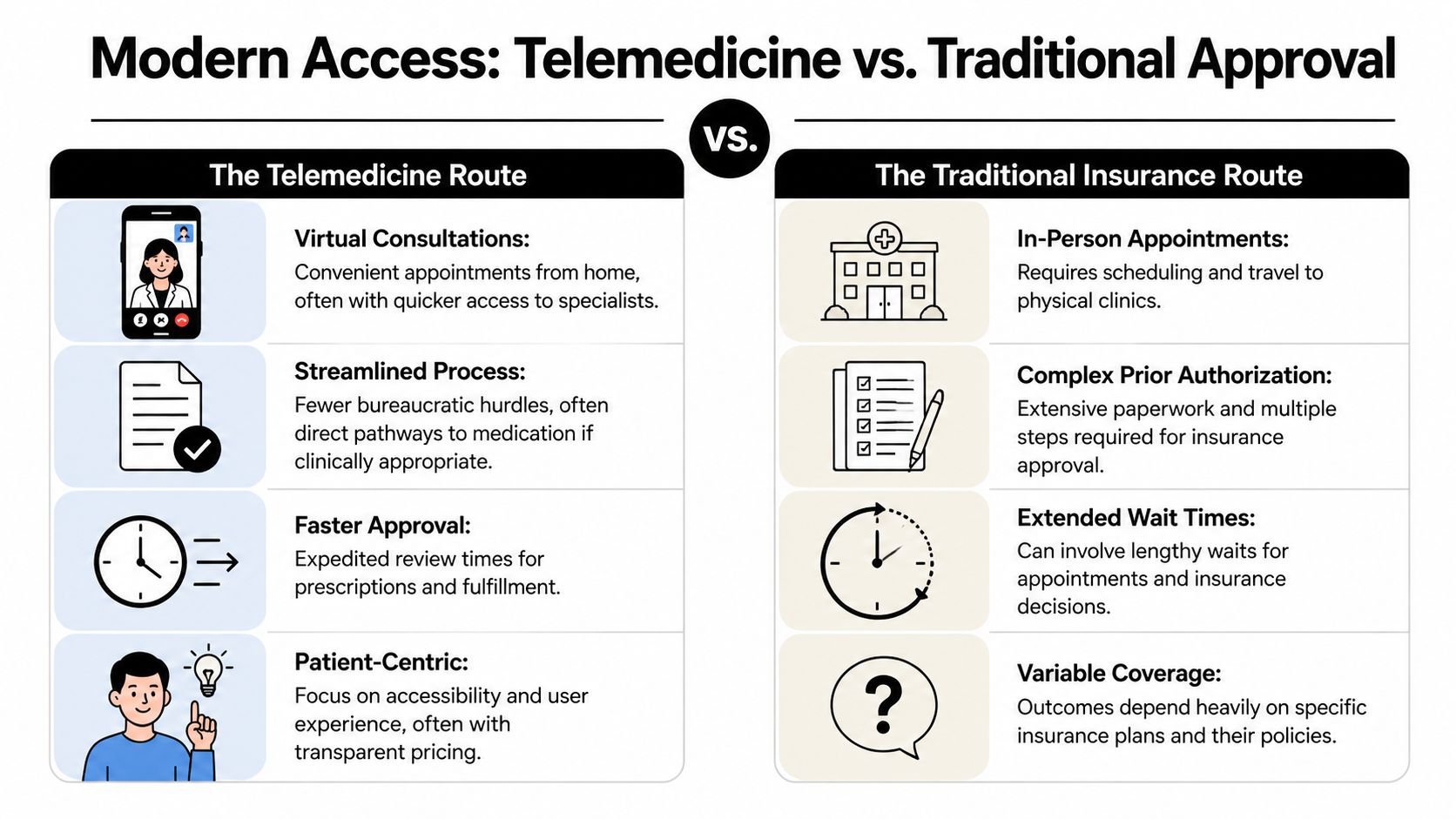
The telehealth path isn’t “better” for everyone. It’s different. The trade-off is usually simple. You may give up the possibility of insurance coverage in exchange for faster access, more predictable process, and less bureaucracy.
For underinsured or uninsured patients, that trade-off can be very practical. Branded GLP-1s can cost over $1,000 per month, while some cash-pay telehealth services offer compounded versions for $200 to $400 per month, bypassing insurance and prior authorization delays entirely, based on this overview of qualification and access paths.
How the two routes differ in real life
The traditional insurance route usually involves coverage verification, prior authorization, possible denial, appeal, and then pharmacy processing. It can work well when the plan is favorable and the documentation is strong.
The telemedicine route is typically more direct. A patient completes an intake, meets with a licensed clinician if appropriate, reviews medical history and contraindications, and moves into a treatment plan without waiting for an insurer to approve payment.
That doesn’t mean telehealth skips medical screening. It should not. A legitimate platform still reviews candidacy, safety, and follow-up needs. The difference is that the gatekeeper is the clinician’s judgment and clinical process, not the insurer’s utilization rules.
When telemedicine makes the most sense
This path tends to fit patients in a few situations:
Insurance excludes weight-loss medication: there may be nothing to appeal if the benefit itself is absent
The patient is uninsured or underinsured: paying cash may be more realistic than chasing uncertain coverage
Administrative delays are unacceptable: some patients need a practical route now, not after multiple rounds of paperwork
The patient values a simpler process: fewer handoffs usually mean fewer dropped details
If you’re comparing options, this guide on how to achieve your goals with weight loss telemedicine offers a helpful look at what a virtual care model can involve from intake through treatment support.
The key trade-offs to understand
Telemedicine can reduce friction, but you should still ask careful questions.
Consider:
Medication type: Are you discussing a branded product, a compounded option, or both?
Clinical oversight: Will a licensed clinician review your history, contraindications, and follow-up plan?
Pricing structure: Is the monthly cost clear up front?
Ongoing monitoring: How are side effects, dose changes, and refill decisions handled?
One factual example in this space is 10 Rx Home, which offers a telemedicine path that connects users with board-certified physicians for assessment and personalized treatment planning. That model can be useful for patients who want clinician-led review without relying on insurance approval.
The right route is the one that matches your medical needs, budget, and tolerance for administrative delay.
The biggest mistake I see is waiting too long to pivot. If your plan excludes coverage, or the paperwork keeps failing for reasons outside your control, an alternate access path may be the more rational choice. The goal isn’t to “win” the insurance battle at all costs. The goal is to get appropriate care in a compliant, safe, sustainable way.
Life After Approval Your First 90 Days and Beyond
Getting approved feels like the finish line for a lot of patients. It isn’t. It’s the handoff point.
The first weeks on GLP-1 therapy are where support matters most. You’re adjusting physically, learning a routine, and figuring out whether the medication is fitting your life in a sustainable way. The patients who do best usually treat this period as active medical follow-up, not a passive prescription refill.
What the start of treatment usually looks like
Clinicians typically begin low and increase gradually. To support tolerance, GLP-1 treatment is started at a low dose and titrated upward, which helps reduce gastrointestinal side effects like nausea that can affect 20% to 40% of patients when treatment begins, as noted in the earlier payer-focused clinical guidance.
That slow build matters. Patients often want to “get to the effective dose” quickly, but rushing can make side effects harder than they need to be.
Early follow-up usually focuses on:
Tolerance: nausea, fullness, bowel changes, or reduced appetite that feels too intense
Hydration and nutrition: eating less doesn’t mean neglecting protein, fluids, or meal structure
Dose timing and consistency: keeping the schedule steady helps both monitoring and adherence
Safety review: making sure no new symptoms suggest a reason to pause or reassess
Practical habits that make the first months smoother
The medication is one tool. The daily routine around it is what determines whether treatment feels manageable.
A few habits help quickly:
Eat smaller meals: large, heavy meals tend to be harder during dose escalation
Slow down at meals: many patients notice fullness earlier than they expect
Keep simple notes: jot down symptoms, appetite changes, and questions for follow-up visits
Don’t disappear after the first prescription: ongoing review is part of safe prescribing
Next-step advice: If side effects show up, don’t assume you have to “push through” alone. Contact your prescribing clinician before changing dose timing or stopping the medication.
Safety still comes first
Not everyone is a good candidate for GLP-1 treatment, and that remains true after approval. A history of pancreatitis, certain thyroid cancer concerns, pregnancy, or other contraindications requires careful review by the prescribing clinician.
This is why follow-up isn’t optional. A proper plan includes check-ins, symptom review, medication adjustments, and a broader health strategy that includes food quality, activity, sleep, and lab monitoring when appropriate.
The most successful long-term patients don’t treat GLP-1 as a standalone fix. They use it as a stabilizing tool that makes healthy behavior more doable. That’s a big difference.
You don’t need to be perfect in the first 90 days. You do need to stay engaged, honest about side effects, and willing to let your clinician guide the pace.
If you’re ready to move from research to action, 10 Rx Home offers a clinician-led telemedicine path where you can start with an assessment, review your options with a board-certified physician, and build a treatment plan that fits your health goals and access needs.