GLP-1’s at low prices with free shipping. Get Started


" transform="translate(53.5 27.5)" width="0px"/><g d="M 164.013 0 C 206.437 0 240.828 33.597 240.828 75.04 C 240.828 116.484 206.437 150.08 164.013 150.08 C 121.589 150.08 87.198 116.484 87.198 75.04 C 87.198 33.597 121.589 0 164.013 0 Z M 164.52 30.422 C 140.298 30.422 120.662 50.398 120.662 75.04 C 120.662 99.682 140.298 119.659 164.52 119.659 C 188.742 119.659 208.377 99.682 208.377 75.04 C 208.377 50.398 188.742 30.422 164.52 30.422 Z M 49.689 117.004 L 49.724 117.026 C 50.148 121.056 54.397 124.222 59.576 124.222 C 60.05 124.222 60.516 124.195 60.973 124.143 L 61.097 124.222 L 83.406 120.926 C 83.406 120.926 73.956 127.316 67.688 131.067 C 60.617 135.299 49.689 141.207 49.689 141.207 C 49.689 141.207 39.295 147.961 27.633 149.827 C 27.576 149.836 27.52 149.844 27.463 149.853 C 26.591 150.023 25.702 150.098 24.814 150.077 C 24.739 150.079 24.665 150.08 24.591 150.08 L 24.577 150.069 C 19.359 149.854 15.211 146.423 15.211 142.221 L 15.211 29.154 C 15.211 28.755 15.022 28.379 14.702 28.139 C 14.383 27.9 13.968 27.826 13.585 27.939 L 0 29.915 L 35.746 8.366 L 49.689 0 Z M 260.136 98.048 C 260.234 98.048 260.33 98.052 260.427 98.058 L 287.219 98.517 L 287.219 98.612 C 295.722 98.712 302.586 105.638 302.586 114.166 C 302.586 121.454 297.574 127.571 290.811 129.259 L 304.648 146.964 L 304.644 146.964 C 304.889 147.252 305.023 147.617 305.023 147.995 C 305.023 148.839 304.365 149.536 303.523 149.585 L 303.523 149.588 L 291.341 149.588 L 291.341 149.582 C 289.373 149.504 287.613 148.618 286.384 147.245 L 286.374 147.245 L 286.328 147.182 C 286.064 146.88 285.827 146.557 285.619 146.215 L 273.443 129.628 L 273.463 129.625 C 272.779 128.705 272.41 127.589 272.412 126.442 C 272.412 123.684 274.502 121.414 277.187 121.13 L 277.191 121.101 L 281.783 120.351 L 281.783 120.348 C 285.214 120.264 287.968 117.864 287.968 114.916 C 287.968 111.968 285.214 109.568 281.783 109.483 L 281.783 109.481 L 270.538 109.481 L 270.538 146.777 L 270.536 146.777 C 270.538 146.808 270.538 146.839 270.538 146.871 C 270.538 148.34 269.371 149.537 267.913 149.586 L 267.913 149.588 L 258.168 149.588 L 258.168 149.573 C 256.799 149.433 255.731 148.277 255.731 146.871 C 255.731 146.839 255.733 146.808 255.733 146.777 L 255.731 146.777 L 255.731 102.359 L 255.733 102.359 C 255.781 100.064 257.585 98.201 259.856 98.058 L 259.856 98.048 L 259.998 98.051 C 260.044 98.049 260.09 98.048 260.136 98.048 Z M 324.515 110.615 C 326.064 110.719 327.396 111.676 328.101 113.049 L 332.884 119.45 L 338.302 112.809 C 339.033 111.565 340.298 110.713 341.756 110.615 L 341.756 110.605 L 352.44 110.605 C 353.577 110.605 354.5 111.528 354.5 112.667 C 354.5 113.003 354.42 113.321 354.276 113.601 L 354.314 113.604 L 354.176 113.776 C 354.1 113.896 354.011 114.008 353.912 114.109 L 342.693 128.222 C 342.693 128.222 342.413 128.627 342.413 128.972 C 342.413 129.318 342.693 129.722 342.693 129.722 L 355.241 146.116 C 355.722 146.507 356 147.094 356 147.714 C 356 148.852 355.077 149.775 353.938 149.775 C 353.876 149.775 353.814 149.772 353.751 149.766 L 353.751 149.775 L 341.756 149.775 L 341.756 149.749 C 340.252 149.58 338.973 148.605 338.31 147.237 L 333.228 140.405 C 333.228 140.405 333.042 140.217 332.76 140.217 C 332.48 140.217 332.291 140.405 332.291 140.405 L 332.289 140.402 L 327.078 147.492 C 326.891 147.825 326.664 148.134 326.401 148.411 L 326.295 148.557 L 326.263 148.553 C 325.588 149.207 324.723 149.641 323.764 149.749 L 323.764 149.775 L 312.331 149.775 C 311.194 149.775 310.271 148.852 310.271 147.714 C 310.271 147.02 310.613 146.407 311.138 146.033 L 323.015 130.659 C 323.015 130.659 323.295 130.255 323.295 129.909 C 323.295 129.564 323.015 129.16 323.015 129.16 L 311.458 114.146 C 311.058 113.758 310.833 113.224 310.833 112.667 C 310.833 111.528 311.756 110.605 312.894 110.605 L 324.515 110.605 Z" fill="transparent" height="150.08043079668755px" id="HpkDSJwpk" transform="translate(0 1)" width="356.0000118682049px"><path d="M 76.815 0 C 119.239 0 153.63 33.597 153.63 75.04 C 153.63 116.484 119.239 150.08 76.815 150.08 C 34.391 150.08 0 116.484 0 75.04 C 0 33.597 34.391 0 76.815 0 Z M 77.322 30.422 C 53.1 30.422 33.464 50.398 33.464 75.04 C 33.464 99.682 53.1 119.659 77.322 119.659 C 101.544 119.659 121.179 99.682 121.179 75.04 C 121.179 50.398 101.544 30.422 77.322 30.422 Z" fill="rgb(8, 9, 35)" height="150.08043079668755px" id="kvrqFybmK" transform="translate(87.198 0)" width="153.62981889920286px"/><path d="M 49.689 117.004 L 49.724 117.026 C 50.148 121.056 54.397 124.222 59.576 124.222 C 60.05 124.222 60.516 124.195 60.973 124.143 L 61.097 124.222 L 83.406 120.926 C 83.406 120.926 73.956 127.316 67.688 131.067 C 60.617 135.299 49.689 141.207 49.689 141.207 C 49.689 141.207 39.295 147.961 27.633 149.827 C 27.576 149.836 27.52 149.844 27.463 149.853 C 26.591 150.023 25.702 150.098 24.814 150.077 C 24.739 150.079 24.665 150.08 24.591 150.08 L 24.577 150.069 C 19.359 149.854 15.211 146.423 15.211 142.221 L 15.211 29.154 C 15.211 28.755 15.022 28.379 14.702 28.139 C 14.383 27.9 13.968 27.826 13.585 27.939 L 0 29.915 L 35.746 8.366 L 49.689 0 Z M 260.136 98.048 C 260.234 98.048 260.33 98.052 260.427 98.058 L 287.219 98.517 L 287.219 98.612 C 295.722 98.712 302.586 105.638 302.586 114.166 C 302.586 121.454 297.574 127.571 290.811 129.259 L 304.648 146.964 L 304.644 146.964 C 304.889 147.252 305.023 147.617 305.023 147.995 C 305.023 148.839 304.365 149.536 303.523 149.585 L 303.523 149.588 L 291.341 149.588 L 291.341 149.582 C 289.373 149.504 287.613 148.618 286.384 147.245 L 286.374 147.245 L 286.328 147.182 C 286.064 146.88 285.827 146.557 285.619 146.215 L 273.443 129.628 L 273.463 129.625 C 272.779 128.705 272.41 127.589 272.412 126.442 C 272.412 123.684 274.502 121.414 277.187 121.13 L 277.191 121.101 L 281.783 120.351 L 281.783 120.348 C 285.214 120.264 287.968 117.864 287.968 114.916 C 287.968 111.968 285.214 109.568 281.783 109.483 L 281.783 109.481 L 270.538 109.481 L 270.538 146.777 L 270.536 146.777 C 270.538 146.808 270.538 146.839 270.538 146.871 C 270.538 148.34 269.371 149.537 267.913 149.586 L 267.913 149.588 L 258.168 149.588 L 258.168 149.573 C 256.799 149.433 255.731 148.277 255.731 146.871 C 255.731 146.839 255.733 146.808 255.733 146.777 L 255.731 146.777 L 255.731 102.359 L 255.733 102.359 C 255.781 100.064 257.585 98.201 259.856 98.058 L 259.856 98.048 L 259.998 98.051 C 260.044 98.049 260.09 98.048 260.136 98.048 Z M 324.515 110.615 C 326.064 110.719 327.396 111.676 328.101 113.049 L 332.884 119.45 L 338.302 112.809 C 339.033 111.565 340.298 110.713 341.756 110.615 L 341.756 110.605 L 352.44 110.605 C 353.577 110.605 354.5 111.528 354.5 112.667 C 354.5 113.003 354.42 113.321 354.276 113.601 L 354.314 113.604 L 354.176 113.776 C 354.1 113.896 354.011 114.008 353.912 114.109 L 342.693 128.222 C 342.693 128.222 342.413 128.627 342.413 128.972 C 342.413 129.318 342.693 129.722 342.693 129.722 L 355.241 146.116 C 355.722 146.507 356 147.094 356 147.714 C 356 148.852 355.077 149.775 353.938 149.775 C 353.876 149.775 353.814 149.772 353.751 149.766 L 353.751 149.775 L 341.756 149.775 L 341.756 149.749 C 340.252 149.58 338.973 148.605 338.31 147.237 L 333.228 140.405 C 333.228 140.405 333.042 140.217 332.76 140.217 C 332.48 140.217 332.291 140.405 332.291 140.405 L 332.289 140.402 L 327.078 147.492 C 326.891 147.825 326.664 148.134 326.401 148.411 L 326.295 148.557 L 326.263 148.553 C 325.588 149.207 324.723 149.641 323.764 149.749 L 323.764 149.775 L 312.331 149.775 C 311.194 149.775 310.271 148.852 310.271 147.714 C 310.271 147.02 310.613 146.407 311.138 146.033 L 323.015 130.659 C 323.015 130.659 323.295 130.255 323.295 129.909 C 323.295 129.564 323.015 129.16 323.015 129.16 L 311.458 114.146 C 311.058 113.758 310.833 113.224 310.833 112.667 C 310.833 111.528 311.756 110.605 312.894 110.605 L 324.515 110.605 Z" fill="rgb(8, 9, 35)" height="150.08043079668755px" id="kdERGws7a" width="356.0000118682049px"/></g></svg>)
Lipo C Benefits: A Guide to Weight Loss & Wellness in 2026
Lipo-C injections are often marketed for weight loss and energy support, but the most evidence-backed benefits appear to center more on nutrient delivery and metabolic support rather than dramatic stand-alone fat loss. Ingredients like methionine, inositol, choline, and B12 may help support liver function, energy production, and fat metabolism, especially in people with nutrient deficiencies or low energy. However, Lipo-C tends to work best as part of a broader wellness plan that includes nutrition, movement, and medical guidance — not as a shortcut or replacement for sustainable weight management strategies.
Explore the real Lipo C benefits, from weight loss support to energy boosts. Our 2026 guide covers ingredients, science, side effects, and safe access.

Lipo C Benefits: A Guide to Weight Loss & Wellness in 2026
You may be at that point where you're doing many things “right” and still not seeing the change you hoped for. You've cleaned up your meals, tried to move more, maybe even looked into injections, supplements, or clinic programs that promise to restart a stalled metabolism. When you keep hearing about Lipo-C, it's easy to wonder whether this is the missing piece or just another wellness trend dressed up as science.
That question deserves a calm, honest answer.
Lipo-C sits in an interesting middle ground. It's often presented as a fat-burning shortcut, yet the strongest support around the broader idea points more toward nutrient delivery and metabolic support than proven stand-alone weight loss. That doesn't mean it's useless. It means you'll make a better decision if you understand what it is, who might benefit most, and where medical supervision matters.
Some people also compare injections like Lipo-C with body contouring options such as advanced non-surgical fat reduction, which can help clarify an important point: different tools aim at different goals. One approach may target appearance, while another may try to support metabolism, energy, or nutrient status. If you're also exploring physician-guided weight care, this overview of telemedicine support for weight goals can help you think about where professional oversight fits in.
Your Wellness Journey and the Promise of Lipo C
The appeal of Lipo-C makes sense. If your progress feels slow, a treatment that claims to support fat metabolism, energy, and overall wellness sounds hopeful rather than extreme. Many people aren't looking for a miracle. They just want something that helps their efforts work better.
That's where much of the confusion starts. Lipo C benefits are often described in sweeping terms, but Lipo-C isn't one single, standardized medical therapy with one universally agreed formula and one proven outcome. In real-world use, it's usually part of the broader world of lipotropic injections, often offered through wellness or aesthetic settings.
Why people get interested in it
People usually come to Lipo-C for one of a few reasons:
Weight-loss frustration: They've hit a plateau and want support beyond diet and exercise.
Low energy concerns: They suspect they're run down, depleted, or not absorbing nutrients well.
Metabolic support: They've heard certain ingredients may help the liver process fats.
A gentler starting point: They want to explore options before considering more intensive obesity treatment.
Those are reasonable motivations. But the most helpful mindset is this: Lipo-C may be supportive, yet it shouldn't be treated as a proven fat-loss engine on its own.
A grounded approach: The more a treatment is marketed as effortless fat burning, the more carefully you should ask what's actually been proven.
What a balanced view looks like
A balanced view doesn't dismiss your goals. It respects them enough to separate possibility from proof.
If you're curious about Lipo-C, think of it as a question with three parts. What's in it? What might those ingredients do? And what has been demonstrated in people, rather than just claimed in marketing language?
That's the lens that helps you judge Lipo C benefits with confidence rather than hope alone.
Decoding the Lipo C Formula
A lot of confusion starts with the name. “Lipo-C” can sound like a single, standardized treatment, but the label is often used for different injection blends sold in wellness settings. That means the first useful question is simple: what is in the formula being offered to you?
What MIC usually refers to
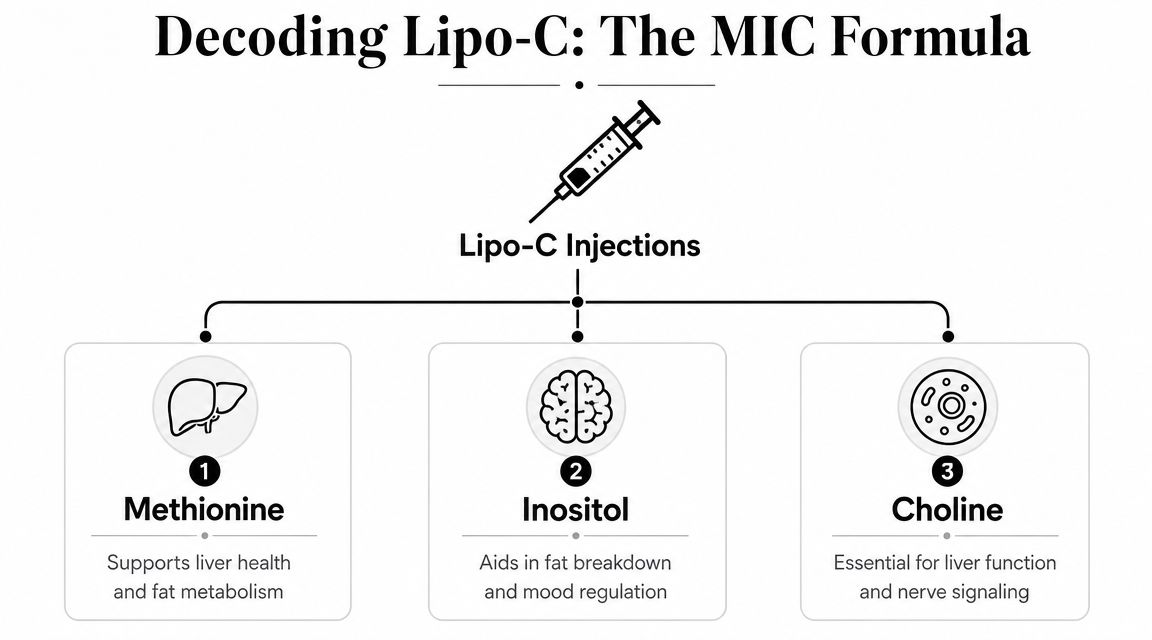
In many products, the core blend is MIC, short for methionine, inositol, and choline. These are the ingredients most often associated with the term “lipotropic.”
Their proposed role is easier to understand if you picture the liver as a busy processing center. It helps sort, package, and move fats. Ingredients in MIC are commonly discussed in relation to that process, especially choline, which has a recognized role in hepatic lipid metabolism. A clinical overview of lipotropic injection review and hepatic lipid handling explains that these compounds are marketed for fat metabolism and liver support, while also noting that controlled trials showing meaningful weight loss from MIC-B12 injections are limited.
So the plain-language takeaway is narrower than many ads suggest. These ingredients are included because they may support metabolic processes tied to fat handling. That is different from showing that the injection itself causes substantial fat loss.
Ingredient | Plain-language role |
|---|---|
Methionine | Included for its role in metabolic and liver-related processes |
Inositol | Commonly discussed in relation to metabolic balance and fat handling |
Choline | Helps with hepatic lipid metabolism |
That distinction matters. Support for a pathway is not the same as a proven body-composition result.
Where B12 and vitamin C fit in
Many formulas also include vitamin B12. That helps explain why people link Lipo-C with energy support. But response varies. Someone with a low B12 level may notice more than someone whose level is already normal, and that difference often gets lost in promotional language.
Vitamin C makes the picture a little more complicated because “Lipo-C” branding does not always mean the same thing. In some cases, the name points to liposomal vitamin C, which is designed to help the body absorb vitamin C more efficiently. That formulation question is one of the more evidence-backed parts of the broader conversation around Lipo-C. Better delivery of a nutrient is a specific claim. It does not automatically support broader promises about weight loss.
If you're trying to understand how vitamin C is used in medical settings more broadly, this overview on understanding vitamin C intake before procedures gives useful context about why formulation and timing can matter. If you're comparing wellness injections more broadly, this article on glutathione for weight loss offers a helpful contrast in how different ingredients get marketed versus what is known.
Why combination formulas can sound stronger than the evidence
A multi-ingredient injection often sounds persuasive because each component has a plausible role on paper. That can create an “everything working together” effect in the marketing, even when direct research on the exact combination is thin.
This is often the point where people understandably get misled. Terms like “fat metabolism,” “detox,” “liver support,” and “energy” can blur into one big promise. A calmer reading is more useful. Some ingredients have legitimate biological roles. Some formulation choices may improve nutrient delivery. The jump from those facts to reliable weight-loss outcomes still requires stronger evidence and careful medical judgment about whether the product fits your health needs at all.
The Spectrum of Potential Lipo C Benefits
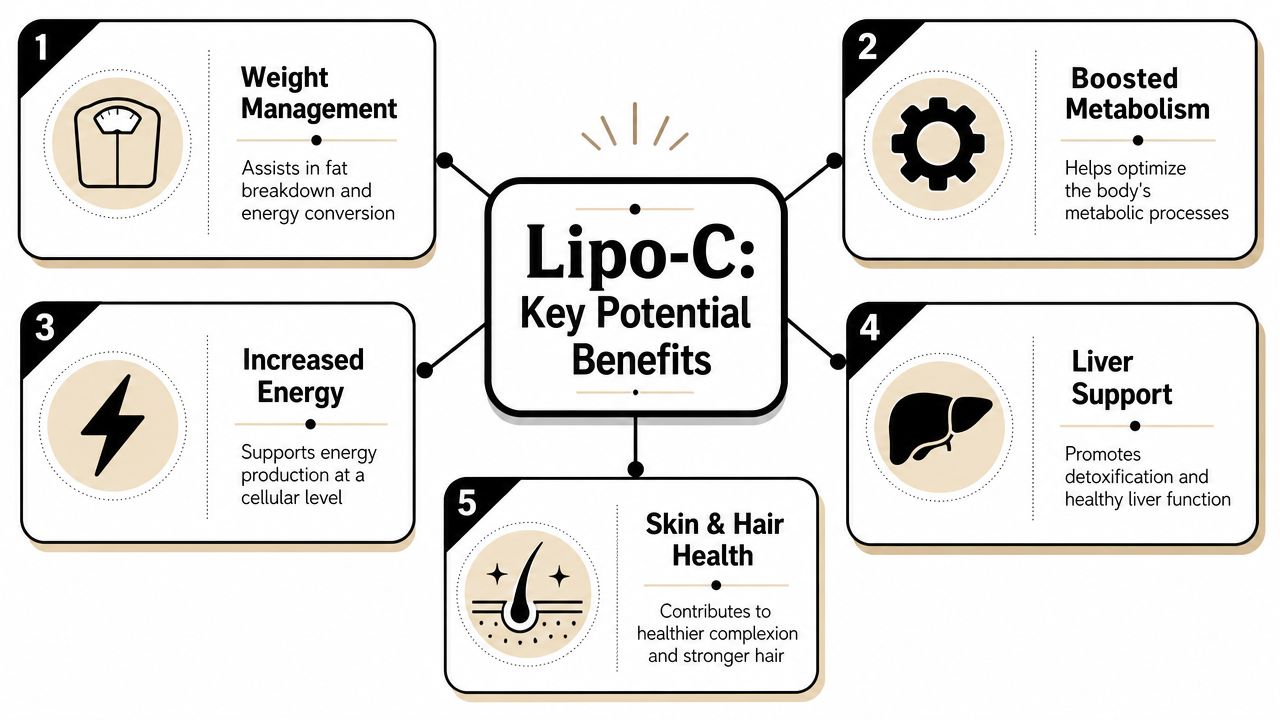
Considering Lipo C benefits, the initial focus is typically on one thing: Will it help me lose weight? Yet, that question often comes with others: Will I feel more energetic? Will my metabolism improve? Could it support liver health or even help me look a bit better overall?
Those questions don't all have the same answer.
The people most likely to notice something
One of the most useful realities to understand is that many reported benefits may come from nutrient repletion rather than from a universal metabolic effect. Neutral medical content notes that Lipo-C formulas usually combine methionine, inositol, choline, and B12, but also points out that they are often used as a short- to medium-term metabolic intervention rather than a long-term treatment. That same discussion says visible improvements are often modest and may appear around 30 days, especially in people who are not deficient to begin with, as described in this guide to lipotropic injections and expected improvement timeline.
That means your baseline matters. A lot.
How claimed benefits differ by person
Consider the most common claims through a more realistic lens:
Energy support: Someone who is low in B vitamins or otherwise nutritionally depleted may notice more than someone who already eats well and has no deficiency.
Weight-management support: A person already working on nutrition, sleep, and movement may see Lipo-C as one supportive piece. Someone expecting it to drive major fat loss by itself may be disappointed.
Metabolic boost: This phrase sounds dramatic, but in many cases it may reflect small, indirect support rather than a sweeping change in calorie burning.
Liver-related support: This is one of the more biologically plausible claims because of the role lipotropic ingredients are intended to play in fat handling by the liver.
Mood or general wellness: Some people report feeling better overall, but those experiences can be heavily shaped by deficiency correction, sleep, stress, and other health variables.
A practical expectation check
If two people try Lipo-C, they may have very different experiences.
One person may say, “I finally feel a bit more like myself.” Another may say, “I didn't notice much.” Neither response is surprising. The difference may have less to do with Lipo-C being good or bad and more to do with whether the person had something to correct in the first place.
Practical rule: The more nutritionally replete you already are, the more modest the visible or felt change may be.
This is why broad claims can mislead. A treatment that helps one person feel less fatigued doesn't automatically mean it will create fat loss, sharper focus, and better skin for everyone else.
What this means for your goals
If your main goal is meaningful body-weight reduction, Lipo-C may not be the strongest primary tool. If your goal is broader wellness support under medical guidance, it might make more sense as an adjunct.
The most honest way to think about Lipo C benefits is this: they may be more noticeable in carefully selected people, and they may be subtler than the marketing suggests.
Weighing the Scientific Evidence for Lipo C
The biggest misunderstanding about Lipo-C is that popularity gets mistaken for proof. A treatment can be widely offered and still have limited controlled evidence behind its most ambitious claims.
That's the situation here.
Where the evidence is thin
The historical version of Lipo-C used for weight loss has grown mostly through lipotropic injections offered in wellness and aesthetic settings, not through a well-established chain of large clinical milestones. Recent review content notes that no clinical trials have evaluated combining lipotropic injections with modern anti-obesity drugs, and that controlled evidence for clinically meaningful weight loss from lipotropic injections alone is lacking. In contrast, tirzepatide monotherapy trials have shown 15% to 21% body-weight loss according to this comparison of lipotropic injections and tirzepatide evidence.
That contrast matters because it places Lipo-C in the right category. It looks more like a supportive wellness intervention than a proven primary obesity treatment.
A simple comparison
Question | Lipo-C style injections | FDA-approved anti-obesity medication |
|---|---|---|
Strong controlled evidence for meaningful weight loss | Lacking | Present |
Often used as a supportive tool | Yes | Sometimes, within a full treatment plan |
Backed by large guideline-driven obesity care pathways | Limited | Much stronger |
This doesn't mean Lipo-C has no place. It means the claim “Lipo-C helps support my plan” is more defensible than “Lipo-C reliably causes major weight loss.”
Why honesty helps more than hype
If you're choosing between options, evidence strength should guide your expectations.
A person with obesity who wants substantial weight loss deserves to know when a therapy has stronger clinical backing. A person mainly interested in nutrient support or metabolic wellness deserves to know that some supportive treatments may still be useful, but they shouldn't be confused with medications that have far more rigorous evidence for body-weight reduction.
The most compassionate advice is often the clearest. Use Lipo-C, if appropriate, as a possible adjunct. Don't treat it as a substitute for better-studied medical care when your goal is significant weight loss.
Safe Use Potential Side Effects and Your Health
Because Lipo-C is commonly given by injection, safety matters from the first conversation. Even when people think of it as a wellness product, it still deserves the same respect you'd give any treatment that enters the body directly.

What safe use usually starts with
Lipo-C is typically administered as an intramuscular injection. The exact schedule and dose can vary by product and provider, which is one reason self-directed use can get risky fast.
Before starting, a clinician should review your current medications, health conditions, and wellness goals. That matters especially if your fatigue, slow weight loss, or low motivation has another cause, such as a medical condition, nutrient deficiency, sleep issue, or medication effect.
Side effects people should watch for
Some reactions are more common and relatively mild. Others should stop the process until a clinician weighs in.
Injection-site irritation: Soreness, redness, or tenderness can happen after an injection.
Sensitivity reactions: Rash, swelling, or worsening discomfort deserve medical attention.
Unexpected systemic symptoms: Feeling unwell, dizzy, or unusual after an injection should never be ignored.
Medication overlap concerns: If you already take other injections, supplements, or prescription drugs, interactions and duplications need review.
If you've had reactions to injectable treatments before, it's smart to discuss that history early. This guide on Mounjaro injection site reactions and what redness or itching can mean offers a useful example of the kind of site symptoms that should be monitored carefully.
Who should pause and ask more questions
A few situations call for extra caution:
Situation | Why it matters |
|---|---|
Pregnancy or breastfeeding | You need individualized medical guidance before using elective wellness injections |
Liver or kidney concerns | Ingredients may not be appropriate for everyone |
Complex medication use | Interaction review becomes more important |
Unclear symptoms | Low energy or weight struggle may have another medical cause |
If a treatment is marketed as simple, that's not a reason to skip screening. It's a reason to insist on it.
The safest mindset is practical. Ask what's in the formulation, how it's prescribed, what side effects are expected, and what symptoms would mean you should stop and call your clinician.
Accessing Lipo C Safely Through Telemedicine
You're tired, your weight has stalled, and an ad for Lipo-C makes the answer sound simple. Then you open a telemedicine intake form and realize a good clinician is asking questions the ad skipped. What symptoms are you trying to improve? What medications are you already taking? Are you looking for better nutrient support, or are you hoping for weight loss results the treatment may not reliably deliver on its own?

That difference matters.
Lipo-C is often marketed with broad promises, but careful care starts by separating two very different ideas. One is formulation and absorption. As noted earlier, some ingredients associated with Lipo-C marketing, such as liposomal vitamin C, may offer better bioavailability than standard forms. The other is weight loss. That claim is much less settled, which is why clinician review matters before anyone treats Lipo-C as a shortcut.
Why telemedicine can improve the process
A well-run virtual visit works like a screening room before a treatment room. The goal is not just convenience. The goal is better decision-making.
Your clinician can review your history, current prescriptions, supplements, past reactions, lab work if available, and the reason you want treatment in the first place. That helps answer a basic but often missed question. Is Lipo-C a reasonable fit, or is fatigue, slow progress, or weight change pointing to something else that needs attention first?
Telemedicine also creates space for a more balanced conversation. If your main goal is weight loss, a responsible provider should explain that Lipo-C may play, at most, a supporting role inside a larger plan. Nutrition, movement, sleep, behavior change, and evidence-based obesity care usually matter more than any single injection.
What a safer telemedicine pathway usually includes
A strong virtual care model often includes a few clear steps:
Clinical screening: Review of symptoms, medical history, medications, and whether your goals are realistic for this treatment.
Product review and sourcing: Discussion of what is in the formulation and where it comes from.
A broader care plan: Lipo-C, if prescribed, should fit into a plan rather than replace one.
Follow-up: Your response should be checked over time so the plan can be adjusted if needed.
That structure protects people from a common wellness mistake. They buy a treatment based on a catchy promise, then judge it without context. Medical supervision adds context.
If you're comparing care formats, this discussion of online vs in-person weight loss care can help you weigh convenience, oversight, and lifestyle fit. If you want a practical look at how virtual evaluation works, this guide to an online weight loss consultation shows what medically guided telehealth care can involve.
Telemedicine does not make Lipo-C proven for every goal. It does make it easier to ask better questions before you start. For a treatment surrounded by hype, that may be the most useful benefit of all.
Frequently Asked Questions About Lipo C Injections
How long does it take to notice anything from Lipo-C
Some people report subtle changes sooner, but visible improvements are often described as modest and may appear around 30 days, especially if you aren't starting from a clear nutrient deficiency. If you expect a dramatic shift in a few days, your expectations may be too high.
Are Lipo-C injections painful
They are often described as uncomfortable rather than severely painful. You may notice brief soreness or tenderness where the injection is given. If pain is intense, keeps worsening, or comes with major redness or swelling, contact a medical professional.
Can I use Lipo-C with other vitamins or medications
Sometimes yes, but don't assume it's automatically fine. If you already take supplements, injections, or prescription medications, a clinician should check for overlap, unnecessary duplication, and whether your symptoms point to a different issue that needs attention first.
Is Lipo-C enough for weight loss by itself
It's better to think of it as a possible adjunct than a complete strategy. If your goal is meaningful weight loss, you'll usually need a full plan built around nutrition, movement, behavior support, and, when appropriate, evidence-based medical treatment.
Who may notice the most benefit
People with nutrient insufficiency, low energy related to deficiency, or a need for medically guided wellness support may notice more than someone who is already nutritionally replete and hoping for stand-alone fat loss.
If you want a medically guided way to explore your options, 10 Rx Home offers telemedicine-based care that connects you with licensed physicians for personalized treatment planning. It's a practical next step if you want to discuss weight management, wellness goals, and whether treatments like Lipo-C belong in your plan at all.