Do NAD Supplements Work? a 2026 Guide
NAD+ supplements have gained attention for their potential to support cellular energy and healthy aging, but the science is more nuanced than the marketing. Research suggests certain NAD+ precursors may help increase NAD+ levels in the body, though this doesn't guarantee dramatic improvements in energy or longevity. Like many wellness tools, NAD+ supplements work best as part of a broader plan that includes healthy nutrition, exercise, quality sleep, and guidance from a healthcare provider.
Curious, do NAD supplements work? Our 2026 guide reviews NAD+, NR, & NMN science for energy, aging, & health. Make an informed decision.

Do NAD Supplements Work? a 2026 Guide
You may be here because your energy feels flatter than it used to. Maybe your workouts don't rebound the way they once did, your focus is less reliable, or you keep seeing ads that make NAD+ sound like the missing key to healthy aging.
That mix of curiosity and skepticism is healthy.
The short answer is that some NAD+ boosters do work in a narrow, measurable way. Certain precursor supplements can raise NAD+ levels in the body. But that doesn't automatically mean they'll transform your energy, slow aging in a dramatic way, or deliver every promise on a supplement label. The science is more useful than the marketing, and also more modest.
A better question than “Do NAD supplements work?” is this: Which forms have human evidence, what do they change, and how should you use them responsibly? When you look at the research through that lens, the picture gets much clearer.
The Cellular Energy Spark Plug Called NAD+
When people want more vitality, they usually think first about sleep, stress, iron, hormones, or nutrition. Those matter. But underneath all of that sits a molecule your cells depend on every day: NAD+.
A simple way to think about it is as a cellular spark plug. Your cells have engines, mainly your mitochondria, and NAD+ helps those engines turn nutrients into usable energy. It also helps support DNA repair and other metabolic processes that keep cells functioning well.
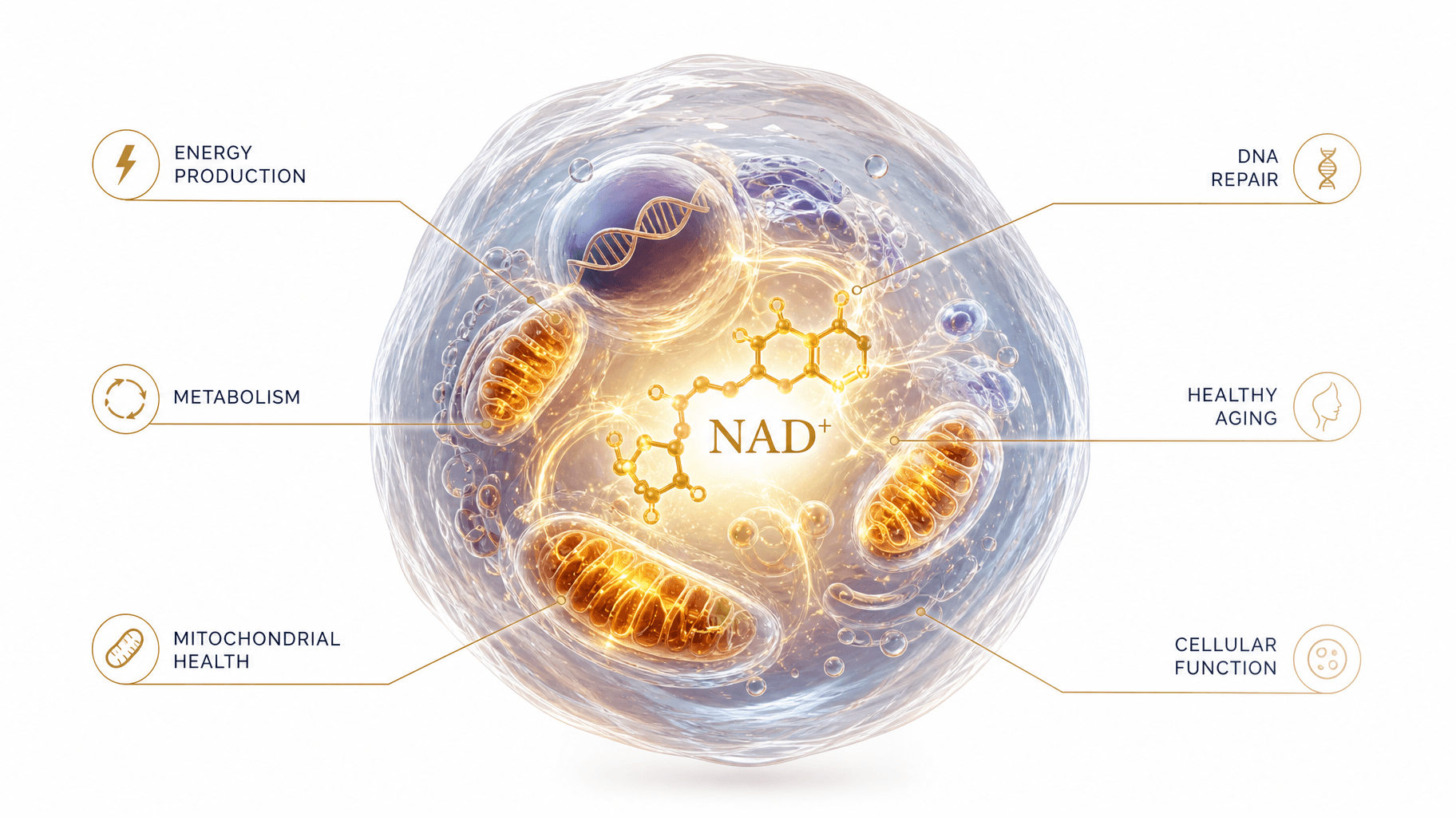
What NAD+ actually does
NAD+ matters because your body uses it in several jobs at once:
Energy production: Your cells rely on it to help convert food into cellular energy.
DNA repair: It supports enzymes involved in maintaining genomic integrity.
Metabolism: It plays a role in how the body processes nutrients.
Cell signaling: It helps regulate pathways tied to stress response and cellular maintenance.
If you've been searching for support around low energy, it can help to pair this conversation with a broader look at supplements for fatigue, because NAD+ is only one piece of the bigger picture.
Why people care about NAD+ and aging
Interest in NAD+ grew because researchers noticed that age-related decline in cellular function often overlaps with processes that depend on NAD+. That doesn't mean NAD+ is a magic youth switch. It means it's a biologically important molecule involved in systems that tend to get less resilient over time.
That distinction matters.
Practical rule: If a molecule is important in the body, that doesn't mean more is always better. It means support has to match how the body actually uses it.
Readers often get tripped up on this point. They hear “NAD+ is essential” and assume taking an NAD+ capsule should directly solve the problem. But biology isn't that linear. The body has to absorb, transport, convert, and use what you swallow. That's why the form of the supplement matters just as much as the idea behind it.
Decoding NAD+ Precursors NR and NMN
The biggest confusion in this space is simple: NAD+ itself is not the same thing as an NAD+ precursor.
Consider baking. If your goal is to make a cake, your kitchen needs ingredients it can work with. In the same way, your body often does better with the raw materials it can convert into NAD+, rather than with a finished molecule that isn't easily usable in oral form.
Why oral NAD+ itself is a weak bet
As of 2023, there were no published human clinical trials showing that oral NAD+ supplements increase NAD+ levels in the body, and research has focused instead on precursors such as nicotinamide riboside. In one human trial, 1,000 mg/day of oral NR increased whole-blood NAD+ by 142% after two weeks according to this review of direct NAD+ versus precursors.
That's the dividing line between hype and evidence.
Oral NAD+ has a basic delivery problem. The molecule is too large and unstable to be absorbed intact in a way that has been convincingly demonstrated in human trials. So when companies market direct NAD+ tablets as if the molecule just slides into your cells, they're skipping the hardest part of the story.
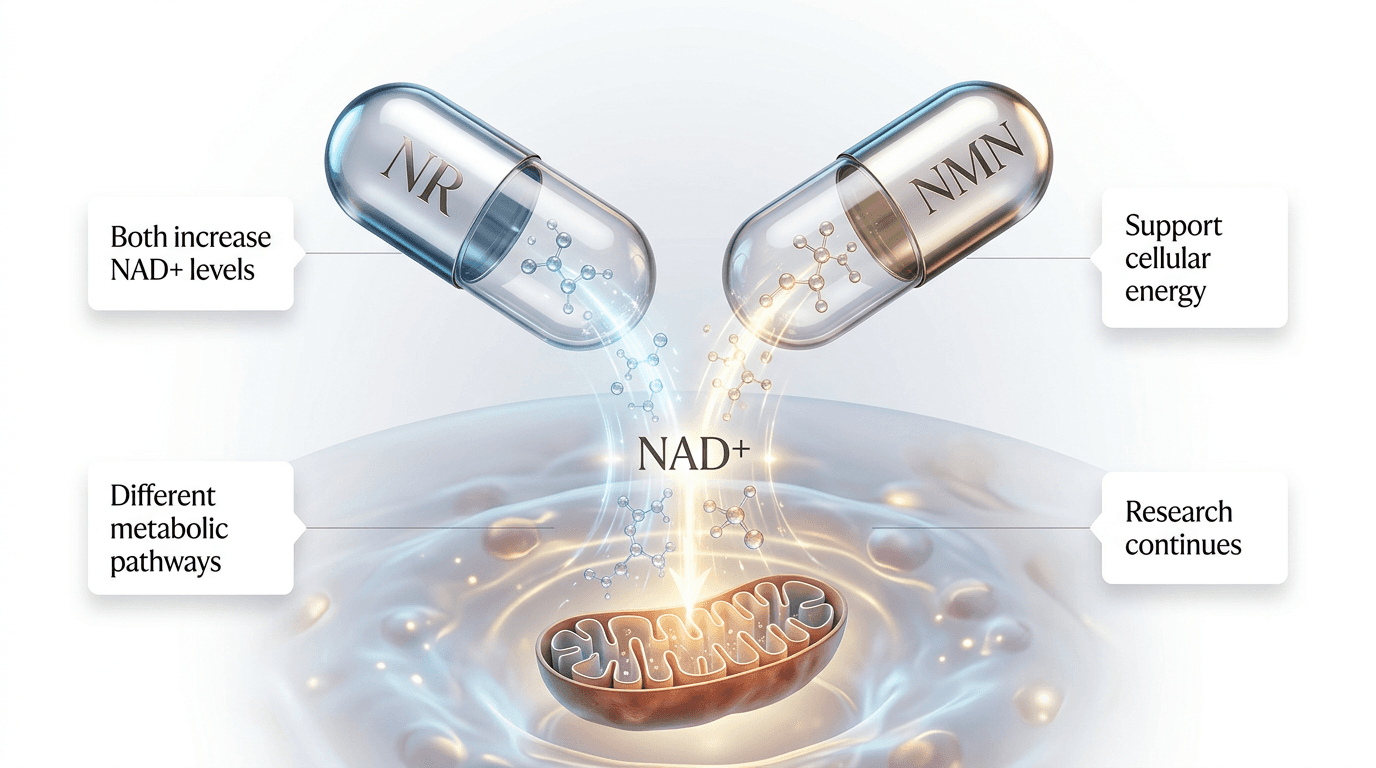
What NR and NMN are
NR stands for nicotinamide riboside.
NMN stands for nicotinamide mononucleotide.
Both are precursor compounds. That means your body can use them as building blocks in the pathway that leads to NAD+.
Here's the simplest distinction:
Compound | Plain-language role |
|---|---|
NR | A precursor form that has been widely studied in human supplementation trials |
NMN | Another precursor that also aims to support the body's own NAD+ production |
The average shopper doesn't need to memorize every metabolic step. What matters is understanding that the research spotlight has been on precursors, not direct oral NAD+.
Where readers often get confused
A label might say “NAD booster,” “NAD support,” or “cellular energy formula.” Those terms can refer to very different products.
Look for the actual active ingredient. Ask:
Is it direct NAD+? If so, the human evidence is weak for oral use.
Is it NR or NMN? Those are the forms people usually mean when they discuss evidence-based NAD+ support.
Is the amount clearly listed? If the label hides the dose inside a blend, you can't compare it to studied use.
Choose the ingredient first, then judge the brand. Many people do that in reverse.
What Human Studies Reveal About NAD+ Boosters
So, do NAD supplements work?
If by “work” you mean raise NAD+ biomarkers, the answer is often yes for precursor compounds. If by “work” you mean consistently improve how people feel and function in major ways, the answer is much more cautious.

What looks solid
Human research supports the idea that precursor supplements can increase NAD+ and related metabolites in blood and some tissues. That part is repeatable enough to take seriously.
It demonstrates these compounds are doing something biologically meaningful. They aren't just clever packaging.
Where the excitement runs ahead of the evidence
A separate question is whether boosted NAD+ leads to obvious benefits in everyday outcomes people care about, such as stamina, blood sugar control, exercise capacity, cognition, or healthy aging.
A 2024 review found that, in older adults and people with metabolic disease, NAD+ precursor supplementation was generally safe, but the effects on measures such as blood pressure, glucose control, and exercise capacity were small and not clinically meaningful. Improvements were often seen in biomarkers rather than primary health outcomes, according to this review of NAD supplements and mitochondrial health.
That's the most balanced answer to the question.
How to read the evidence by category
Energy and physical performance
People often buy these supplements because they want to feel more energetic. That's understandable. But current human evidence doesn't support the idea that most users should expect a dramatic jump in performance.
Some trials have hinted at possible changes in secondary markers, but the overall pattern is mixed. If you feel a difference, it may be subtle. If you don't, that doesn't necessarily mean the product failed to affect NAD+ levels. It may mean the biological change didn't translate into a noticeable day-to-day result.
Aging and longevity
At this stage, marketing gets the boldest and the evidence gets thinnest.
No large-scale randomized human trial has shown that NAD+ supplementation slows aging or extends lifespan in people. That doesn't rule out future findings. It means current claims should stay modest.
Metabolic health
This area is promising enough to study further, especially because NAD+ is deeply tied to metabolism. But “promising” isn't the same as “proven.” Reviews to date describe effects that are generally small or inconsistent in major clinical measures.
Brain function and cognition
Interest is high here because mitochondrial health and cellular repair matter in the brain. But right now, evidence for meaningful cognitive benefit in humans remains limited and uneven.
Biomarkers can improve before daily-life outcomes do. Sometimes they never translate in a way a person can feel.
The practical conclusion
The most honest answer is this:
Yes, some NAD+ boosters can raise NAD+
Maybe, they can help certain people in specific contexts
No, they haven't been proven to be broad anti-aging miracle products
That may sound less exciting than a flashy ad, but it's much more useful when you're deciding what belongs in your wellness plan.
Practical Dosing and Setting Realistic Expectations
Once you understand that precursor choice matters, the next question is dosage. With dosage, people often make two mistakes. They either take too little to match studied use, or they expect results that no human trial has established.
A human trial found that 12 weeks of oral nicotinamide riboside was safely tolerated up to 2,000 mg/day and increased whole blood NAD+ levels by approximately 100%, showing clear dose-dependent bioavailability according to this clinical review on NAD pharmacokinetics and supplementation.
What that means in real life
First, dose matters. Higher doses have been associated with greater increases in blood NAD+ in human studies. That doesn't mean everyone should jump to the highest amount. It means there is a measurable dose-response relationship for NR.
Second, blood level changes are not the same thing as guaranteed symptom changes. You might see gradual shifts in recovery, resilience, or overall energy. You might also notice very little.
A realistic way to think about trial-informed use
Use this framework when talking with a clinician:
Match the ingredient to the evidence Look for a precursor with human data behind it, especially NR if you want the most direct alignment with published dosing studies.
Be patient with the timeline Human studies didn't test “one capsule and instant youth.” They looked at sustained use over weeks.
Track outcomes that matter Don't rely only on hope. Notice trends in energy consistency, exercise recovery, sleep quality, or mental stamina.
What not to expect
A precursor isn't a substitute for sleep, adequate protein, stress management, or treatment of an underlying condition. If your fatigue is driven by anemia, thyroid issues, depression, sleep apnea, medication effects, or under-fueling, an NAD+ supplement won't fix the root cause.
That's why the smartest mindset is to treat these products as supportive tools, not rescue tools.
If your expectations are “I want to support cellular health,” the evidence is more aligned. If your expectations are “I want guaranteed anti-aging results,” the evidence isn't there.
How to Choose a Quality NAD+ Supplement
The label can tell you a lot before you ever buy a bottle.
A strong product usually looks boring in the best way. It states the active ingredient clearly, tells you how much is in each serving, and doesn't hide behind vague claims about “advanced cellular technology.”
What to look for on the label
Here's a practical checklist:
Named active ingredient: Look for clear identification of NR or NMN, not just “NAD support.”
Transparent dose: Avoid formulas that bury key ingredients in proprietary blends.
Testing documentation: Independent verification matters for identity, potency, and contaminants.
Simple positioning: Be wary when a product claims to overhaul energy, metabolism, cognition, and aging all at once.
If you want a useful framework for evaluating testing claims, this DTC playbook for supplement testing gives a grounded overview of what independent lab verification should entail.
Red flags that deserve skepticism
Some warning signs are easy to spot:
Overbuilt marketing language: If the page sounds more dramatic than specific, slow down.
Direct oral NAD+ as the headline feature: That's less persuasive than a clearly labeled precursor.
No meaningful customer guidance: Brands that avoid basic questions about ingredients, sourcing, or testing don't earn much trust.
For people exploring prescription-style wellness options alongside supplements, NAD+ injection access through telehealth is one example of a route that involves clinician review rather than pure over-the-counter shopping. The point isn't that one format is automatically better. It's that route, oversight, and product transparency all matter.
A smarter buying mindset
Buy the supplement you can understand.
If a company makes it hard to tell what you're taking, how much you're taking, and how it was verified, move on. Clarity is one of the strongest signals of quality in a crowded category.
Safety Interactions and When to Consult a Clinician
Most conversations about NAD+ focus on upside. The more responsible conversation includes context, especially if you take medications or manage a health condition.
Human studies on precursor supplements have generally described them as safe and well tolerated in the short term. But “generally safe” isn't the same as “appropriate for everyone.”

When a clinician should be involved
Talk with a clinician before starting if any of these apply:
You take prescription medications: Potential interactions need review in context.
You're pregnant or breastfeeding: This is not the time for experimental self-optimization.
You have a chronic medical condition: Liver issues, cancer treatment, metabolic disease, and complex medication regimens deserve individualized advice.
You're using multiple “longevity” products at once: Stacking compounds can make side effects and attribution harder to sort out.
People also ask whether alternative delivery methods change the safety conversation. They can change it, but not always in simple ways. If you're comparing delivery routes, this overview of NAD nose spray can help you understand how format affects expectations and decision-making.
The more complex your health picture is, the less useful supplement marketing becomes. That's where clinical judgment matters most.
Telemedicine can be a practical option here because it gives you a way to review your medications, goals, and symptoms without guessing alone.
Your Personalized Path to Healthy Aging
By now, the answer to “Do NAD supplements work?” is more precise.
They can work as NAD+ boosters, especially when you're talking about precursor compounds rather than direct oral NAD+. But the leap from “raises a biomarker” to “changes my life” is where expectations need grounding.
The more useful model is to think in systems. Human studies suggest that multi-ingredient approaches targeting the broader NAD+ network may be more effective than single precursors, and that these strategies work best alongside lifestyle practices such as exercise and sleep. That systems-based perspective is reflected in the same clinical discussion summarized earlier in the literature, even though daily results still need to be judged person by person.
What tends to support better results
A good plan usually includes more than one lever:
Movement: Regular exercise supports metabolic health and cellular resilience.
Sleep: Recovery is where many repair processes do their work. If you're trying to improve sleep without melatonin, a resource like this melatonin-free sleep aid may be worth reviewing as part of a broader routine.
Nutrition and consistency: Supplements work better on top of stable habits than in place of them.
If you want to build from the foundation up, this guide on how to increase NAD levels naturally is a useful next step because it puts daily habits in the center of the conversation.
Healthy aging rarely comes from one bottle. It comes from matching the right tools to your biology, your goals, and your actual barriers.
If you want help turning this information into a plan, 10 Rx Home offers a telehealth pathway to review your symptoms, health history, and wellness goals with a licensed clinician so you can decide whether NAD-related support fits into a broader, personalized strategy.