Your Hydroquinone Dark Spot Corrector Guide for 2026
Hydroquinone has long been considered one of the most effective topical treatments for reducing stubborn dark spots, including melasma, sun spots, and post-acne hyperpigmentation. By helping slow excess melanin production, it can gradually improve skin tone when used correctly and under medical guidance. For the best results, hydroquinone should be paired with daily sunscreen and used as part of a personalized skincare plan.
Unlock clearer skin with a hydroquinone dark spot corrector. Our guide explains how it works, safety, and how to get a prescription for lasting results.

Your Hydroquinone Dark Spot Corrector Guide for 2026
Some mornings, the dark spot is the first thing you see. Not your eyes. Not your skin as a whole. Just that one patch left behind by acne, sun exposure, or melasma that seems to ignore every serum you've tried.
That frustration is real. Dark spots can linger long after the original trigger is gone, and the search for something that works often leads to a mix of hype, half-truths, and products that promise quick change but don't explain what they're really doing to your skin.
Unveiling Your Path to Clearer Skin
You have a dark spot that has outlasted the breakout, the summer sun, or the hormonal flare that caused it. You have tried brightening serums, exfoliating acids, and spot treatments that promised visible change. Yet the mark stays put, and the question shifts from "What should I buy next?" to "What works, and how do I use it safely?"
That question matters, because stubborn discoloration often needs more than a cosmetic approach. It needs a plan.
Hydroquinone is often part of that plan. Dermatologists have used it for years to treat hyperpigmentation because it addresses excess pigment production rather than merely polishing the skin's surface. For someone dealing with melasma, post-acne marks, or sun-related spots, that difference is important.
If you are also trying to understand what caused the discoloration in the first place, this guide from Skinsation Aesthetics Inc. gives helpful context on common triggers behind facial dark spots.
Why a medical mindset helps
Hydroquinone works best when you treat it like a prescription-strength tool, not a casual add-on to an already crowded routine. A hammer can hang a picture or crack a tile. The result depends on how and when you use it. Hydroquinone is similar. Its value comes from correct diagnosis, careful application, time-limited treatment cycles, and daily sun protection.
That is why hope and caution belong together here.
A hydroquinone dark spot corrector can be one of the most effective options for fading visible discoloration, but it is not meant for indefinite, unsupervised use. The spot itself matters. Your skin tone matters. The cause of the pigment matters. A mark left by acne may respond differently than melasma, and both behave differently from a lesion that needs medical evaluation before any lightening treatment is started.
Many people feel less intimidated once they understand that success usually comes from a full strategy, not one tube of cream. You apply hydroquinone to the right areas. You use it for a defined period. You protect the skin from ultraviolet and visible light, because sunlight can keep telling pigment cells to stay active. And if hydroquinone is not the right fit for long-term management, there are other ingredients and treatment plans that can take over.
That approach gives you something better than hype. It gives you a clear, medically grounded path.
Understanding the Gold Standard of Pigment Correction
Hydroquinone earns its reputation because it targets pigment formation near the source. Instead of only helping shed discolored surface cells, it reduces the skin's ability to keep producing excess melanin in the treated areas.
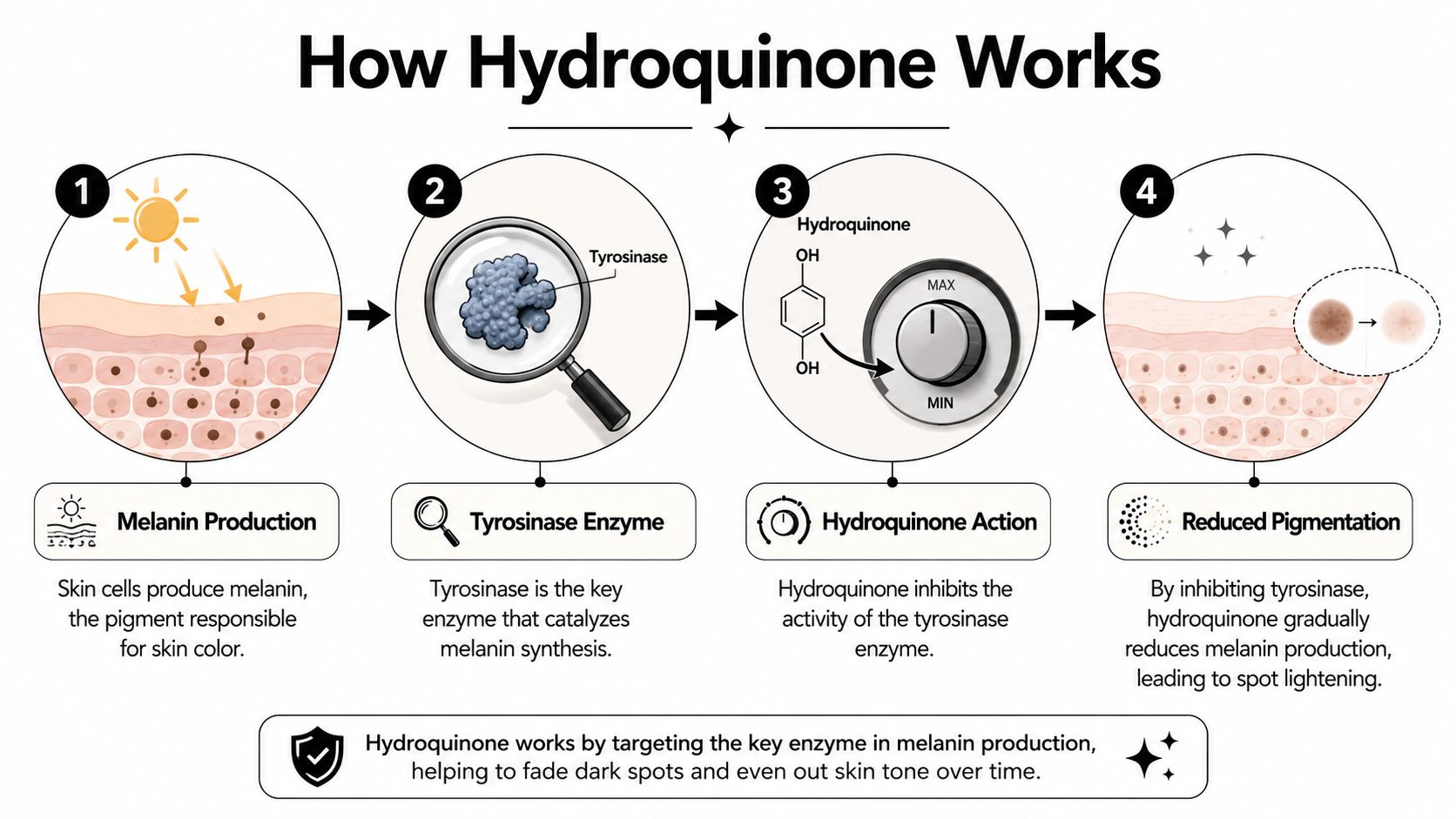
Here is the key idea. Dark spots persist when pigment cells keep receiving signals to make more color. Hydroquinone helps quiet that signal by suppressing tyrosinase, the rate-limiting enzyme in melanogenesis. With less new melanin being formed, existing discoloration can fade over time. Dermatology literature describes hydroquinone as the gold-standard topical depigmenting agent for hyperpigmentation, and notes that visible improvement often takes 8 to 12 weeks of steady use, according to this review in the medical literature.
Why it's different from exfoliants
Many patients frequently misunderstand. An exfoliant helps remove some of the pigment you can already see. Hydroquinone changes the supply line.
That difference matters. If exfoliation is like sweeping leaves off a walkway, hydroquinone is closer to slowing the tree that keeps dropping them in the same spot. Both approaches can have a role, but they do different jobs. Hydroquinone is used when the goal is true pigment correction, not just a brighter surface.
It also explains why results are gradual. The skin needs time to move older pigmented cells upward and out while making less new pigment underneath.
Why concentration changes the plan
Hydroquinone is not one-size-fits-all. The percentage, the size of the treatment area, your skin tone, and the cause of the discoloration all shape the plan.
A few practical distinctions make this easier to understand:
Lower strengths may be used for milder cases, smaller areas, or skin that is more irritation-prone.
Prescription strengths are often chosen for melasma or stubborn pigmentation that needs closer follow-up.
Combination treatment may be recommended when a clinician wants to address inflammation, pigment production, and cell turnover together.
That is one reason a medically guided approach matters. Two people may both say they are using a hydroquinone dark spot corrector, but one may be treating post-acne marks with a short course while another is managing melasma with a stricter schedule and a maintenance plan. If you need help getting that kind of structured care, this guide explains how to get prescriptions online.
If you want a broader plain-language primer before you start treatment, this overview can help you learn about hyperpigmentation in simple terms.
Practical rule: Don't judge hydroquinone by the first week. Its mechanism is gradual by design.
The clearest way to understand hydroquinone is this. It is a treatment that lowers excess pigment production for a defined period under the right conditions. Used with the right diagnosis, timing, and follow-up, it can be remarkably effective.
How to Use Hydroquinone for Maximum Results
Application is where good results are won or lost. Many problems with hydroquinone happen not because the ingredient is ineffective, but because people use too much, apply it too broadly, skip sunscreen, or keep going long after they should have stopped.
The basic routine
Hydroquinone is generally most effective when it is a focused part of an evening routine.
Use this framework:
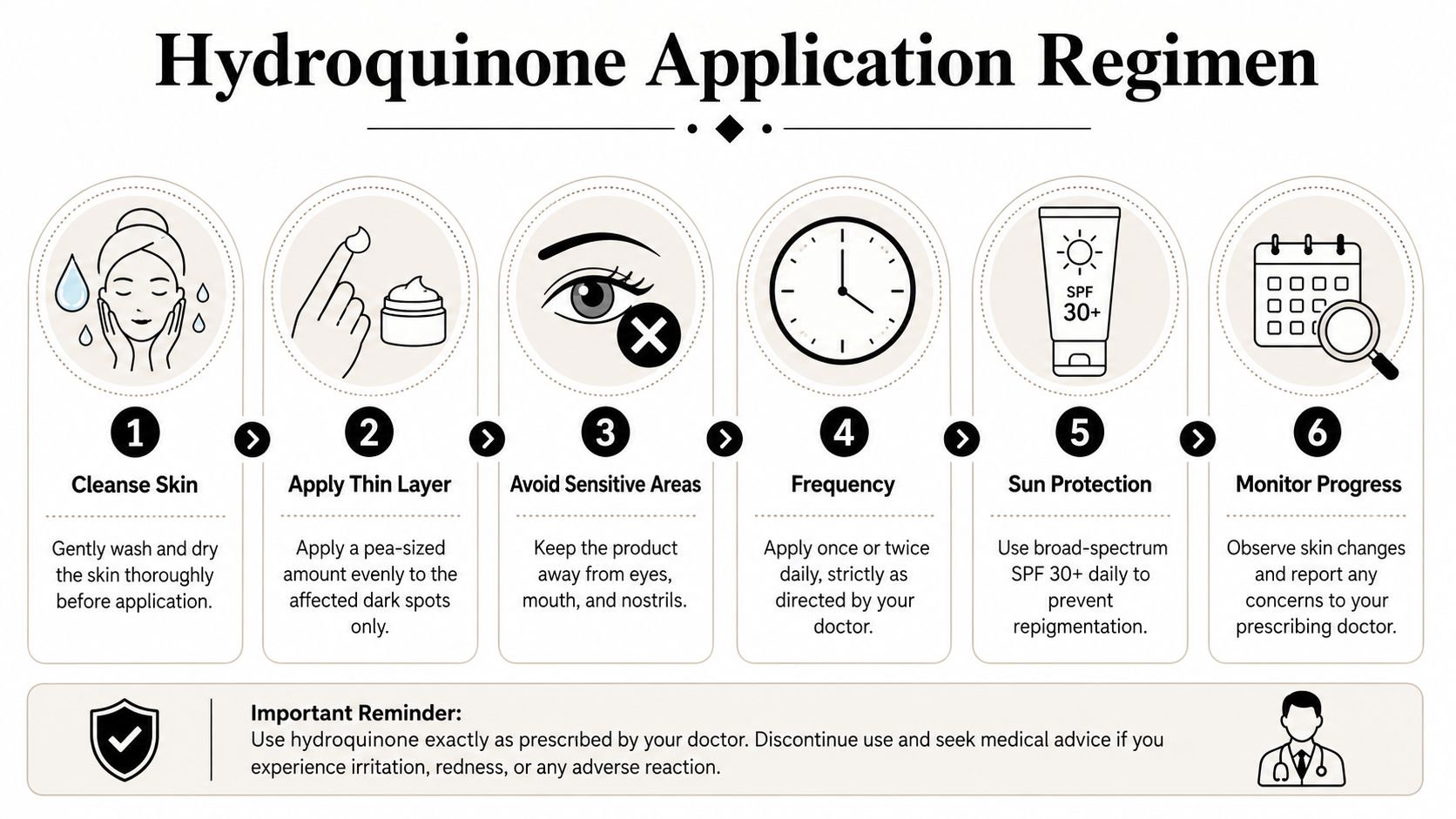
Start with clean, dry skin. Wash gently and let the skin fully dry before applying anything active.
Use a small amount. A pea-sized amount is usually enough for the areas being treated.
Apply only where pigment exists. Don't spread it all over the face unless your prescribing clinician specifically told you to.
Keep it away from delicate areas. Avoid the eyes, corners of the nose, lips, and irritated skin.
Follow the exact schedule you were given. Some people are instructed to use it once daily. Others may have a different plan.
Watch your skin. Mild dryness or irritation can happen. Strong burning or persistent inflammation means you need medical guidance.
Why treatment cycles matter
Hydroquinone is usually not meant for indefinite, casual use. Medical sources describe common regimens of 3 to 6 months, applied only to affected areas, with daily broad-spectrum sunscreen (SPF 30+) because ultraviolet exposure can offset treatment by stimulating melanogenesis, as explained in this safety and use review.
That's why dermatologists often talk about cycling hydroquinone. You use it for a defined window, then reassess. This lowers the chance of overuse and helps fit hydroquinone into a longer-term pigment strategy rather than making it your permanent default.
Your daytime routine decides your outcome
Here's the truth many people underestimate. If you use hydroquinone at night and then neglect sun protection during the day, you can undercut your own progress.
Sun exposure stimulates pigment. Hydroquinone tries to quiet pigment production. Those two things work against each other.
A strong daytime routine should include:
Broad-spectrum sunscreen every day. This is not optional, even on cloudy days.
Reapplication when you're outdoors. Especially if you sweat or spend long periods outside.
Protective habits. Hats, shade, and avoiding unnecessary peak sun matter.
Gentle support products. Fragrance-heavy or highly irritating products can inflame the skin and make discoloration harder to control.
The medicine fades pigment at night. Your daytime choices protect those gains.
Precision beats aggression
More product doesn't mean faster fading. It usually means more irritation.
That's one reason medical supervision matters. If you're exploring prescription treatment pathways, resources on how to get prescriptions online can help you understand the process before starting.
A well-run hydroquinone routine is disciplined, not aggressive. You're not trying to force the skin. You're trying to guide it steadily and safely.
Understanding the Risks and How to Stay Safe
Hydroquinone works well, but it deserves respect. Good education doesn't hide the risks. It puts them in context so you can make a smarter decision.
Common problems are usually manageable
The side effects people notice first are usually local skin reactions. Irritation, dryness, redness, or a stinging feeling can happen, especially if the product is applied too often, layered with too many harsh actives, or used on already sensitive skin.
That doesn't automatically mean hydroquinone is wrong for you. It often means the routine needs adjustment. Sometimes the answer is less frequent use. Sometimes it's better moisturization. Sometimes it's stopping and checking in with a clinician before the irritation turns into a bigger problem.
The rare risk people should know by name
The serious complication most often discussed with long-term misuse is exogenous ochronosis. This is a paradoxical darkening of the skin that can appear blue-black or gray-brown rather than lighter.
A literature review cited in dermatology guidance found only 22 cases of hydroquinone-related ochronosis among more than 10,000 patient exposures over 50 years, indicating the complication is rare but associated with prolonged or high-concentration use, according to this dermatology source summary.
That number should do two things at once. It should reassure you that this isn't common in properly managed treatment. It should also remind you why endless, unsupervised use is a bad idea.
What safe use looks like
Safe use is less about fear and more about boundaries.
Use it only where needed. Don't treat normal skin out of habit.
Stay within the prescribed cycle. Longer is not automatically better.
Stop if the skin becomes markedly inflamed. Irritation can worsen pigment problems.
Avoid self-escalation. Don't decide on your own to increase strength or frequency.
Ask before combining actives. Layering too many strong ingredients can backfire.
Who should be especially cautious
Some patients need a more individualized plan from the start. That includes people with very sensitive skin, those with recurrent melasma, and anyone who's had strong reactions to active skincare before.
Pregnancy and breastfeeding also deserve a direct conversation with a physician before use. This is not the kind of medication to start casually based on social media advice or a friend's routine.
If you want a practical framework for thinking about medication oversight and responsible use, this patient resource on medication safety information is a helpful place to start.
Respecting hydroquinone doesn't mean fearing it. It means using it with limits, observation, and a real plan.
That's the difference between a treatment that helps and a treatment that creates a new problem.
Exploring Other Powerful Skincare Ingredients
A good pigment plan rarely relies on one ingredient forever. Hydroquinone often does its best work as an intensive treatment phase. After that, many patients need a steadier maintenance strategy that keeps pigment quiet without pushing the skin too hard.
That shift matters most with conditions like melasma, where discoloration can fade, then return with sun exposure, heat, hormones, or irritation. In that setting, the goal is not just to lighten spots quickly. The goal is to control the triggers, calm pigment production, and choose ingredients your skin can stay with over time.
When alternatives make more sense
Dermatologists often build hydroquinone-free phases with ingredients such as cysteamine, azelaic acid, tranexamic acid, and resorcinol derivatives, especially for long-term management or for skin that reacts easily. This dermatologist-written overview of dark spot correctors gives a useful snapshot of how these options fit into pigment care.
These alternatives may be a better fit if you:
Need maintenance care after a hydroquinone cycle
Have sensitive skin and develop irritation easily
Deal with chronic melasma that tends to come back
Want a routine built for long-term control, not repeated short bursts of correction
One way to understand the difference is to picture treatment in phases. Hydroquinone is often the strong reset button. Alternatives are often the stabilizers that help hold those gains.
Hydroquinone vs Popular Alternatives
Ingredient | How it fits into pigment care | Best For | Prescription Status |
|---|---|---|---|
Hydroquinone | Reduces melanin production and is often used for faster correction in supervised treatment cycles | Stubborn dark spots, melasma, short-course intensive treatment | Often prescription-based, depending on strength and formulation |
Cysteamine | Used as a non-hydroquinone option in pigment routines | Persistent discoloration and maintenance planning | Varies by product |
Azelaic acid | Helps address uneven tone and is often easier for acne-prone or reactive skin to tolerate | Sensitive or acne-prone skin, longer-term use | Some forms are prescription |
Tranexamic acid | Commonly added for recurrent pigmentation patterns, especially melasma-focused plans | Chronic discoloration and maintenance strategies | Varies by formulation |
Resorcinol derivatives | Included in hydroquinone-free routines aimed at gradual pigment control | Patients who need alternatives or off-cycle support | Varies by product |
Combination prescriptions matter too
Some patients do best with a single ingredient. Others need a combination approach because pigment is rarely driven by just one process. A doctor may pair pigment suppression with a retinoid to speed cell turnover, or with an anti-inflammatory ingredient when irritation is part of the cycle.
As noted earlier, prescription hydroquinone comes in multiple strengths, and combination formulas are sometimes used for facial melasma under medical supervision. That is one reason self-selecting products can be confusing. Two people may both have "dark spots" but need very different plans based on whether the cause is melasma, acne-related marks, or sun damage.
If acne marks are part of your pigment story, this overview of treatments for acne pigmentation can help explain why post-breakout discoloration often needs more than a fading cream.
Some readers also ask about oral or wellness-oriented approaches discussed in skin forums. This background on a reduced glutathione supplement for skin-focused discussions may help you understand the conversation, but it does not replace a topical plan chosen for your diagnosis.
The big picture is simple. Hydroquinone can be the powerful first move. Safer long-term control often comes from knowing when to pause it, what to use after it, and how to build a plan your skin can sustain.
Connecting with a Doctor for Your Personalized Plan
The hardest part of treating dark spots isn't finding products. It's knowing what you're treating.
Not every dark mark is the same. Melasma behaves differently from post-inflammatory hyperpigmentation. Sun spots don't follow the same pattern as irritation-driven discoloration. If the diagnosis is wrong, the routine can be wrong from day one.
Why medical supervision changes the outcome
A clinician helps in ways that a shopping cart can't.
They can decide whether hydroquinone fits your skin type, whether your discoloration needs a prescription-strength approach, whether a combination treatment makes more sense, and when it's time to stop, pause, or switch to maintenance. That's especially important because hydroquinone comes in a real range of prescription strengths, not a one-size-fits-all formula.

What a doctor can tailor
A personalized plan may involve several decisions:
Choosing the right strength based on how stubborn the pigment is and how reactive your skin tends to be
Confirming the target condition so you're not treating the wrong cause
Building a cycle plan that includes a start point, follow-up, and maintenance strategy
Adjusting the routine if irritation appears
Considering combinations such as prescription formulas that include multiple active ingredients
For people who want remote access to prescription evaluation, online doctor prescription consultation resources can help explain what telemedicine-based care looks like.
Why convenience matters less than accuracy
Telemedicine is useful because it removes friction. But its true value isn't speed alone. It's access to informed decision-making from home.
One option in that space is 10 Rx Home, a telemedicine service that connects patients with physicians for personalized treatment planning. In a category like hydroquinone, that structure matters because this isn't a product to guess your way through.
A physician-guided plan turns hydroquinone from a risky experiment into a controlled treatment strategy. That's the safest way to use a powerful pigment corrector.
Your Hydroquinone Questions Answered
Can I use hydroquinone with other active skincare products
Sometimes, yes. But people often cause needless irritation in this manner. If you're already using retinoids, exfoliating acids, or other strong pigment products, ask your clinician how to space them. Stacking everything at once can inflame the skin and make discoloration harder to manage.
What if my dark spots come back after I stop
That depends on the cause. If the trigger is still active, such as melasma tendencies, acne, irritation, or ongoing sun exposure, pigment can return. That's why maintenance care matters. Hydroquinone often plays the intensive role, while other ingredients and strict sun protection help hold gains afterward.
Is hydroquinone only for the face
No. Clinicians may use it on other affected areas, but treatment should still be targeted and supervised. Skin on different parts of the body can respond differently, and some areas are more prone to irritation.
Is it normal not to see change right away
Yes. Hydroquinone works gradually. If you expect fast peeling or instant brightening, you may think it's failing when it is following its normal course. Progress with pigment correction usually asks for consistency and patience.
Should everyone with melasma use hydroquinone
Not always. Hydroquinone is often important in short courses, but some patients with recurrent melasma do better with a broader plan that includes maintenance ingredients and careful light protection. In deeper skin tones, tinted or mineral sunscreens can be especially relevant because visible light may worsen pigmentation, as noted earlier in the article's discussion of long-term strategies.
Is hydroquinone banned
The answer depends on the formulation and where it's being used. What matters most as a patient is this: you should treat hydroquinone as a medication-level decision, not a casual cosmetic purchase.
What's the single biggest mistake people make
Using a hydroquinone dark spot corrector without respecting the full plan. That usually means one of three things: overapplying it, using it too long, or skipping sunscreen.
Hydroquinone can produce significant results. It can also disappoint people who use it without structure. The more precisely you use it, the more likely it is to reward your patience.
If you're ready to turn dark spot treatment into a medically guided plan instead of another guessing game, 10 Rx Home offers a telemedicine pathway to connect with a physician and discuss whether prescription options like hydroquinone fit your skin goals.