Vitamin B6 and Weight Loss: Your Strategic Guide
Vitamin B6 isn’t a magic fat burner — but it can play an important supporting role in sustainable weight loss. As explained in , B6 helps your body process carbohydrates, fats, and protein while supporting energy production and lean muscle preservation during a calorie deficit. That matters because successful long-term weight loss isn’t just about lowering the number on the scale — it’s about protecting metabolism, maintaining energy, and preserving muscle while reducing body fat.
Explore the real link between vitamin b6 and weight loss. Learn how it aids metabolism and muscle, not just burns fat. Get our expert guide to safe use.

Vitamin B6 and Weight Loss: Your Strategic Guide
Most advice about vitamin b6 and weight loss gets one big thing wrong. It treats B6 like a shortcut, as if one vitamin can melt fat on its own.
It can't.
That isn't bad news. It's better news. When you understand what vitamin B6 does, you stop chasing hype and start using it in a way that supports real progress. B6 is most useful when you're eating in a calorie deficit, trying to protect your energy, and working to hold onto lean muscle so your metabolism doesn't take a hit.
That shift matters. Fast weight loss tricks often cost people the very thing that helps long-term results: muscle. A smart plan protects it.
The Weight Loss Myth You Need to Unlearn
The myth is simple. Vitamin B6 is often marketed like a fat burner. That idea sounds appealing because it promises an easy answer to a hard problem.
But the more honest view is stronger. B6 doesn't appear to work as a standalone “burn fat” pill. Its real value is strategic. It helps your body handle the stress of dieting better by supporting metabolism and making it easier to preserve lean tissue while you lose weight.
That's a major difference.
When people cut calories, the body doesn't only lose fat. It can also lose muscle. That matters because muscle is metabolically active tissue. If too much of it disappears during weight loss, your body may feel weaker, your energy may dip, and staying consistent gets harder.
Key idea: The best nutrient support for weight loss isn't always the one that promises faster fat loss. It's often the one that helps you lose weight without undermining your metabolism.
This is why broad weight management support usually works better than supplement guessing. If you're exploring medical options too, a physician-guided resource like this wellness clinic for weight loss injections can help you understand how nutrition support and prescription strategies may fit together.
A lot of confusion comes from using one phrase for two different goals:
Losing scale weight means the number goes down
Improving body composition means you keep more lean mass while reducing fat
Supporting metabolism means your body keeps functioning well during a calorie deficit
Those goals overlap, but they aren't identical. Vitamin B6 makes more sense when you judge it by the second and third goals, not just the first.
Understanding Vitamin B6 Your Body's Spark Plug
Vitamin B6 helps your body run the background processes that make a weight loss plan workable. It does not melt fat on its own. What it does is far more practical. It helps your body process food, use protein, and support nervous system function while you are asking it to do more with fewer calories.
That distinction matters.
B6 is involved in many enzyme reactions tied to carbohydrates, fats, and amino acids. It also helps your body make neurotransmitters that influence mood, focus, and day-to-day steadiness. During a calorie deficit, those functions can shape how you feel, train, recover, and stay consistent.

Why B6 matters beyond the scale
A bathroom scale only shows one outcome. Your body is managing many jobs at once.
If dieting leaves you tired, short-tempered, or mentally foggy, the issue is rarely about willpower alone. It often reflects how well your body is keeping up with energy production, protein turnover, and stress response. B6 supports those systems, which is why it comes up so often in conversations about sustainable weight loss.
Here is the practical way to look at it:
Energy use: B6 helps enzymes involved in turning food into usable energy.
Protein metabolism: That matters when your goal is to hold onto muscle while eating less.
Nervous system support: Neurotransmitter production can influence mood, motivation, and mental clarity.
Daily function: When these basics are supported, healthy routines tend to feel more manageable.
A helpful review in this analysis of vitamin B6 and weight loss explains that B6 is often overstated as a direct weight loss aid, while its more realistic value is supporting metabolism and lean mass preservation during a calorie deficit.
Where readers often get confused
“Supports metabolism” does not mean “causes fat loss.”
A better analogy is a construction crew. A calorie deficit is the plan. Protein and resistance training supply the building materials. Vitamin B6 helps the workers do their jobs efficiently. If the crew is missing support, progress can feel harder and the structure is less likely to hold up well.
That is why B6 makes the most sense as part of the foundation, not as the headline act.
Your results still depend on the basics:
A calorie deficit
Enough protein
Resistance training or other muscle-preserving activity
Sleep and recovery
A plan you can repeat consistently
Your metabolism is a system, not a single switch. Vitamin B6 supports that system, especially when preserving lean tissue is part of the goal.
If low energy keeps disrupting your routine, this guide to the best supplements for fatigue can help you look at other missing pieces too.
How B6 Powers Your Metabolism for Weight Loss
B6 becomes more interesting once you look at what happens during a calorie deficit. When you eat less, your body has to decide where to pull energy from and how well it can maintain important tissue while doing it.
That's where the conversation changes from “Does B6 burn fat?” to “Does B6 help my body manage weight loss more intelligently?”
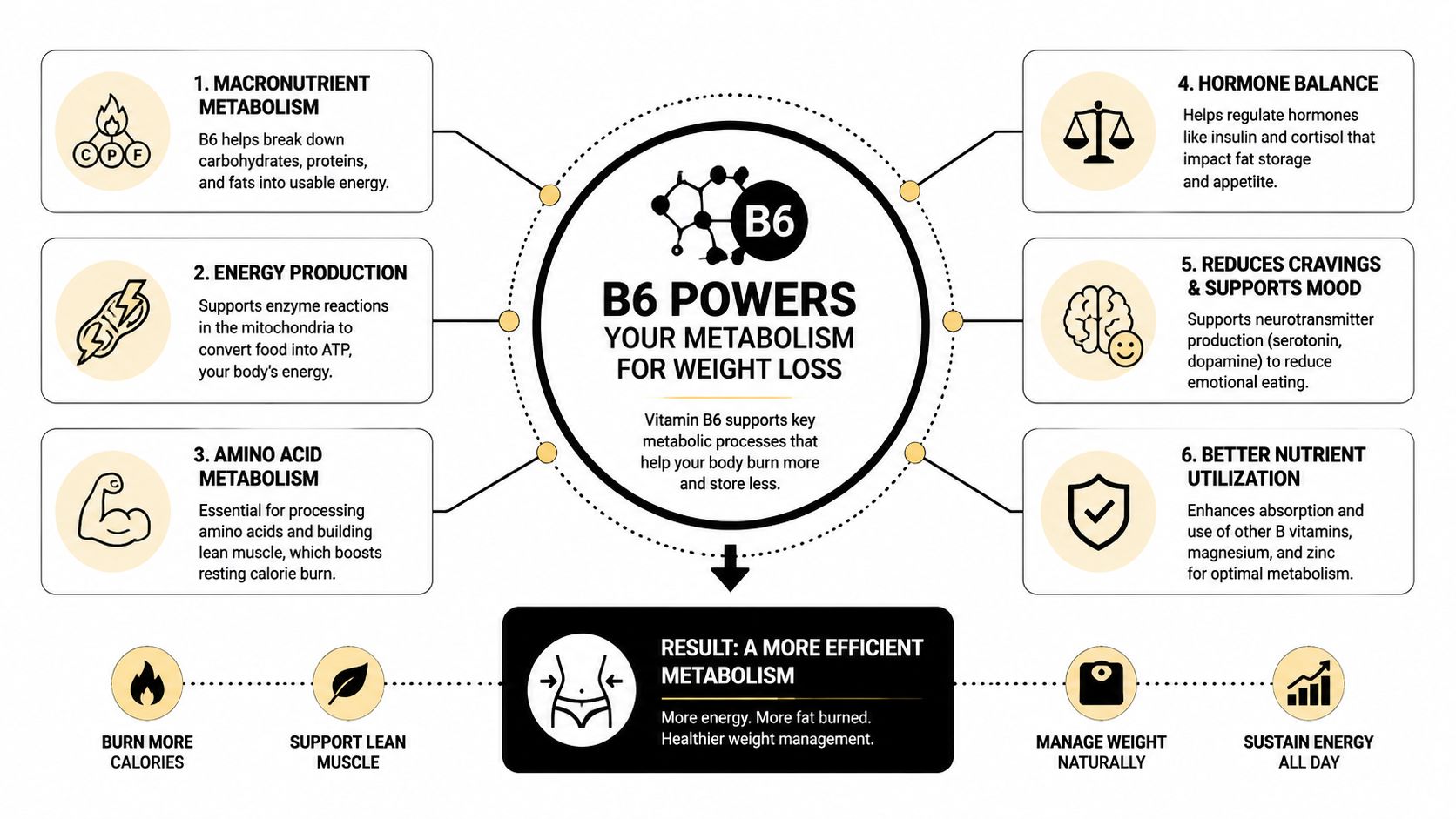
B6 helps your body process fuel
Your body constantly breaks down and rebuilds. During weight loss, that work becomes more sensitive because you're asking the body to do more with less incoming energy.
Vitamin B6 supports enzymes involved in processing:
Carbohydrates, which affect how you use readily available fuel
Fats, which matter when stored energy is being mobilized
Proteins, which becomes essential when muscle maintenance is the goal
This is why vitamin b6 and weight loss should be discussed in terms of function, not fantasy. If your body can manage fuel well and use protein appropriately, your diet has a better chance of producing the kind of result you want.
The muscle-preservation connection
Here's the part many people never hear. During weight loss, preserving muscle may be just as important as reducing fat.
A 2008 study on overweight women following a hypocaloric diet found that women with greater increases in active B6 status, measured as PLP, also had greater gains in fat-free mass percentage (r=0.4426, P<0.05). That matters because fat-free mass is a practical stand-in for the lean tissue you want to protect while dieting.
Why does that matter in everyday life?
More muscle support can help protect metabolic function
Better body composition usually beats quick scale drops
Strength and energy are easier to maintain when lean tissue is preserved
Practical rule: Don't judge a weight-loss strategy only by pounds lost. Ask whether it helps you keep the muscle that supports your long-term metabolism.
This also explains why nutrient status, digestion, protein intake, and training all work together. If you're improving your nutrition but your digestion feels off, this article on how to improve gut health for weight loss can help you think about the bigger picture.
What this means in real life
A smart use of B6 looks like this:
Goal | Smart question to ask |
|---|---|
Better energy during a diet | Am I eating enough nutrient-dense foods? |
Preserving lean mass | Am I getting enough protein and strength stimulus? |
Avoiding supplement hype | Am I using B6 as support, not as a magic fix? |
That is a significant win. B6 may help your plan work better, especially when the plan already includes the fundamentals.
Proof from Clinical Studies
Mechanisms are useful, but individuals typically want to know one thing. Has this idea shown up in actual human research?
Yes, with an important qualifier. The evidence supports B6 as an adjunct, not a miracle.

What the clinical trial found
A 2021 randomized controlled trial in obese adults tested 300 mg/day of vitamin B6 for 8 weeks against placebo. The B6 group had significant reductions in BMI, fat mass, visceral adiposity index, and fasting insulin compared with the placebo group.
That's meaningful because it points to more than one area of improvement. The findings suggest B6 may support body composition and metabolic markers when used in a structured plan.
The same study also reported that the RDA for B6 is 1.6 mg/day for adults, while the upper limit is 100 mg/day, with neuropathy risks seen at 2 to 6 g/day. That's an important reminder that “effective” and “safe for self-prescribing” are not always the same thing.
How to read the evidence without overhyping it
The right takeaway is not “everyone should take high-dose B6.”
The right takeaway is closer to this:
Clinical support exists: B6 has human trial data behind it.
Context matters: The evidence fits best within a broader weight-management effort.
Dose decisions need judgment: Trial doses can differ from what's appropriate for routine personal use.
Research is most useful when it helps you ask better questions, not when it convinces you to copy a study dose on your own.
If you like looking at ingredient decisions through a research lens, the formula research behind Restore+ is a good example of how to think critically about supportive wellness ingredients instead of chasing trendy claims.
Finding Your Daily B6 Through Food and Supplements
Focusing on food is a recommended starting point. That approach gives you vitamin B6 in the context of protein, fiber, minerals, and other nutrients that support weight management as a whole.
Food also helps you avoid the mindset trap of treating a single capsule like the center of your plan. The center should still be your meals, habits, and consistency.
Food first is usually the smartest move
Common dietary sources of B6 include poultry, fish, starchy vegetables, legumes, bananas, and fortified cereals. If your eating pattern is built around whole foods with enough protein, you may already be getting some B6 support without thinking much about it.
The table below gives you a quick planning framework. Exact B6 amounts vary by product and preparation, so use it as a shopping and meal-building guide rather than a strict scorecard.
Food Source | Serving Size | Vitamin B6 (mg) | % Daily Value |
|---|---|---|---|
Chickpeas | 1 cup | Varies | Varies |
Salmon | 1 serving | Varies | Varies |
Chicken breast | 1 serving | Varies | Varies |
Tuna | 1 serving | Varies | Varies |
Potato | 1 medium | Varies | Varies |
Banana | 1 medium | Varies | Varies |
Fortified cereal | 1 serving | Varies | Varies |
Easy ways to build B6 into real meals
You don't need a perfect diet. You need a repeatable one.
Try combinations like these:
Breakfast option: Fortified cereal with protein on the side
Lunch idea: Chickpea bowl with vegetables and olive oil
Dinner base: Salmon or chicken with potatoes and greens
Snack support: A banana paired with a higher-protein choice
Athletes often do this well because they think in patterns, not random superfoods. If you want practical meal-thinking examples, these nutrition habits for Pittsburgh athletes show how consistent food choices support performance and body goals together.
When supplements make sense
Supplements can be useful when food intake is limited, diet quality is poor, or a clinician suspects a deficiency or increased need. They can also help when someone is following a structured medical weight-loss plan and needs closer nutritional support.
Before buying a random bottle, ask:
Am I trying to correct a likely deficiency, or am I just hoping for a shortcut?
Have my eating habits improved first?
Do I know the dose I'm taking and why?
For practical meal support while you improve your basics, this guide to healthy snacks for weight loss can make day-to-day choices easier.
The Rules of Safe B6 Supplementation
Safety matters more than excitement. Vitamin B6 is helpful, but it's still possible to misuse it.
A lot of supplement mistakes happen because people assume that if a little is good, more must be better. That logic breaks down fast with B6.

What makes self-prescribing risky
One major blind spot is deficiency. A review focused on obesity and B6 deficiency highlights a critical gap in weight-loss care: B6 deficiency is highly prevalent in obese individuals, yet many programs don't screen for it. The review also notes that deficiency can worsen insulin resistance and fatigue, both of which can make it harder to stick with a nutrition plan.
That creates a strange situation. Some people take high doses without knowing if they're deficient, while others who might benefit from targeted correction never get tested at all.
The safe way to think about B6
Use these rules:
Know the baseline: If you're struggling with fatigue, stubborn progress, or poor tolerance of dieting, ask whether nutrient status could be part of the issue.
Respect upper limits: More isn't automatically more effective.
Use the whole plan: Supplements work best when paired with diet quality, protein intake, movement, and medical context.
Watch for symptoms: Tingling, numbness, or unusual nerve symptoms deserve medical attention.
The goal isn't to take the most vitamin B6. The goal is to take the right amount for your body, if you need it at all.
Who should be especially careful
Professional guidance becomes more important if any of these apply:
Situation | Why caution matters |
|---|---|
You want high-dose supplements | Study doses aren't DIY instructions |
You take regular medications | Interactions and overall context matter |
You feel exhausted while dieting | Deficiency or another issue may be contributing |
Your weight loss keeps stalling | The problem may be bigger than calorie math |
The smartest move is personalization. Test when appropriate. Adjust based on real information. Don't guess.
Get Expert Guidance for Your Wellness Plan
If your weight loss has stalled, if you're considering high-dose supplements, or if you're managing other health concerns at the same time, expert help isn't optional. It's the safest way to make a good plan better.
This is especially true with vitamin b6 and weight loss. The question usually isn't “Should everyone take B6?” The better question is “Do I need it, in what amount, and how does it fit with the rest of my plan?”
Telemedicine can make that process much easier. You can discuss symptoms, review your current routine, and get guidance without piecing together advice from random supplement labels and social posts. If you want to explore that route, an online weight loss consultation can help you understand what physician-guided care looks like.
You don't need a magic pill. You need a plan that protects your metabolism, supports your body, and gives you a realistic path forward.
10 Rx Home makes that kind of support easier to access. Through 10 Rx Home, you can connect with board-certified physicians, review your goals, and build a personalized wellness plan that fits your health history and lifestyle. If you're ready to stop guessing and start using a smarter strategy, physician-guided care can help you move forward with more confidence.