Bloating or Belly Fat: Key Differences and Management Tips
May 6, 2026
Bloating and belly fat can look similar, but they come from very different causes and require different solutions. As explained in , bloating is often temporary and linked to digestion, gas, or food triggers, while belly fat develops gradually over time through changes in body composition. Understanding the difference can help you stop guessing, reduce frustration, and choose a more effective path toward better gut health and long-term wellness.
Confused about bloating or belly fat? Learn the differences in causes and symptoms plus get expert tips to manage both for a healthier you in 2026.

Bloating or Belly Fat: Key Differences and Management Tips
Some days your stomach looks normal in the morning, then feels tight, rounded, and uncomfortable by dinner. You loosen your waistband, wonder if you ate something “bad,” and then ask the same frustrating question a lot of people ask: is this bloating or belly fat?
That question matters because the next step depends on the answer. Bloating and belly fat can look similar in the mirror, but they don't come from the same process, and they don't respond to the same plan. One usually behaves like a short-term digestive event. The other builds more slowly and tends to stick around.
You're not overreacting, and you're not alone. Abdominal bloating affects 13.1% of people in Canada, 7% in the United States, and up to 25% in Iran, according to this review on abdominal bloating prevalence and diet. That same review also found a significant link between higher omega-3 PUFA intake and lower incidence of bloating.
The Daily Dilemma of a Changing Belly
A common pattern goes like this. Breakfast feels fine. Lunch is normal. By evening, your lower abdomen feels stretched, your pants dig in, and your stomach looks different enough that you start second-guessing everything from your meals to your metabolism.

That uncertainty can wear on you. If it's temporary bloating, you want relief. If it's body fat, you want a realistic plan that doesn't rely on gimmicks. The hard part is that both can make your midsection feel “bigger,” so people often lump them together and end up using the wrong solution.
Why this feels so confusing
Bloating can appear fast. Belly fat usually doesn't. But in real life, the line can get blurry because your body changes from day to day, meals affect digestion, and stress can make physical sensations feel louder.
A lot of readers tell me the same thing: “I don't know what I'm looking at anymore.” That's a fair reaction.
Practical rule: If your stomach seems to change shape within the same day, you're usually dealing with something dynamic, not a lasting tissue change.
There's also an emotional layer. A suddenly swollen belly can make you feel like you gained weight overnight, even when that's not what happened. On the flip side, gradual fat gain can hide behind the word “bloat” for months, especially if your clothes slowly get tighter and you keep waiting for the feeling to pass.
Relief starts with naming the right problem
Think of this article as a calm sorting process. First, you'll learn how bloating and belly fat behave differently. Then you'll learn why they happen. Then you'll have a practical way to check your own patterns at home and know when it's time to get professional help.
A clear label changes everything. If your issue is bloating, you can focus on digestion, food triggers, gas movement, and hydration patterns. If it's fat gain, the conversation shifts toward nutrition, movement, stress, sleep, and body composition.
Both deserve compassion. Neither means you've failed.
Bloating vs Belly Fat The Core Differences
The simplest way to think about it is this. Bloating is a temporary visitor. Belly fat is a permanent resident. A visitor may show up after a meal and leave later. A resident stays until you actively change the conditions that keep it there.
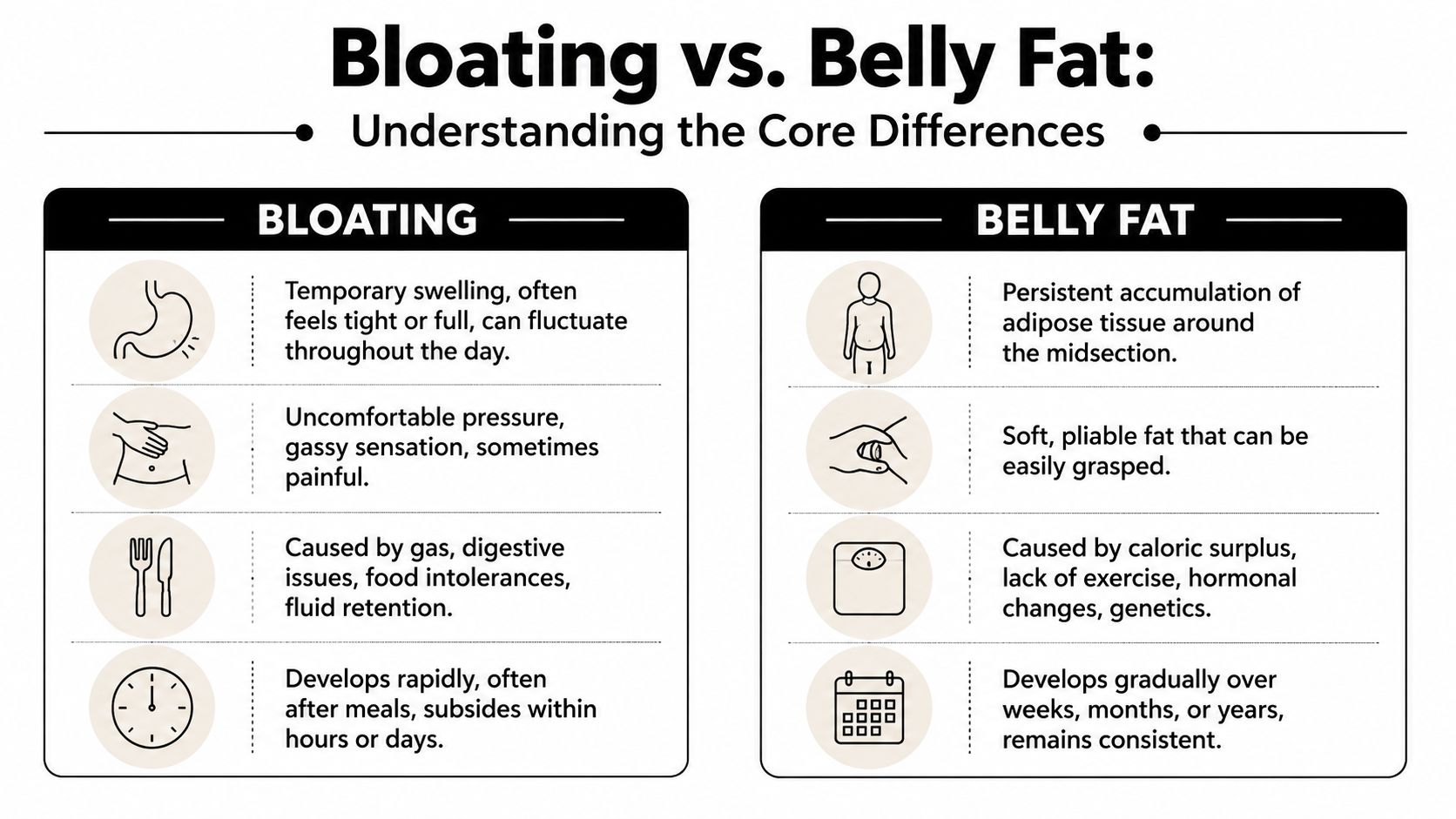
According to this comparison of bloating and belly fat, bloating is temporary and often resolves within hours, while belly fat develops gradually over weeks due to caloric surplus. The feel is different too. Bloating tends to feel tight and gassy and can fluctuate daily. Belly fat is more often a consistent, soft mass.
Bloating vs belly fat at a glance
Characteristic | Bloating | Belly Fat |
|---|---|---|
Onset | Often appears quickly, especially after meals | Develops gradually |
Duration | Comes and goes | Persists |
How it feels | Tight, full, pressured, gassy | Soft, more uniform, graspable |
Daily pattern | Often changes through the day | Usually stays relatively consistent |
Main drivers | Digestion, gas, fluid shifts, food triggers | Energy imbalance, lifestyle, metabolic factors |
What the scale does | Often little to no major same-day shift | Tends to reflect longer-term change |
Two body signals people often miss
The first signal is timing. If your stomach is flatter when you wake up and more distended by evening, that points more toward bloating than body fat.
The second is texture. Fat usually feels like tissue you can grab. Bloating often feels like inward pressure, as if your abdomen is being inflated from the inside.
A belly that changes fast is sending a different message than a belly that changes slowly.
A quick example
Say you eat dinner, feel uncomfortable an hour later, and your stomach seems stretched and firm. The next morning it looks calmer. That pattern fits bloating.
Now compare that with noticing over several weeks that your waistline is steadily changing, your abdomen feels more consistently soft, and the shape doesn't reset overnight. That pattern fits fat gain much better.
Neither pattern is a moral issue. They're just different biological stories. Once you know which story your body is telling, you stop guessing and start choosing smarter next steps.
Unpacking the Causes Behind Your Discomfort
Bloating and belly fat don't just look different. They happen for different reasons inside the body.
With bloating, the issue is often movement and sensitivity. Your digestive tract may be producing gas, holding onto fluid, or moving contents too slowly. With belly fat, the issue is stored energy and body composition. That means the same “big belly” feeling can come from very different mechanisms.
What commonly drives bloating
A major clue comes from this clinical review of bloating mechanisms. It explains that bloating often involves impaired gas transit and visceral hypersensitivity. In plain English, gas may not move through your system well, and your gut may react strongly to normal stretching.
That same review notes that small intestinal bacterial overgrowth, or SIBO, and high-FODMAP foods can lead to excess gas and fluid retention, with distention measurable by up to 5 to 10 cm.
Here's what that can look like in daily life:
Fermentable foods: Some carbohydrates pull water into the gut or get fermented by bacteria, which can create gas and pressure.
SIBO: If bacteria are growing where they shouldn't be, your body may react to meals with repeated bloating, especially when generic advice hasn't helped.
A sensitive gut-brain connection: Some people feel normal digestive volume as major discomfort.
If you suspect your digestion has been off for a while, this AloeCure guide to poor gut health offers a helpful overview of patterns that often travel with bloating, such as irregularity and post-meal discomfort.
What commonly drives belly fat
Belly fat is different. It builds when your body stores more energy over time, and it's shaped by more than just one large meal or one “bad” week. Appetite, routine, sleep, stress, age-related body changes, and activity all play a role.
A useful distinction is this:
Bloating is about volume in the digestive space
Belly fat is about stored tissue around the midsection
That's why the fixes are different. You don't “burn off” bloat the way you reduce fat tissue. And you don't solve persistent fat gain with anti-gas tricks alone.
For some people, water retention muddies the picture even more. If swelling and puffiness seem to come and go along with abdominal fullness, it may help to review practical strategies in this guide on reducing water retention.
If your symptoms spike after specific foods, meals, or stress, your body is giving you clues. Keep them. They matter more than generic advice.
Your At-Home Detective Kit to Tell Them Apart
You don't need to become your own doctor. But you can become a better observer of your own patterns. That alone makes the bloating or belly fat question much easier to answer.
The three checks that tell you the most
Start with the morning versus evening check. If your abdomen looks or feels noticeably different by the end of the day, bloating moves higher on the list.
Next is the pinch test. If you can grab soft tissue with your fingers, that points more toward fat. If your stomach feels hard, tense, or pressurized, that points more toward bloating.
Then use the trigger check. Ask yourself whether your stomach changes after meals, carbonated drinks, rushed eating, constipation, or specific foods. Fast-changing triggers fit bloating more than body fat.
The hidden middle ground
There's one nuance many people miss. Sometimes recent weight gain reduces the space inside the abdomen, so even normal meals feel more uncomfortable. According to this review on functional abdominal bloating and distention, a key factor in bloating can be abdomino-phrenic dyssynergia, where abdominal wall muscles relax inappropriately. The same review also notes that recent weight gain, such as 10+ pounds, can reduce intra-abdominal space, making a normal meal feel like a bloating event.
That means your answer may not be purely one or the other. Some people have both: more abdominal fat plus true digestive bloating layered on top.
A changing belly can be part digestion, part body composition, and part mechanics.
A simple tracking habit
For one week, write down these five things once in the morning and once in the evening:
How your stomach feels
What you ate
Your bowel pattern
Whether your waistband feels tighter
Any obvious triggers
If you also want a clearer sense of body composition, this guide on measuring body fat percentage can help you place your observations in better context.
A short record often reveals what memory misses. You may notice that your “weight gain” is mostly evening fullness. Or you may see that the change is consistent all day, every day, which points in a different direction.
Find Immediate Relief from Bloating Today
When bloating is the problem, you usually want relief now, not next month. The good news is that simple actions can often calm things down, especially when your symptoms are linked to meal timing, gas buildup, or digestive sluggishness.
What to do in the moment
Take a gentle walk: Light movement can help gas move through the digestive tract instead of sitting and stretching the abdomen.
Sip peppermint or ginger tea: Many people find warm liquids soothing when their stomach feels tight or unsettled.
Eat slower at your next meal: Fast eating often means more swallowed air and less awareness of fullness.
Skip carbonated drinks for the day: Fizzy drinks can add to that inflated feeling.
Loosen pressure on your abdomen: Tight waistbands make a bloated belly feel worse.
When food support may help
Some people notice their bloating happens with certain meals, especially ones heavy in specific carbohydrates or rich foods. In those cases, targeted digestive support may be useful. If you want a plain-language overview, this article on evidence-based enzymes for digestion explains where digestive enzymes may fit and where they may not.
Not every bloated stomach needs a supplement. Sometimes the answer is smaller meals, less rushing, and avoiding your most obvious triggers for a few days while you observe the pattern.
What not to do
Avoid a sudden reduction in food intake following a single night of bloating. Such a response frequently causes further issues and may be counterproductive if the underlying problem is gas, constipation, or irritation.
Also, don't assume “healthy” foods are always harmless for your gut. A food can be nutritious and still trigger bloating in a sensitive digestive system.
Relief gets easier when you stop treating every swollen stomach like fat gain.
If bloating keeps returning despite these simple measures, that's useful information. Repeated symptoms after meals often call for a more focused gut-health workup rather than more trial and error.
A Lasting Strategy for Gut Health and Weight
Short-term relief matters, but long-term progress comes from matching your strategy to the underlying cause. If you've been stuck in the cycle of feeling swollen, cutting foods randomly, and still not feeling better, it's time for a more structured approach.

Build a plan that fits the pattern
If your main issue is bloating, think in terms of gut calm, meal awareness, and trigger reduction. If your main issue is belly fat, think in terms of consistency, strength-building, and sustainable nutrition.
That may include:
Mindful eating: Slow down enough to notice fullness and reduce swallowed air.
Meal pattern cleanup: Fewer chaotic eating swings often means a calmer gut.
Strength training and regular movement: These support body composition better than chasing sweat alone.
Sleep and stress support: Many people underestimate how strongly these affect appetite, digestion, and routine.
When standard advice makes things worse
Fiber is a good example of why personalized care matters. Generic advice often says to eat more of it. But that doesn't work for everyone. According to this article on bloating versus belly fat, contrarian data suggests that for a subset of people, standard high-fiber advice can worsen bloating, often because of undiagnosed SIBO. The same source says a 2025 meta-analysis found SIBO in 35% of chronic bloating cases in overweight adults.
That's an important reminder. “Healthy” advice can fail when the underlying problem hasn't been identified correctly.
For a broader, food-and-routine perspective, this Ayurvedic-inspired guide to digestive wellness can give you ideas for building a gentler daily rhythm around digestion.
Aim for systems, not reactions
A sustainable plan usually works better when it's boring in the best possible way:
Choose repeatable meals you digest well
Keep movement regular
Track reactions instead of guessing
Adjust based on patterns, not panic
If you're also working on body composition, this guide on improving gut health for weight loss can help you think about digestion and weight goals as connected, not separate.
The goal isn't a flatter stomach by tonight. The goal is a body that feels more predictable, more comfortable, and easier to care for.
When to Partner with a Health Professional
Self-observation is useful. It just has limits. If your symptoms keep coming back, if your belly changes don't match your efforts, or if every meal seems to trigger discomfort, you may need more than home experiments.

Signs it's time to get help
Reach out to a clinician if:
Bloating keeps returning without a clear trigger
Your stomach feels uncomfortable after most meals
You suspect constipation, food intolerance, or a gut issue but can't sort it out
Your midsection is changing and you're not sure whether it's bloating, fat, fluid, or more than one thing
Generic fixes keep failing
A clinician can help distinguish a digestive issue from a body-composition issue, and from there decide whether you need testing, nutrition changes, prescription treatment, or a broader metabolic plan.
Why telehealth can be especially helpful
Modern telemedicine makes this process much easier than it used to be. Instead of guessing based on social media advice, you can talk through your pattern with a licensed professional, review your symptom history, and discuss what testing makes sense.
That may include evaluation for issues like SIBO when your symptoms suggest it, especially if “eat more fiber” only made things worse. It may also include a personalized plan for weight management if the main issue is persistent abdominal fat rather than meal-related bloating.
If you want to prepare for that conversation well, this guide on talking to your doctor about weight loss can help you organize your symptoms and questions beforehand.
The smartest next step isn't more guessing. It's better information.
What a personalized plan can do
A personalized care plan can connect the dots that generic wellness tips miss. That may mean identifying digestive triggers, deciding whether breath testing is appropriate, addressing constipation or fluid retention, or building a realistic plan for body fat reduction that fits your life.
Most of all, professional help can shorten the time you spend stuck in confusion. If you've been wondering whether it's bloating or belly fat for weeks or months, that clarity is worth a lot.
If you're ready for personalized support, 10 Rx Home connects you with board-certified physicians through a convenient telemedicine experience. You can take a free quiz, discuss symptoms like bloating, digestion concerns, or weight changes, and get a treatment plan specific to your needs, including prescription options and ongoing wellness support.