Online Weight Loss Treatment: Your Complete 2026 Guide
May 5, 2026
Online weight loss treatment is changing how people access medical support for sustainable weight management. As explained in , effective virtual care combines clinical oversight, personalized treatment plans, and ongoing follow-up—making professional guidance more accessible without sacrificing quality. The goal isn’t perfection or quick fixes, but building a realistic plan that fits real life and supports long-term success.
Explore online weight loss treatment with our guide. Learn about prescription meds, coaching, costs, and how to safely start with providers like 10 Rx Home.

Online Weight Loss Treatment: Your Complete 2026 Guide
Somewhere between your last “fresh start” and the meal plan still taped to the fridge, weight loss may have started to feel less like a health goal and more like a second job. You try to be disciplined. You track. You cut back. You restart on Monday. Then life happens, hunger wins, stress piles up, and the whole thing feels personal, as if effort should have been enough.
That’s why online weight loss treatment has resonated with so many people. It shifts the question from “Why can’t I do this alone?” to “What kind of medical support would fit my life?” For many adults, the missing piece isn’t motivation. It’s access to structured care, clinical oversight, and a plan that can change when their body and routine change.
A smart online program doesn’t promise magic. It offers something more useful. A real medical process, delivered through telehealth, with ongoing guidance instead of one-time advice. If you’ve been wondering whether care from home can be legitimate, safe, and effective, the answer is yes, but only when you know what to look for.
A New Path to Weight Loss Begins Online
You wake up determined. Breakfast is “healthy.” Lunch is packed. By evening, you’re exhausted, hungry, and trying to negotiate with yourself in front of the pantry. That pattern is common, and it doesn’t mean you’ve failed. It often means your plan asked too much from willpower and too little from science.
Many people come to online weight loss treatment after years of trying to outwork biology. They’ve done the strict food rules, the all-or-nothing workouts, the short bursts of progress followed by regain. They may even feel embarrassed to ask for help, especially if they’ve absorbed the idea that weight is only about discipline.
Medical care reframes that experience. Weight regulation involves appetite, hormones, habits, sleep, stress, medications, mobility, and environment. When treatment happens online under clinical supervision, support becomes easier to access. You don’t need to carve out half a day for a waiting room. You can start from home and still receive a thoughtful evaluation.
Online care isn’t a shortcut. It’s a way to bring professional support into ordinary life, where weight decisions actually happen.
That matters because consistency is easier when care fits your schedule. A person juggling work, family, or caregiving responsibilities may do better with virtual visits, secure messaging, medication review, and progress tracking than with a plan that depends on frequent in-person appointments.
The hopeful shift is simple. You may not need more punishment. You may need a better system, one that treats weight management like healthcare instead of a morality test.
Understanding Medically Supervised Online Weight Loss
Medically supervised online weight loss is best understood as a virtual clinic, not an online store. The difference matters. A clinic evaluates your health, reviews your history, checks whether treatment is appropriate, and follows you over time. A pill seller just moves products.

What makes it medical
In a legitimate program, your care starts with assessment. A licensed clinician reviews issues like weight history, prior attempts, current medications, side effects, eating patterns, and related conditions. If prescription treatment is appropriate, it’s part of a broader plan, not the whole plan.
That’s why the phrase “doctor supervised” matters. A proper program is closer to a remote specialty clinic than a trendy wellness app. If you want a deeper look at what that structure should include, this overview of a doctor supervised weight loss program is a useful reference point.
A real clinic also helps you understand where supportive habits fit. For example, nutrition conversations often go beyond calories and include protein, fiber, hydration, and micronutrients. Readers who want a simple explanation of magnesium's role in healthy weight may find that helpful as one piece of the bigger picture.
What it is not
Online weight loss treatment is not:
A miracle shot with no follow-up that appears after a short form
A social media ad with vague sourcing and dramatic promises
An anonymous pharmacy arrangement where you never interact with a clinician
A one-size-fits-all diet challenge dressed up as healthcare
Those models confuse convenience with care. Convenience is valuable, but safety comes from evaluation, prescribing standards, and ongoing monitoring.
The virtual clinic analogy
Think of a quality online program like a well-run clinic that happens to live on your phone or laptop.
The intake desk is your health questionnaire and scheduling process.
The exam room is your telehealth visit.
The treatment plan may include medication, coaching, supplements, or behavior tools.
The follow-up schedule keeps the plan current as your body responds.
Practical rule: If a service makes getting the medication feel easy but makes getting answers feel hard, that’s not care. That’s fulfillment.
The smartest consumer question isn’t “Can I get weight loss treatment online?” It’s “Am I joining a clinic, or am I buying from a website?” Once you separate those two, the picture gets much clearer.
Exploring Your Treatment Options from Home
A smart consumer looks at online weight loss options the way you would compare cars, not vitamins. You are not only picking a product. You are choosing a system of support, follow-up, and safety checks that will shape what happens over the next several months.
That matters because the same headline promise, lose weight from home, can describe very different experiences. One program may center on prescription treatment with regular clinician review. Another may focus on coaching and habit change. A third may sell supplements aggressively and offer very little medical oversight. The goal is not to find the flashiest option. The goal is to understand what each category does well, where its limits are, and how the pieces fit together.
The main options usually fall into three groups: prescription medications, coaching and behavior support, and supportive wellness products. Some online programs combine all three into one plan.
Prescription medications
Prescription treatment gets the most attention, especially GLP-1 medicines and other anti-obesity medications. These drugs work on biology, not willpower. In plain terms, they can reduce hunger, increase fullness, and help quiet the constant mental pull toward food that makes weight regain so common.
GLP-1 receptor agonists are one example. They copy signals your body already uses to regulate appetite and digestion, which is why they can affect how hungry you feel and how quickly food leaves the stomach. They still require screening, prescribing judgment, dose adjustments, and follow-up. A high-quality online clinic treats these medications like serious medical tools, not fast-shipping consumer products.
If you’re comparing commonly discussed options, this guide to tirzepatide and semaglutide can help you understand how patients and clinicians often think about them.
Coaching and behavior support
Medication can lower the volume on appetite. Coaching helps you build a routine you can live with.
A good coach turns broad advice into real-life decisions. What do you order when work runs late? How do you eat enough protein if you are less hungry than usual? What kind of movement makes sense if your joints hurt or your energy is low? Those details often determine whether progress lasts beyond the first burst of motivation.
This part also helps smart consumers judge program quality. If a service talks endlessly about prescriptions but says very little about meal structure, sleep, stress, physical activity, or side-effect management, that tells you something. It may be optimized for sales, not long-term care.
Supportive wellness products
Some programs also offer supplements or other wellness products. These can play a supporting role, but they should stay in that lane. A supplement is not a substitute for diagnosis, prescribing standards, or medical follow-up.
Marketing often blurs that line, which is where people get misled. The safer question is not “Does this product sound impressive?” It is “What job is this product supposed to do, and what evidence or clinical reasoning supports that role?” If you want a clearer view of one category that comes up often in weight management conversations, these expert insights on exogenous ketones can help you understand what they are and what questions to ask before spending money.
Online Weight Loss Treatment Modalities Compared
Modality | Primary Mechanism | Best For Individuals... | Level of Supervision | Typical Role in Plan |
|---|---|---|---|---|
Prescription medications | Alters appetite, fullness, or other weight-related pathways | Who have struggled with lifestyle-only approaches and may qualify for medical treatment | High | Core treatment for eligible patients |
Health coaching | Builds eating, movement, sleep, and behavior routines | Who need accountability, practical problem-solving, or help turning advice into habits | Moderate to high | Foundation for sustainable change |
Supportive supplements | Supports broader wellness goals depending on product and context | Who want an added layer of support and understand supplements are not a substitute for care | Low to moderate | Secondary support, not primary treatment |
One example of a telemedicine platform in this space is 10 Rx Home, which offers a free assessment, physician-guided plans, and wellness products as part of a broader remote care model. What matters most is fit. A good program matches the plan to the patient’s medical history, goals, and constraints, then adjusts course as real life happens.
The Patient Journey A Step-by-Step Walkthrough
A lot of uncertainty around online weight loss treatment comes from one simple question: what happens after you sign up? For many people, the unknown feels heavier than the treatment itself. The process usually feels much more manageable once you can see the steps in order and know what a careful provider should be doing at each one.
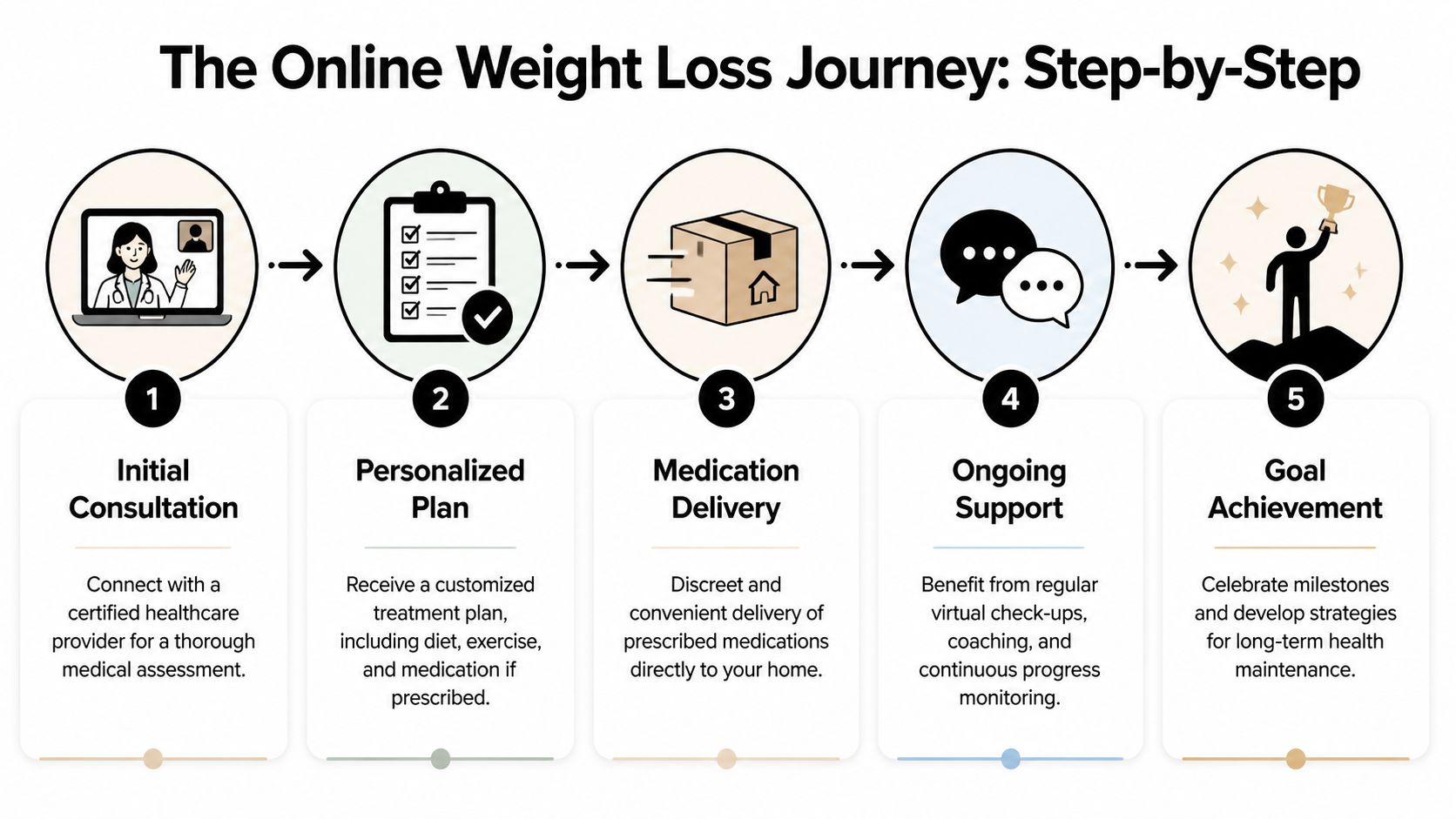
Step one involves more than clicking a button
The first step is usually an intake form or assessment. You share your health history, current medications, weight goals, past attempts, and any conditions that could affect treatment. A careful intake works like a triage desk in a clinic. It helps sort out who may be a good fit, who needs more evaluation, and who may need a different type of care.
If you are new to telehealth prescribing, this guide on how to get prescriptions online explains the basics in plain language.
This is also your first chance to judge the provider. If the form barely asks about your medical history and rushes you toward payment, that is a warning sign. Safe care starts with good questions.
The consult is where the plan becomes personal
Next comes the visit with a licensed clinician. This should feel less like a sales call and more like a thoughtful medical conversation. The clinician may ask how long weight has affected your health, what approaches you have already tried, what your daily routine looks like, and what concerns you have about medication, side effects, cost, or long-term use.
That conversation matters because weight care is not only about whether a prescription is available. It is about whether treatment fits your body, your health history, and your real life. A parent juggling shift work may need a different plan than someone with a steady schedule, frequent exercise, and no history of medication side effects.
A good visit leaves you clearer, not confused.
Your treatment plan should answer practical questions
After the consultation, an eligible patient may receive a care plan. That plan may include medication, eating guidance, movement goals, follow-up timing, and instructions for what to do if side effects show up. The details matter.
A strong plan should help you answer basic consumer questions. What is the starting dose? When could it change? How will progress be measured besides the scale? Who do you contact if nausea, constipation, or missed doses become a problem? Clear answers signal real care. Vague promises often signal a pill mill.
Follow-up is where quality becomes visible
The first prescription is only the beginning. Ongoing care is where you can tell whether a program is built for patient safety or quick transactions.
Good follow-up usually includes regular check-ins, symptom review, progress tracking, and dose adjustments when needed. It works like having a coach and a clinician watching the same map. If you are losing weight too quickly, struggling with side effects, or feeling no benefit at all, the plan should change before small problems become bigger ones.
That is the smart consumer test. Ask yourself whether the program has a clear system for monitoring, answering questions, and changing course.
Progress is rarely a straight line
Weight treatment often unfolds in uneven weeks, not perfect ones. Travel, stress, illness, holidays, appetite changes, and medication adjustments can all affect the pace. That does not mean the treatment has failed.
What matters is how the provider responds. Careful programs look for patterns, solve problems early, and adjust the plan without blaming the patient. That approach helps people stay engaged long enough to see whether the treatment is working for them.
The Real-World Effectiveness of Virtual Weight Care
A cautious reader should ask a simple question. Do online programs produce measurable results outside marketing copy?
The strongest answer comes from outcomes seen in routine care, where patients are living normal lives, missing perfect weeks, and working through treatment over time. That matters because online weight loss treatment should be judged the way a smart consumer would judge any health service. By asking whether it works in practice, whether people stay engaged, and whether the model supports long-term care rather than quick prescribing.

What happened over 12 months
One large retrospective cohort study followed 66,094 participants in a virtual weight care clinic. At 6 months, 54.1% had lost 5% or more of body weight. At 12 months, 64.2% had achieved clinically significant weight loss, with an average body weight reduction of 8%. By that point, 18.4% had reached 15% or greater loss, and 7.3% had reached 20% or more, according to the peer-reviewed study on virtual obesity care.
Those numbers are useful because they reflect care delivered in ordinary clinical settings, not only tightly controlled trials. The study also found a pattern that smart consumers should pay attention to. People who stayed more involved tended to do better. Participants who logged weight weekly lost 12.0% on average, and those engaging weekly lost 10.0% on average.
That does not mean patients are responsible for doing all the work alone. It means good online care works more like an ongoing feedback loop than a one-time purchase. The platform, clinician, and patient each have a role.
Another point often gets missed. In that same cohort, fewer than 10% used GLP-1 medications like semaglutide, yet overall outcomes were still strong. That suggests successful virtual care is not just a story about one popular drug. Program structure, follow-up, and behavior support still matter.
What happened over 18 to 24 months
Longer follow-up gives a better test of quality. Short-term weight loss can happen in many settings. Keeping progress going over a year or two is harder.
A retrospective observational study of 11,675 adults using anti-obesity medications through a U.S. telemedicine weight management clinic reported average total body weight reductions of -18.53% at 18 months and -20.27% at 24 months. Among 4,317 participants who maintained treatment for 24 months, results matched or exceeded clinical trial benchmarks, according to the 24-month telemedicine outcomes study.
The practical takeaway is straightforward. Better online programs are built for continuity. They are set up to monitor progress, adjust treatment, and help patients stay on course long enough to see whether the plan is working.
How to read these results like a smart consumer
Study results are not guarantees. They are more like a road test than a promise sticker. They show what can happen under a certain care model, with a certain level of follow-up and patient participation.
That is why outcomes should shape your questions, not end them.
Online care can work well. The format itself is not the problem if the clinical model is sound.
Time is part of the treatment. Serious weight care usually unfolds over months and often years.
Engagement changes outcomes. Regular tracking and follow-up are not extras. They are part of how treatment works.
Support adds value. Medication management paired with coaching or behavior support is different from receiving a prescription and being left alone.
If you want a concrete example of the kind of clinical transparency consumers should look for, review 10 Rx Home's provider information page. It shows the type of details that help you judge whether an online program operates like a clinic or like a checkout page.
One more smart-consumer point. Many online programs also mention supplements, but product quality can vary widely. If you are comparing add-ons or trying to verify ingredient standards, this resource for supplement transparency can help you ask better questions.
For readers who still wonder whether virtual care is somehow less substantial than office-based treatment, the stronger question is simpler. Is the program built to assess, monitor, adjust, and support you over time? When the answer is yes, online care can be a credible setting for serious obesity treatment.
How to Choose a Safe Provider and Spot Red Flags
The internet makes it easy to find weight loss offers. It does not make it easy to tell which ones deserve your trust. That’s why a smart consumer mindset matters as much as medical interest.

Green flags that suggest real care
The safest services usually share a recognizable pattern.
A real clinical assessment: They ask detailed health questions and require meaningful review before prescribing.
Licensed medical oversight: You can identify who is responsible for care and how follow-up works.
Clear medication sourcing: They explain where prescriptions are filled and how medications reach you.
Side-effect support: They don’t disappear once treatment starts.
Lifestyle guidance: They treat food, activity, sleep, and behavior as part of care, not an afterthought.
Transparent information: Pricing, services, limitations, and next steps are understandable before you commit.
If you want to check whether a platform is clear about who provides care, where services are offered, and how the model is structured, the 10 Rx Home provider information shows the kind of details consumers should look for.
Red flags that deserve immediate caution
Risky programs often rely on urgency, vagueness, or unrealistic promises.
No real consult: If you can buy a prescription-only treatment with almost no clinical review, step back.
Guaranteed results: Weight loss is variable. Promises of specific outcomes are a warning sign.
Murky sourcing: If it’s hard to tell who dispenses the medication, that’s a problem.
No plan for follow-up: A prescription without monitoring is not a full treatment program.
Aggressive sales language: “Miracle,” “instant,” and “secret” claims belong to marketing, not medicine.
Silence on side effects: If a provider barely mentions nausea, GI symptoms, or what happens if treatment doesn’t go smoothly, they may be minimizing risk.
Consumer check: The more a company sounds like a shortcut, the more carefully you should inspect it.
Two areas many shoppers overlook
The first is affordability. Insurance coverage and out-of-pocket costs can be complicated, and vague language from providers often leaves people guessing. A trustworthy service should explain the difference between the clinical program fee, the medication cost, pharmacy fulfillment, and any lab requirements in plain English.
The second is body composition and long-term planning. Some online programs talk constantly about weight lost but say very little about preserving muscle, managing side effects, or preparing for life after medication. That gap matters. If a provider can’t explain how they think about resistance training, protein intake, or transitions in care, ask more questions.
This is also where supplement quality enters the conversation. If a program recommends add-on products, it’s fair to ask about testing and quality controls. For readers who want a practical benchmark, this resource for supplement transparency explains what third-party testing means and why it matters.
Questions worth asking before you enroll
A short list of direct questions can reveal a lot:
Who reviews my medical history and prescribes treatment?
What happens if I have side effects or need a dose change?
How often are follow-ups, and through what channel?
How do you handle medication sourcing and refills?
What lifestyle support is included beyond the prescription?
What does the total cost include, and what might cost extra?
You’re not being difficult when you ask these. You’re acting like a patient, not a shopper. That distinction protects you.
Starting Your Journey with 10 Rx Home
By this point, the big picture is clearer. Online weight loss treatment can be legitimate, structured, and effective. It can also be shallow, rushed, or risky if the provider treats prescriptions like products instead of medical care.
The safest path is to think like an informed patient. Look for clinical review, licensed oversight, transparent processes, follow-up, and a plan that addresses real life. Be wary of anything that sounds effortless, secret, or guaranteed.
A good first step is usually simple. Start with an assessment. Share accurate information. Read the program details closely. Notice whether the service educates you or tries to rush you. The right program should make you feel more grounded, not more confused.
If you’ve struggled with traditional methods, that doesn’t mean you’re out of options. It may mean you need a form of care that’s easier to access and more responsive to your actual needs. Weight care works better when it becomes part of your life instead of competing with it.
The goal isn’t perfection. It’s a treatment plan you can stay with long enough to learn what your body responds to, what support helps, and what changes are realistic to maintain.
If you’re ready to explore a medically guided option from home, 10 Rx Home offers a free quiz that can help you understand your next step. It’s a simple way to begin with more clarity, ask better questions, and see whether a personalized telehealth plan fits your needs.