Your Guide to a Successful Weight Loss Treatment for PCOS
PCOS can make weight loss more challenging by affecting hormones, insulin sensitivity, appetite, and metabolism—but it doesn't make success impossible. The most effective treatment plans often combine balanced nutrition, regular movement, lifestyle changes, and, when appropriate, medical therapies tailored to your individual needs. With the right approach, even modest weight loss can lead to meaningful improvements in metabolic health and PCOS symptoms.
Find the right weight loss treatment for PCOS. This guide covers evidence-based diet, medication (GLP-1s), and lifestyle strategies to help you take control.

Your Guide to a Successful Weight Loss Treatment for PCOS
If you're reading this after another disappointing attempt to lose weight, you're not alone. Many people with PCOS do all the “right” things, eat carefully, exercise consistently, and still feel like their body is working against them.
That experience is real. And it doesn't mean you've failed.
PCOS changes how the body handles insulin, hunger signals, fat storage, and reproductive hormones. So a successful weight loss treatment for PCOS usually isn't about trying harder. It's about using the right combination of treatments for your biology, your symptoms, and your goals.
Your Journey to Effective PCOS Weight Management Starts Here
A common story goes like this. Someone starts a diet with a lot of motivation, loses little or nothing, and then blames herself. After a few rounds of that, hope gets smaller. Even doctor visits can feel discouraging if the only advice sounds like “just lose weight.”
What often gets missed is that PCOS is a medical condition with metabolic effects. That changes the conversation.
For overweight women with PCOS, a 2% to 5% reduction in total body weight can be enough to restore ovulation, reduce central fat, and improve insulin sensitivity. Around 5% weight loss is also associated with improved insulin sensitivity and lower androgen concentrations, which is why it's considered a meaningful treatment target rather than a cosmetic goal according to PCOS guideline evidence summarized in this trial record.
That matters because it gives you a different target. You don't need to chase a dramatic transformation to start seeing health benefits. Your first milestone can be clinically meaningful and achievable.
A better way to frame the goal
Instead of asking, “Why can't I lose all this weight?” try asking:
What treatment mix fits my body
What symptom matters most right now, such as irregular cycles, insulin resistance, acne, fertility, or energy
What support will help me stick with it
For many people, understanding the relationship between insulin, appetite, and hormone balance for PCOS weight makes the whole process feel less confusing and less personal.
You are not starting from a place of failure. You are starting from a place of better information.
If you've been stuck, it may help to begin with a structured medical pathway instead of another self-directed reset. A practical starting point is learning how online care works through this guide to getting started with 10Rx, especially if scheduling in-person specialty care has been a barrier.
Why It's So Hard to Lose Weight with PCOS
Trying to lose weight with PCOS can feel like rowing a boat against a strong current. You're moving, but the current keeps pushing back. The problem isn't effort alone. The problem is the biology underneath it.
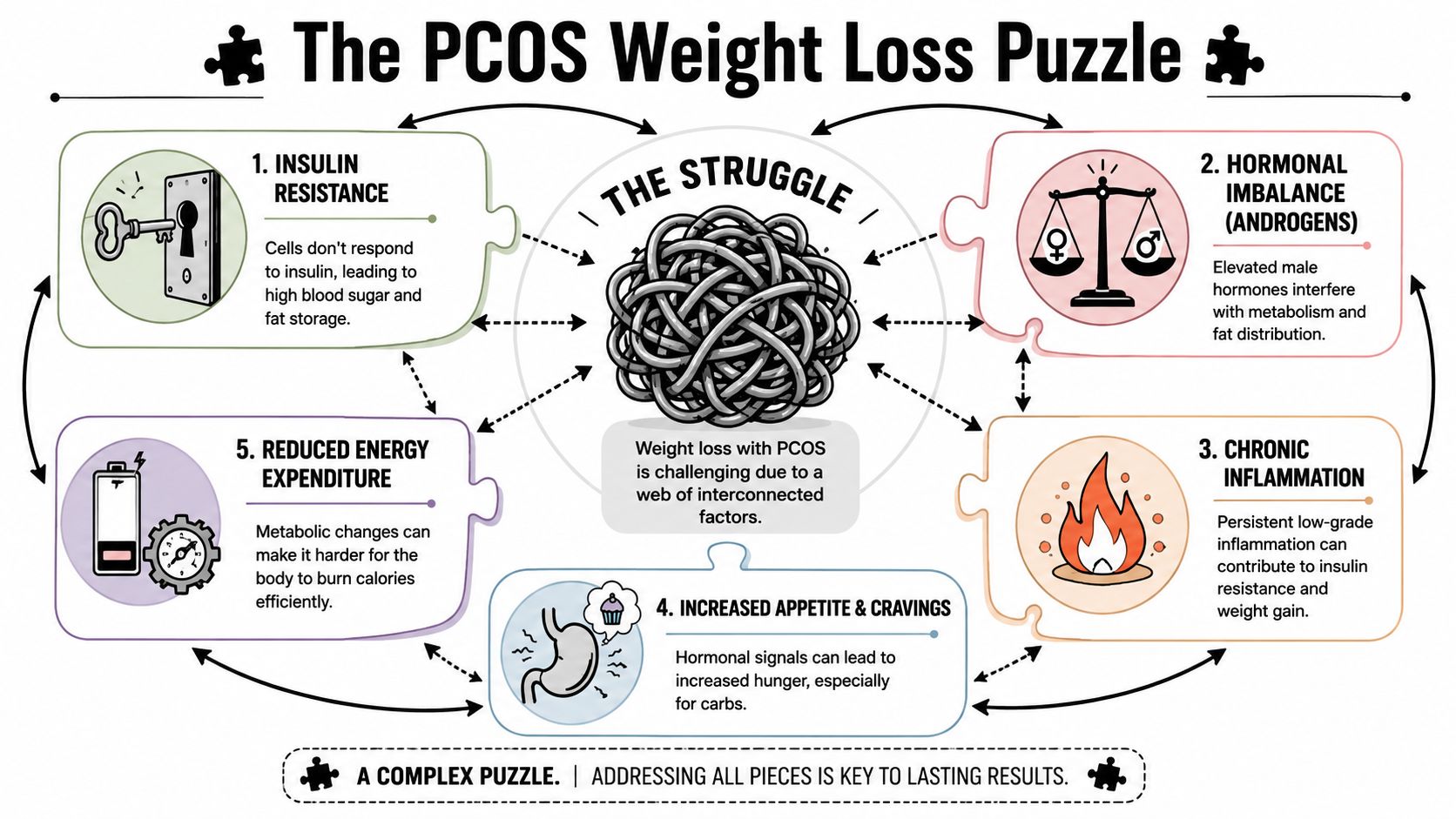
Insulin resistance changes the whole equation
In many people with PCOS, the body doesn't respond well to insulin. When that happens, the pancreas may produce more of it to compensate. Higher insulin levels can make fat storage easier and weight loss harder.
It can also increase hunger, especially for quick-energy foods. That doesn't mean cravings are “all in your head.” Sometimes they're part of the metabolic picture.
Androgens affect more than periods and hair growth
PCOS is also associated with higher androgen activity. These hormones are often discussed in terms of acne, unwanted hair growth, or scalp hair thinning, but they can also affect body composition and fat distribution.
That helps explain why some people notice more weight around the abdomen and feel like their metabolism has shifted. A broader explanation of how hormones interact with weight regulation can be helpful, and this overview from Axelrad Clinic on hormonal health gives useful context.
Inflammation and appetite signals add more noise
Another reason weight loss treatment for PCOS can feel unpredictable is that several systems interact at once. Low-grade inflammation, altered appetite signaling, sleep disruption, and fatigue can all make healthy routines harder to maintain.
This is why generic advice often falls flat. “Eat less and move more” skips over the fact that PCOS can affect:
Hunger regulation, making you feel less satisfied after meals
Energy levels, which can make exercise feel harder to start and recover from
Fat storage patterns, especially around the midsection
Cycle regularity, which can change motivation and symptoms throughout the month
Practical rule: When a body is dealing with insulin resistance and hormonal imbalance, treatment needs to target the current, not just the rowing.
A helpful reframe is this. Your body isn't broken. It's responding to a set of signals. Once you understand those signals, your strategy gets much more precise.
Building Your PCOS-Friendly Lifestyle Plan
You might start a week feeling motivated, prep healthy meals, fit in a few workouts, and still watch the scale barely change. That can feel discouraging. With PCOS, though, a lifestyle plan works more like adjusting several dials at once than flipping a single switch. The goal is to build a routine that fits your biology, lowers friction, and gives your treatment plan something solid to stand on.

Build meals that steady blood sugar
Food choices can change how hungry, energized, and satisfied you feel across the day. For many women with PCOS, the most useful eating pattern centers on protein, fiber, and less processed carbs because those meals tend to digest more slowly and create fewer blood sugar spikes.
A simple way to picture it is this. Protein and fiber act like brakes on a fast-moving meal. They slow things down, help you stay full longer, and make it easier to avoid the cycle of crashing, craving, and grazing.
Try building meals around a few repeatable combinations:
Protein plus fiber first. Eggs with vegetables, Greek yogurt with seeds, tofu stir-fry, or chicken with beans and roasted vegetables.
Carbs with support. Pair fruit, oats, rice, or potatoes with protein or fat so the meal feels steadier and more filling.
Meals you can repeat on busy days. Boring is sometimes useful. A dependable breakfast or lunch can reduce decision fatigue and late-day overeating.
If you need simple ways to raise protein intake, this ultimate guide to low carb protein offers practical examples that can be adapted to different preferences.
Structure often works better than restriction
Many people ask whether they need to count every calorie. Some do well with tracking. Others burn out quickly and end up feeling more stressed around food.
A better question is whether your eating pattern gives your body a predictable rhythm. Regular meals, fewer high-sugar snack cycles, and a consistent plan for busy days can matter as much as perfect logging.
Research has also started to examine meal timing in PCOS. In a 2023 study, researchers reported that an eight-hour time-restricted eating pattern was associated with improvements in weight, insulin resistance, and hyperandrogenism in women with PCOS, as summarized in this report from Endocrine Society on time-restricted eating and PCOS.
That does not mean everyone should eat in the same window. It means some bodies respond well to structure. If a schedule makes you obsess about food, feel weak, or overeat later, it may not be the right tool for you.
A good nutrition plan should make daily life easier to manage, not harder.
Choose movement that your body can recover from
Exercise helps, but the best type is the kind you can recover from and repeat. PCOS-friendly movement usually works best when it improves insulin sensitivity, preserves muscle, and does not leave you exhausted for two days.
A balanced week often includes:
Focus | Why it helps |
|---|---|
Strength training | Builds or preserves lean mass, which supports metabolic health |
Walking | Gentle daily movement can help with blood sugar control and stress |
Restorative work | Stretching, yoga, or mobility sessions can support recovery and consistency |
Your response matters. Some women feel great with intervals or intense classes. Others notice more hunger, poor sleep, or burnout when every workout is hard. That feedback is useful clinical information, not a lack of discipline.
Lifestyle treatment can still be challenging to sustain, which is why rigid plans often fall apart. For many patients, a written routine with meals, movement, sleep goals, and backup options works better than relying on motivation alone. These wellness plan examples show what a realistic structure can look like.
The right lifestyle plan is personal. For one woman, that may mean higher protein breakfasts and three strength sessions a week. For another, it may mean walking after dinner, a consistent lunch, and telemedicine support to fine-tune nutrition and medications together. That is the core idea with PCOS weight care. You are not trying harder. You are finding the combination that fits your biology.
Exploring Medical Treatments for PCOS Weight Loss
When lifestyle changes help but don't move the needle enough, medical treatment becomes a reasonable next step. This isn't “giving up” on natural methods. It's responding to a medical condition with medical tools.
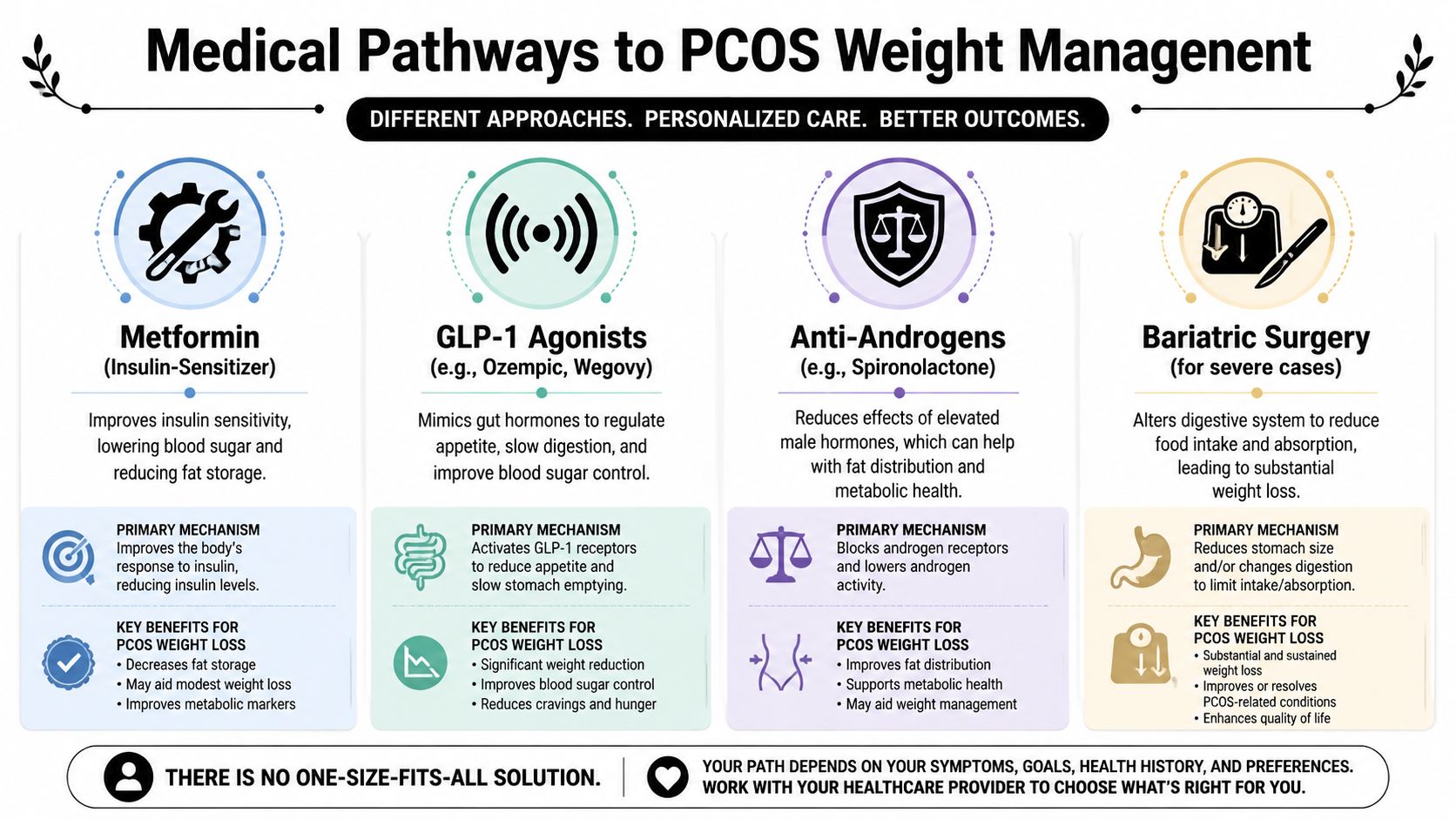
Metformin and newer GLP-1 options work differently
Metformin is commonly used to improve insulin sensitivity. For some people with PCOS, that can support better blood sugar control and modest weight benefit, especially when insulin resistance is a major driver.
GLP-1 medications such as Semaglutide work through a different pathway. They can affect appetite, fullness, gastric emptying, and blood sugar regulation. In practice, that means they may help people who feel constantly hungry or who struggle to sustain a calorie deficit despite good habits.
What the comparison shows
Recent clinical trials have shown that newer prescription agents such as Semaglutide can achieve weight loss outcomes exceeding 10% in obese women with PCOS. A key trial comparing Semaglutide to Metformin reported that Semaglutide-treated subjects achieved a significant weight loss of greater than 10% compared with the placebo group, based on the clinical trial record for this PCOS medication study.
That degree of weight loss matters clinically, not just visually. It can influence reproductive and metabolic outcomes in ways that smaller changes sometimes don't.
Choosing the right medical path
Medication decisions depend on your symptoms, goals, medical history, and tolerance for side effects. A simple comparison can help:
Option | Main role in PCOS care | Best suited for |
|---|---|---|
Metformin | Improves insulin sensitivity | People with clear insulin resistance features |
GLP-1 medication | Targets appetite regulation and metabolic control | People who need more weight loss support or struggle with hunger |
Anti-androgen treatment | Helps address symptoms linked to androgen excess | People focused on acne, hirsutism, or related concerns |
Not everyone needs medication. But many people do better once treatment matches the biology driving their symptoms.
If you're trying to understand the pros and cons of prescription options, this guide to the best weight loss medication for women can help you organize questions for a clinician. One telemedicine option people may consider is 10 Rx Home, which connects patients with board-certified physicians for personalized treatment plans that may include prescription weight-loss medications when appropriate.
Medication isn't a shortcut. For many patients with PCOS, it's the missing piece that finally makes the rest of the plan work.
Advanced Options When Diet and Medication Aren't Enough
Some people do everything thoughtfully and still remain stuck. When that happens, it's worth discussing whether the issue is no longer motivation, but treatment intensity.
For the right candidate, bariatric surgery is a metabolic intervention, not a moral verdict. It can change appetite signaling, improve insulin-related dysfunction, and produce more durable weight loss than low-calorie diets in some people with PCOS.
When a higher level of care makes sense
You might talk with a specialist about advanced treatment if:
Weight-related health risks are rising, including worsening metabolic concerns
PCOS symptoms remain severe despite consistent lifestyle work and appropriate medication trials
Fertility goals are time-sensitive, and the current approach isn't creating enough improvement
Quality of life has narrowed, with fatigue, cycle disruption, or body changes affecting daily function
Major clinical sources acknowledge that while a 5% weight loss can improve PCOS symptoms, bariatric surgery can produce more prolonged and significant weight loss than low-calorie diets, with academic reviews emphasizing its role in the additive risks of obesity plus PCOS according to this discussion of weight-loss surgery and PCOS.
Surgery is a treatment decision, not a personal failure
People often wait too long to ask about surgery because they see it as a last resort. That framing can create shame and delay useful care.
A better question is whether surgery fits your medical picture and your long-term goals. If it does, learning about it is responsible healthcare. It doesn't commit you to anything.
Some bodies need stronger tools. Using them is not weakness. It's appropriate treatment.
The most important step is evaluation by clinicians who understand both obesity medicine and PCOS. The decision should consider fertility plans, nutritional follow-up, medication history, and your readiness for long-term care after surgery.
Get a Personalized PCOS Treatment Plan with Telemedicine
You start strong. You clean up meals, try to move more, maybe even lose a little weight, and then your body seems to push back. Appointments are hard to schedule, questions pile up between visits, and it becomes easy to wonder whether you are doing something wrong.
With PCOS, that cycle often reflects biology, not a lack of effort. Many people need a treatment plan that combines several tools and then adjusts them over time. Telemedicine can support that kind of care by making follow-up easier and more consistent.

Why remote care fits PCOS so well
PCOS usually does not respond to a single visit and a generic handout. It behaves more like a puzzle. One piece may be insulin resistance, another may be appetite regulation, another may be sleep, stress, or medication side effects. The plan works better when someone helps you keep fitting those pieces together as your body responds.
Remote care makes that process more practical. You can check in with a clinician, review symptoms, talk through side effects, and adjust treatment without repeated travel or long gaps between visits. As noted earlier, even modest weight loss can improve PCOS symptoms, but many people need more support than advice alone to stay with a plan and see meaningful progress.
What a personalized plan can include
A telemedicine plan for PCOS weight management may include:
A detailed history and symptom review so treatment matches your cycles, lab pattern, weight history, and goals
Lifestyle coaching that works with your real schedule, food preferences, budget, and energy level
Medication assessment if insulin resistance, appetite, or stalled progress suggest your body needs added medical support
Regular follow-up visits so the plan can change when your symptoms, priorities, or response to treatment change
That ongoing adjustment matters. PCOS treatment often works less like flipping a switch and more like tuning a thermostat. Small changes, made at the right time, can improve how the whole system functions.
If you want a clearer picture of how remote support works in practice, this guide to achieving your goals with weight loss telemedicine explains what that care can look like.
PCOS can make weight loss slower and more medically complex. Improvement is still possible. The goal is to find the right combination of strategies for your biology, with a clinician who treats PCOS as a medical condition that deserves a medical plan.
If you're ready for a more personalized approach, 10 Rx Home offers a telemedicine pathway for people who want structured weight-loss care with physician guidance. You can start with a simple assessment, review your options with a licensed clinician, and build a plan that fits your symptoms, goals, and daily life.