GLP-1’s at low prices with free shipping. Get Started


" transform="translate(53.5 27.5)" width="0px"/><g d="M 164.013 0 C 206.437 0 240.828 33.597 240.828 75.04 C 240.828 116.484 206.437 150.08 164.013 150.08 C 121.589 150.08 87.198 116.484 87.198 75.04 C 87.198 33.597 121.589 0 164.013 0 Z M 164.52 30.422 C 140.298 30.422 120.662 50.398 120.662 75.04 C 120.662 99.682 140.298 119.659 164.52 119.659 C 188.742 119.659 208.377 99.682 208.377 75.04 C 208.377 50.398 188.742 30.422 164.52 30.422 Z M 49.689 117.004 L 49.724 117.026 C 50.148 121.056 54.397 124.222 59.576 124.222 C 60.05 124.222 60.516 124.195 60.973 124.143 L 61.097 124.222 L 83.406 120.926 C 83.406 120.926 73.956 127.316 67.688 131.067 C 60.617 135.299 49.689 141.207 49.689 141.207 C 49.689 141.207 39.295 147.961 27.633 149.827 C 27.576 149.836 27.52 149.844 27.463 149.853 C 26.591 150.023 25.702 150.098 24.814 150.077 C 24.739 150.079 24.665 150.08 24.591 150.08 L 24.577 150.069 C 19.359 149.854 15.211 146.423 15.211 142.221 L 15.211 29.154 C 15.211 28.755 15.022 28.379 14.702 28.139 C 14.383 27.9 13.968 27.826 13.585 27.939 L 0 29.915 L 35.746 8.366 L 49.689 0 Z M 260.136 98.048 C 260.234 98.048 260.33 98.052 260.427 98.058 L 287.219 98.517 L 287.219 98.612 C 295.722 98.712 302.586 105.638 302.586 114.166 C 302.586 121.454 297.574 127.571 290.811 129.259 L 304.648 146.964 L 304.644 146.964 C 304.889 147.252 305.023 147.617 305.023 147.995 C 305.023 148.839 304.365 149.536 303.523 149.585 L 303.523 149.588 L 291.341 149.588 L 291.341 149.582 C 289.373 149.504 287.613 148.618 286.384 147.245 L 286.374 147.245 L 286.328 147.182 C 286.064 146.88 285.827 146.557 285.619 146.215 L 273.443 129.628 L 273.463 129.625 C 272.779 128.705 272.41 127.589 272.412 126.442 C 272.412 123.684 274.502 121.414 277.187 121.13 L 277.191 121.101 L 281.783 120.351 L 281.783 120.348 C 285.214 120.264 287.968 117.864 287.968 114.916 C 287.968 111.968 285.214 109.568 281.783 109.483 L 281.783 109.481 L 270.538 109.481 L 270.538 146.777 L 270.536 146.777 C 270.538 146.808 270.538 146.839 270.538 146.871 C 270.538 148.34 269.371 149.537 267.913 149.586 L 267.913 149.588 L 258.168 149.588 L 258.168 149.573 C 256.799 149.433 255.731 148.277 255.731 146.871 C 255.731 146.839 255.733 146.808 255.733 146.777 L 255.731 146.777 L 255.731 102.359 L 255.733 102.359 C 255.781 100.064 257.585 98.201 259.856 98.058 L 259.856 98.048 L 259.998 98.051 C 260.044 98.049 260.09 98.048 260.136 98.048 Z M 324.515 110.615 C 326.064 110.719 327.396 111.676 328.101 113.049 L 332.884 119.45 L 338.302 112.809 C 339.033 111.565 340.298 110.713 341.756 110.615 L 341.756 110.605 L 352.44 110.605 C 353.577 110.605 354.5 111.528 354.5 112.667 C 354.5 113.003 354.42 113.321 354.276 113.601 L 354.314 113.604 L 354.176 113.776 C 354.1 113.896 354.011 114.008 353.912 114.109 L 342.693 128.222 C 342.693 128.222 342.413 128.627 342.413 128.972 C 342.413 129.318 342.693 129.722 342.693 129.722 L 355.241 146.116 C 355.722 146.507 356 147.094 356 147.714 C 356 148.852 355.077 149.775 353.938 149.775 C 353.876 149.775 353.814 149.772 353.751 149.766 L 353.751 149.775 L 341.756 149.775 L 341.756 149.749 C 340.252 149.58 338.973 148.605 338.31 147.237 L 333.228 140.405 C 333.228 140.405 333.042 140.217 332.76 140.217 C 332.48 140.217 332.291 140.405 332.291 140.405 L 332.289 140.402 L 327.078 147.492 C 326.891 147.825 326.664 148.134 326.401 148.411 L 326.295 148.557 L 326.263 148.553 C 325.588 149.207 324.723 149.641 323.764 149.749 L 323.764 149.775 L 312.331 149.775 C 311.194 149.775 310.271 148.852 310.271 147.714 C 310.271 147.02 310.613 146.407 311.138 146.033 L 323.015 130.659 C 323.015 130.659 323.295 130.255 323.295 129.909 C 323.295 129.564 323.015 129.16 323.015 129.16 L 311.458 114.146 C 311.058 113.758 310.833 113.224 310.833 112.667 C 310.833 111.528 311.756 110.605 312.894 110.605 L 324.515 110.605 Z" fill="transparent" height="150.08043079668755px" id="HpkDSJwpk" transform="translate(0 1)" width="356.0000118682049px"><path d="M 76.815 0 C 119.239 0 153.63 33.597 153.63 75.04 C 153.63 116.484 119.239 150.08 76.815 150.08 C 34.391 150.08 0 116.484 0 75.04 C 0 33.597 34.391 0 76.815 0 Z M 77.322 30.422 C 53.1 30.422 33.464 50.398 33.464 75.04 C 33.464 99.682 53.1 119.659 77.322 119.659 C 101.544 119.659 121.179 99.682 121.179 75.04 C 121.179 50.398 101.544 30.422 77.322 30.422 Z" fill="rgb(8, 9, 35)" height="150.08043079668755px" id="kvrqFybmK" transform="translate(87.198 0)" width="153.62981889920286px"/><path d="M 49.689 117.004 L 49.724 117.026 C 50.148 121.056 54.397 124.222 59.576 124.222 C 60.05 124.222 60.516 124.195 60.973 124.143 L 61.097 124.222 L 83.406 120.926 C 83.406 120.926 73.956 127.316 67.688 131.067 C 60.617 135.299 49.689 141.207 49.689 141.207 C 49.689 141.207 39.295 147.961 27.633 149.827 C 27.576 149.836 27.52 149.844 27.463 149.853 C 26.591 150.023 25.702 150.098 24.814 150.077 C 24.739 150.079 24.665 150.08 24.591 150.08 L 24.577 150.069 C 19.359 149.854 15.211 146.423 15.211 142.221 L 15.211 29.154 C 15.211 28.755 15.022 28.379 14.702 28.139 C 14.383 27.9 13.968 27.826 13.585 27.939 L 0 29.915 L 35.746 8.366 L 49.689 0 Z M 260.136 98.048 C 260.234 98.048 260.33 98.052 260.427 98.058 L 287.219 98.517 L 287.219 98.612 C 295.722 98.712 302.586 105.638 302.586 114.166 C 302.586 121.454 297.574 127.571 290.811 129.259 L 304.648 146.964 L 304.644 146.964 C 304.889 147.252 305.023 147.617 305.023 147.995 C 305.023 148.839 304.365 149.536 303.523 149.585 L 303.523 149.588 L 291.341 149.588 L 291.341 149.582 C 289.373 149.504 287.613 148.618 286.384 147.245 L 286.374 147.245 L 286.328 147.182 C 286.064 146.88 285.827 146.557 285.619 146.215 L 273.443 129.628 L 273.463 129.625 C 272.779 128.705 272.41 127.589 272.412 126.442 C 272.412 123.684 274.502 121.414 277.187 121.13 L 277.191 121.101 L 281.783 120.351 L 281.783 120.348 C 285.214 120.264 287.968 117.864 287.968 114.916 C 287.968 111.968 285.214 109.568 281.783 109.483 L 281.783 109.481 L 270.538 109.481 L 270.538 146.777 L 270.536 146.777 C 270.538 146.808 270.538 146.839 270.538 146.871 C 270.538 148.34 269.371 149.537 267.913 149.586 L 267.913 149.588 L 258.168 149.588 L 258.168 149.573 C 256.799 149.433 255.731 148.277 255.731 146.871 C 255.731 146.839 255.733 146.808 255.733 146.777 L 255.731 146.777 L 255.731 102.359 L 255.733 102.359 C 255.781 100.064 257.585 98.201 259.856 98.058 L 259.856 98.048 L 259.998 98.051 C 260.044 98.049 260.09 98.048 260.136 98.048 Z M 324.515 110.615 C 326.064 110.719 327.396 111.676 328.101 113.049 L 332.884 119.45 L 338.302 112.809 C 339.033 111.565 340.298 110.713 341.756 110.615 L 341.756 110.605 L 352.44 110.605 C 353.577 110.605 354.5 111.528 354.5 112.667 C 354.5 113.003 354.42 113.321 354.276 113.601 L 354.314 113.604 L 354.176 113.776 C 354.1 113.896 354.011 114.008 353.912 114.109 L 342.693 128.222 C 342.693 128.222 342.413 128.627 342.413 128.972 C 342.413 129.318 342.693 129.722 342.693 129.722 L 355.241 146.116 C 355.722 146.507 356 147.094 356 147.714 C 356 148.852 355.077 149.775 353.938 149.775 C 353.876 149.775 353.814 149.772 353.751 149.766 L 353.751 149.775 L 341.756 149.775 L 341.756 149.749 C 340.252 149.58 338.973 148.605 338.31 147.237 L 333.228 140.405 C 333.228 140.405 333.042 140.217 332.76 140.217 C 332.48 140.217 332.291 140.405 332.291 140.405 L 332.289 140.402 L 327.078 147.492 C 326.891 147.825 326.664 148.134 326.401 148.411 L 326.295 148.557 L 326.263 148.553 C 325.588 149.207 324.723 149.641 323.764 149.749 L 323.764 149.775 L 312.331 149.775 C 311.194 149.775 310.271 148.852 310.271 147.714 C 310.271 147.02 310.613 146.407 311.138 146.033 L 323.015 130.659 C 323.015 130.659 323.295 130.255 323.295 129.909 C 323.295 129.564 323.015 129.16 323.015 129.16 L 311.458 114.146 C 311.058 113.758 310.833 113.224 310.833 112.667 C 310.833 111.528 311.756 110.605 312.894 110.605 L 324.515 110.605 Z" fill="rgb(8, 9, 35)" height="150.08043079668755px" id="kdERGws7a" width="356.0000118682049px"/></g></svg>)
What medicine should you not take with wegovy: Key interactions to discuss
Wegovy can interact with certain medications, especially other GLP-1 drugs, diabetes treatments like insulin or sulfonylureas, and some oral medications that rely on consistent absorption. Because Wegovy slows stomach emptying and can lower blood sugar, it’s important to review your full medication list with your provider before starting. A personalized plan helps ensure your treatment is both safe and effective.
Discover what medicine should you not take with wegovy and learn essential interactions to discuss with your doctor for safer weight loss.

What medicine should you not take with wegovy: Key interactions to discuss
Taking the first step on your Wegovy journey is a moment filled with hope and possibility. But to make that journey a truly successful one, safety has to be your co-pilot. Understanding how this powerful medication works is only half the battle; the other half is knowing which other medicines don't play well with it.
If you’re currently taking diabetes medications like insulin or sulfonylureas, for instance, your risk of low blood sugar (hypoglycemia) can increase significantly when you add Wegovy to the mix. It's also critical to know that you should never take Wegovy with other GLP-1 medications like Ozempic or Rybelsus.
Think of this as your personal safety briefing. We're here to give you the clear, straightforward information you need to feel confident and prepared.
Your Wegovy Journey Begins With Safety First
Deciding to start Wegovy is a big, positive step towards taking charge of your health. It’s a commitment to yourself. To honor that commitment, it's essential to understand how Wegovy interacts not just with your body, but with other medications you might be taking. This isn't about creating fear; it's about building confidence through knowledge.
Our goal here is simple: to translate the complex medical information into practical advice you can actually use. We want you to walk into your next conversation with your doctor—whether it's in an office or through a telehealth service—feeling empowered and ready to be an active partner in your own care.
Quick Guide to Potential Wegovy Drug Interactions
Let's get right to it. Here’s a quick-glance table of the most common medications that need special attention when you're on Wegovy. We’ll dive deeper into these, but this is a great starting point for your discussion with your healthcare provider.
Medication Class | Potential Risk | Recommended Action |
|---|---|---|
Other GLP-1 Agonists (e.g., Ozempic, Rybelsus) | Duplicate therapy that dramatically increases side effects. | Strictly avoid taking these at the same time. Wegovy should be your only GLP-1 medication. |
Insulin & Secretagogues (e.g., sulfonylureas) | A significantly higher risk of severe hypoglycemia (low blood sugar). | Your doctor will almost certainly need to reduce your dose and will require you to monitor your blood sugar. |
Oral Medications (e.g., birth control, antibiotics) | Wegovy slows stomach emptying, which can delay absorption and effectiveness. | Talk to your provider about timing. For some critical drugs, they may suggest a non-oral alternative. |
This table is a guide, not a substitute for professional medical advice. Every person's health profile is different, and your treatment plan needs to reflect that.
The single most important rule is this: Never start, stop, or change a medication dose without talking to your doctor first. Your health journey is unique, and a personalized plan is the only way to ensure it's a safe one.
Feeling secure in your treatment is the bedrock of lasting success. By asking the right questions and staying informed, you're doing more than just managing your weight—you're owning your health story. To see how we prioritize this in every step of our process, you can learn more about our commitment to patient safety here.
How Wegovy Interacts With Your Body
Before we dive into which specific medicines to watch out for, it's incredibly helpful to understand what Wegovy is actually doing inside your body. It’s not just about what it adds, but how it changes the whole environment.
Imagine your stomach is a bustling sorting center for a courier service. Normally, everything you eat and any oral medications you take are processed and sent along their way at a predictable pace. Wegovy steps in and, a bit like a new manager, slows the entire operation down.
This effect has a name: delayed gastric emptying. It simply means food and pills hang out in your stomach for longer before moving on to the intestines where they get absorbed. This is a big part of why Wegovy is so effective for weight loss—it helps you feel full and satisfied for much longer. But, and this is the important part, it also creates a ripple effect for any other medications you take by mouth.
The Slowdown Effect on Oral Medications
When the packages in that stomach sorting center are delayed, their delivery schedules get thrown off. This can be a real issue for medicines that need to be absorbed quickly to work properly. It's especially concerning for drugs with a narrow therapeutic window, where even a tiny shift in absorption can make the medicine either ineffective or, on the flip side, too strong.
The FDA has officially noted that Wegovy's impact on gastric emptying can mess with the absorption of other oral drugs. A perfect example is oral birth control. If its absorption is reduced—and you add in common side effects like vomiting or diarrhea—its effectiveness could be compromised. This isn't something to take lightly.
This diagram gives a great visual overview of the main safety checkpoints to keep in mind when you're on Wegovy.
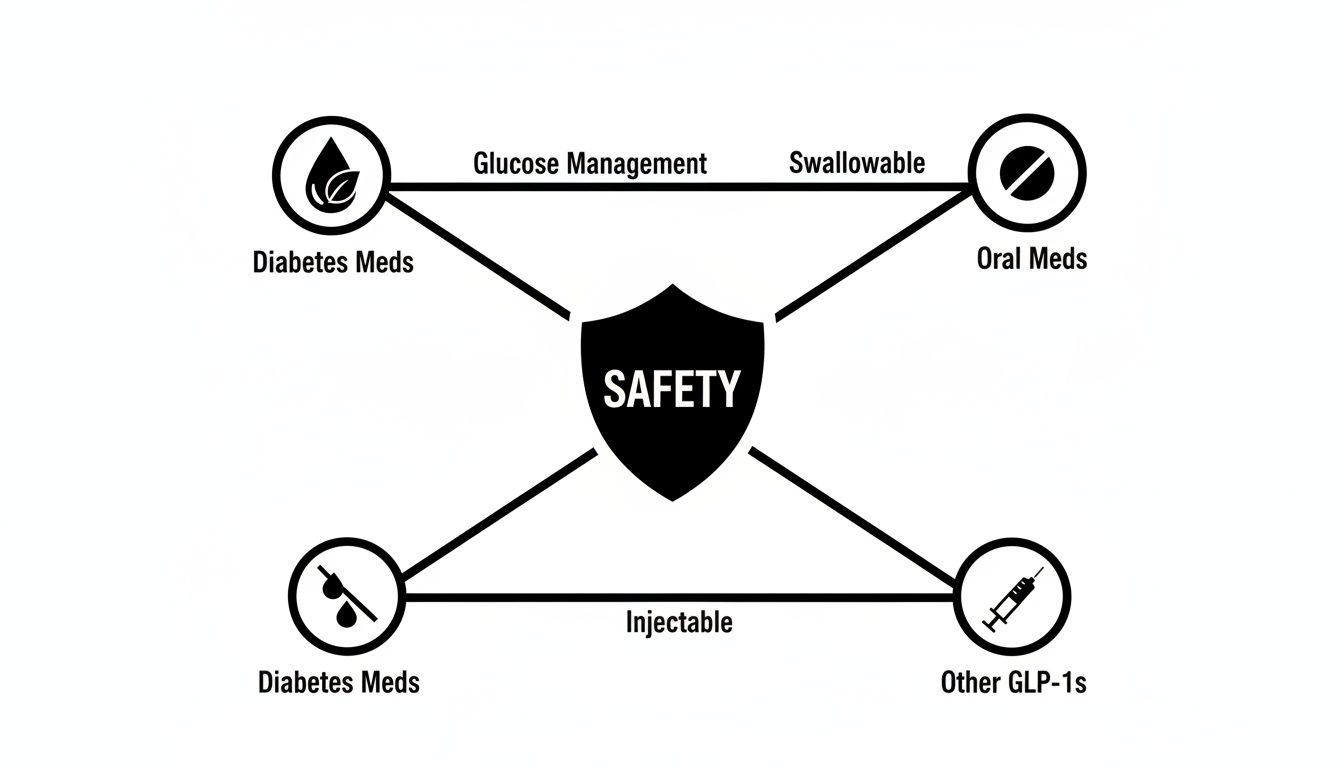
As you can see, the big picture involves being mindful of diabetes medications, really all oral meds, and other drugs in the same family as Wegovy.
The Role of GLP-1 Receptor Agonists
Beyond just slowing down your digestion, Wegovy works by mimicking a hormone your body already makes called glucagon-like peptide-1 (GLP-1). This natural hormone is a key player in managing your appetite and blood sugar. Wegovy is what's known as a GLP-1 receptor agonist—it latches onto the same receptors as your body’s own GLP-1, but its effect is much more powerful and lasts a whole lot longer.
This powerful action is exactly why you absolutely cannot combine Wegovy with other medications from the same GLP-1 class. It's a major safety red flag.
Think of it this way: you're following a recipe that calls for one teaspoon of salt. If you add two full cups instead, you don’t just get a slightly saltier dish—you get something completely inedible and overwhelming. Taking multiple GLP-1 drugs at once does something similar to your body, flooding your system and dramatically increasing the risk of severe side effects.
Getting familiar with the common side effects of GLP-1 medications like Ozempic (which uses the same active ingredient) can give you a solid foundation for understanding what to watch for. If you're looking for a deeper dive, our guide on semaglutide injection and how it works is a great resource. Having this background knowledge will make our next discussion on specific drug interactions much clearer.
Critical Interactions With Diabetes And Heart Medications
Starting Wegovy is a big step toward taking control of your health. A huge part of that process is making sure it plays well with any other medications you’re taking, especially for conditions like diabetes or heart disease. Wegovy is fantastic at lowering blood sugar, but that very strength can create a serious risk if it’s combined with other drugs that have the same goal.
Imagine you and a friend are carrying a heavy box down a set of stairs. As long as you communicate and move in sync, you’ll get it down safely. But what if your friend suddenly drops their end without warning? The box comes crashing down. That’s a good way to think about what can happen to your blood sugar when you mix Wegovy with certain diabetes medications.
The number one concern here is hypoglycemia—in other words, dangerously low blood sugar. This risk is highest when you’re also taking insulin or a class of drugs known as insulin secretagogues. This group includes common medications like sulfonylureas (think glipizide, glyburide, and glimepiride).

The Dangers Of Low Blood Sugar
Hypoglycemia isn't something to take lightly; it can become a medical emergency if it isn't managed fast. Being able to spot the warning signs is one of the most important things you can do to stay safe.
You'll want to watch for common signs of low blood sugar, which can include:
Feeling shaky or starting to tremble
A sudden wave of anxiety or irritability
Sweating, clamminess, and chills
Feeling dizzy or lightheaded
A pounding or racing heartbeat
Intense, sudden hunger
Confusion or finding it hard to focus
If you start feeling any of these, the first step is to check your blood sugar. Then, you'll need to eat or drink a fast-acting source of sugar, like a small glass of juice, some glucose tablets, or even a few pieces of hard candy. Your doctor will walk you through exactly how to handle these moments.
The clinical trial data backs up this need for vigilance. The evidence clearly shows that combining Wegovy with insulin or sulfonylureas increases the odds of a low blood sugar event. For example, in studies, the 2.4 mg dose of Wegovy was linked to clinically significant hypoglycemic episodes at a rate of 10.7 per 100 patient-years. For patients on a placebo, that rate was just 3.2 episodes.
Your Doctor's Role In Safe Dosing
This is precisely why your doctor will want to take a close look at your medication plan and make some adjustments. It’s a standard, and absolutely essential, safety protocol.
Before you even begin Wegovy, your provider will almost certainly lower the dose of your insulin or sulfonylurea. This isn't a guess—it's a proactive, deliberate move to prevent your blood sugar from dipping too low as the Wegovy starts doing its job.
This is where teamwork comes in. Constant, open communication with your doctor and pharmacist is non-negotiable. They'll tell you how often to monitor your blood sugar, especially as you're getting started or increasing your Wegovy dose. This gives them the data they need to get your medication balance just right—effective, but safe.
If you’re interested in learning more about how these types of medications work, we explain the science behind a similar GLP-1 drug in our guide on how Rybelsus works.
Blood Pressure Medications And Added Caution
While diabetes drugs are the main area of concern, it’s worth noting that some blood pressure medications can also complicate things. Specifically, drugs like ACE inhibitors (e.g., lisinopril) and ARBs (e.g., losartan) have been known to sometimes increase the risk of hypoglycemia on their own.
When you throw Wegovy into that mix, the potential for low blood sugar can become even greater. Your doctor will consider every single medication you're on, from hypertension drugs to kidney protectors, to build a plan that works safely for you.
Ultimately, you are your own best advocate. By understanding which medicines require a second look when taking Wegovy and working as a team with your provider, you can navigate these interactions with confidence and stay focused on the incredible health journey ahead.
The Rule Of One: Never Mix GLP-1 Medications
When you start your journey with Wegovy, there's one rule so fundamental that it stands above the rest: Wegovy is meant to be the only GLP-1 medication you take. Think of this as the "Rule of One." Sticking to it isn't just a suggestion—it's absolutely critical for your safety.
Trying to combine Wegovy with another medication from the same family is like having two different coaches shouting conflicting plays at a quarterback. The result isn't a better game; it's confusion, fumbles, and a team that falls apart. This is precisely what can happen to your body when you double up on GLP-1 receptor agonists.
Why Stacking These Medications Is a Bad Idea
GLP-1 medications, at their core, all speak the same biological language. They latch onto the same receptors in your body to slow down your digestion, help regulate blood sugar, and quiet the "I'm hungry" signals from your brain. Because they all use the exact same playbook, taking more than one at a time doesn't give you extra benefits. It just dramatically dials up the risks.
Be aware of these other common GLP-1 medications:
Semaglutide (the active ingredient in Ozempic and Rybelsus)
Liraglutide (found in Saxenda and Victoza)
Dulaglutide (the active ingredient in Trulicity)
Tirzepatide (found in Mounjaro and Zepbound, which acts on both GLP-1 and GIP receptors)
Combining Wegovy with any of these can unleash a storm of gastrointestinal side effects. Nausea, vomiting, and diarrhea can quickly go from manageable to severe, putting you at risk for dehydration and other serious health issues. To get a better sense of how these powerful medications differ, you can read our detailed comparison of tirzepatide and semaglutide.
A Clear Warning You Can't Ignore
This isn't just friendly advice; it's a direct safety warning from the drug manufacturers themselves. Clinical trials have consistently shown that significant gastrointestinal problems and negative interactions with other GLP-1 drugs are major safety concerns. They are crystal clear: Wegovy should not be used with another GLP-1 receptor agonist because the risk is simply too high.
This is why having a complete review of all your current medications is a non-negotiable first step, especially with easy-to-use platforms like 10 Rx Home that can help facilitate these conversations with a provider.
The bottom line is this: Wegovy is a powerful, complete therapy all on its own. It was designed to give you the full therapeutic effect you need for weight management without any "help" from a similar drug. Adding another GLP-1 only puts your system under dangerous, unnecessary stress.
If you are already taking another GLP-1 medication for weight loss or diabetes, you absolutely must talk to your doctor before even thinking about starting Wegovy. Your doctor will work with you to safely stop the other medication and map out a treatment plan where Wegovy is your sole GLP-1 therapy. Your health is the top priority, and following this "Rule of One" is a cornerstone of a safe and successful journey.
Your Health History: The Ultimate Safety Check for Wegovy
While we’ve covered how Wegovy interacts with other medications, there’s an even more fundamental topic we need to discuss: your personal and family health history. Certain medical conditions are what we call absolute contraindications. Think of this as a non-negotiable "stop sign"—it means Wegovy is simply not a safe option because the potential risks are too great.
This is why a deep dive into your medical background with your doctor is so much more than a formality. It’s the single most important safety check we can perform before you even consider starting this medication.
The "Black Box Warning" for Thyroid Cancer Risk
Let's start with the most serious alert. Wegovy carries what the FDA calls a “boxed warning”, which is their highest level of caution. It points to a potential risk of a rare type of thyroid cancer known as Medullary Thyroid Carcinoma (MTC).
This warning came about because studies in rodents showed that semaglutide could cause specific thyroid tumors. Now, it's crucial to know that it's still unknown if Wegovy has the same effect in humans, but the medical community takes this potential risk very seriously.
Because of this, there are two specific groups of people who absolutely should not take Wegovy:
Anyone with a personal or family history of Medullary Thyroid Carcinoma (MTC).
Anyone with a rare genetic condition called Multiple Endocrine Neoplasia syndrome type 2 (MEN 2).
If you fall into either of these categories, Wegovy is off the table. It's a clear-cut contraindication, and your provider will help you find a different path forward for your health goals. This is exactly why being completely open about your family’s health history is so vital.
Other Important Red Flags in Your Medical History
Beyond the boxed warning, a few other conditions in your past can be red flags. Your health history is the roadmap that guides your treatment, and your doctor is looking for these specific points to make sure your journey is a safe one.
Think of your medical history as the unique blueprint of your body. Your doctor needs to study that blueprint carefully to ensure a new addition like Wegovy will be a safe and stable fit, not something that could jeopardize the entire structure.
Here are the other key conditions that serve as major warnings:
A History of Pancreatitis: If you’ve ever had pancreatitis (a painful inflammation of the pancreas), you’re at a higher risk of it happening again. Because Wegovy has been linked to cases of pancreatitis, it's typically not prescribed for anyone who has experienced it before.
A Severe Allergic Reaction: This one is simple but critical. If you've ever had a serious allergic reaction—like anaphylaxis or swelling of the face and throat—to semaglutide or any other ingredient in Wegovy, you must never take it again.
Understanding these absolute contraindications puts you in the driver’s seat of your own healthcare. An honest, thorough conversation with your prescriber, whether you see them in person or connect through a trusted telehealth service like 10 Rx Home, is the first and most powerful step toward ensuring Wegovy is a safe, effective, and positive part of your health journey.
Your Action Plan for a Safe Wegovy Start
You’ve done the research, and you’re ready to take the next step. That’s a huge moment, and it’s completely normal to feel a mix of excitement and a little bit of apprehension. The key to moving forward with confidence is preparation. Let's turn your knowledge into a clear, actionable game plan.
Think of this as your personal pre-flight check. Before you begin this journey, your most important mission is to get a crystal-clear picture of your current health regimen. This starts with creating a complete and totally honest inventory of everything you take.

Step 1: Create Your Master Medication List
Find a quiet moment and a place to focus—your kitchen table with a notepad or just the notes app on your phone will do perfectly. It's time to list every single thing you put into your body. This list is the single most important document you can bring to a conversation with your doctor.
Be thorough. Your list needs to include:
All Prescription Medications: Write down the drug name, the exact dose, and what you take it for. This includes everything from your daily blood pressure pill to an occasional migraine medication.
Over-the-Counter (OTC) Drugs: Think about your routine. Do you rely on ibuprofen for aches and pains? Allergy pills to get through the season? Antacids for heartburn? Every single one goes on the list.
Vitamins and Supplements: This is a big one. Don't leave anything out, from your daily multivitamin and vitamin D to fish oil, herbal remedies like St. John's Wort, or even "natural" weight loss teas. These can have surprisingly powerful effects and interactions.
This list isn't just a formality; it’s your story. It gives your healthcare provider the complete context they need to spot potential issues and tailor a safe plan just for you.
Step 2: Schedule Your Comprehensive Consultation
With your master list ready, it’s time for the most important conversation you’ll have before starting Wegovy. This is where your hard work pays off. The good news? Getting this expert guidance is more convenient than ever.
Telehealth services like 10 Rx Home are a fantastic option for this. You can have a dedicated, unhurried conversation with a board-certified physician from the privacy of your own home. It allows you to skip the waiting room and have a focused review of your health profile, giving you the time and space to truly understand your path forward.
Your job is to be an open book about your health and history. Your provider’s job is to read that book carefully. A thorough medication review isn't just a good idea—it is the absolute foundation of a safe and successful Wegovy experience.
Step 3: Ask the Right Questions
Remember, this consultation is a partnership. You are the leading expert on your own body, and you have a right to feel confident and clear about your treatment. Use this checklist to guide the conversation and make sure all your bases are covered.
Your Consultation Safety Checklist:
Start by sharing your complete medication and supplement list.
Openly discuss your personal and family medical history. Be sure to mention any history of pancreatitis, thyroid tumors, or MEN 2 syndrome.
Ask the big question directly: "Based on my list, what medicine should you not take with Wegovy, and are there any I'm on that will need to be adjusted?"
If you take diabetes medication, be specific. Ask: "How will we change my insulin or other diabetes drug doses to prevent low blood sugar?"
If you use oral birth control, ask: "Will I need to use a backup method of contraception, especially at the beginning?"
Plan for potential side effects. Ask: "What should I do if I start experiencing significant nausea or vomiting?"
Get clarity on the road ahead. Make sure you understand the dose-increase schedule and what to look out for as your dose changes.
Your dialogue with your provider doesn't end after the first appointment. Keep the lines of communication open. Your body's response can evolve as you slowly increase your dose over the first few months. Report any new or concerning side effects, and never feel shy about asking for clarification. This proactive partnership is what ensures your Wegovy journey is not just effective, but safe from day one.
Answering Your Top Questions About Wegovy
Starting a new medication is a huge step, and it’s completely normal for a bunch of practical, real-world questions to bubble up as you get started. You've got the big picture, but what about the little day-to-day things?
Think of this as a quick chat where we can tackle some of the most common questions I hear from people on their Wegovy journey. Getting these details sorted out is key to feeling confident and in control.
Can I Still Take Tylenol or Advil for a Headache?
Yes, for the most part. Reaching for common over-the-counter pain relievers like acetaminophen (Tylenol) or ibuprofen (Advil) is generally fine. The main thing to remember is how Wegovy works.
Wegovy slows down how quickly your stomach empties. Because of this, that pain reliever might take a little longer than usual to get absorbed and start working. So, if your headache relief seems delayed, that's likely why.
One small heads-up: if you’re already dealing with some stomach upset from Wegovy, something like ibuprofen can sometimes make that irritation a bit worse. As always, it’s a great idea to let your doctor know about any OTC meds you take on a regular basis.
Does Wegovy Make My Birth Control Pills Less Effective?
This is a big one, and the answer is crucial: Yes, it can. This is not something to take lightly. Because Wegovy slows down your whole digestive process, it can mess with how your body absorbs oral medications—and that includes birth control pills.
The risk gets even higher if you’re dealing with side effects like vomiting or significant diarrhea. These issues can drastically reduce the amount of the contraceptive that actually makes it into your system, potentially making it less effective and raising the risk of an unplanned pregnancy.
You absolutely need to have a conversation with your healthcare provider about your birth control method. They will almost certainly recommend using a backup, non-oral form of contraception—like an IUD, patch, ring, or injection—especially when you first start Wegovy and during any dose increases.
What About My Daily Vitamins and Herbal Supplements?
For your standard daily multivitamin, there’s not much to worry about. Just like with pain relievers, absorption might be a bit slower, but it shouldn't really affect their long-term benefits.
Where you need to be extremely careful is with herbal supplements. This is especially true for any products sold for weight loss, blood sugar management, or "detoxing." These supplements are often unregulated and can contain potent ingredients with unpredictable effects.
Mixing these with Wegovy could:
Directly interfere with how the medication works.
Amplify your side effects, making you feel much worse.
Cause a dangerous drop in your blood sugar (hypoglycemia), which can be a serious medical event.
This is exactly why your "master medication list" for your doctor needs to include every single thing you take. Even if it seems "natural," it matters. Being completely open with your provider is the single best way to keep yourself safe.
Navigating your health journey is always better with a trusted partner. At 10 Rx Home, we connect you with board-certified physicians who can build a safe and effective plan tailored just for you. Take control of your wellness story by starting your free assessment today at https://take10rx.com.