GLP-1 Maintenance Dose: Your Path to Lasting Success
May 8, 2026
Reaching your goal weight is a huge milestone, but long-term success often comes from what happens next. As explained in , a GLP-1 maintenance dose helps support lasting appetite control, metabolic health, and weight stability after the initial weight-loss phase. The right maintenance plan isn’t about “staying on a medication forever” — it’s about creating a sustainable strategy that protects the progress you worked so hard to achieve.
Unlock lasting success with your GLP-1 maintenance dose. Discover how it's determined, what to expect, and confidently manage your journey.

GLP-1 Maintenance Dose: Your Path to Lasting Success
You’ve done the hard part. You started treatment, worked through the early dose increases, adjusted to a new appetite, and watched your health begin to change. Now a different question shows up, and it often feels surprisingly emotional: What happens next?
A lot of people expect the finish line to feel simple. Instead, this stage can feel uncertain. You may be close to your goal weight, or maybe you’ve reached a point where your body feels steadier and your clothes fit differently, but you’re not sure whether to stay on the same medication dose, lower it, or stop altogether. That uncertainty is common, and it doesn’t mean you’re doing anything wrong.
Long-term success with a glp-1 maintenance dose usually isn’t about guessing. It’s about learning how to support your progress in a sustainable, medically guided way so the results you fought for can last.
Your Journey Beyond Initial Weight Loss
A patient I might see in telehealth often sounds like this: “I finally feel like myself again, but I’m nervous about losing momentum.” That feeling deserves respect. Reaching a healthier weight or building better control around food doesn’t erase the fear of going backward.
For many people, the first phase of treatment feels active and obvious. You’re increasing the dose, tracking changes, and noticing progress. The maintenance phase can feel quieter, but it’s no less important. In many ways, it’s the chapter where confidence is built.

Some readers arrive here after a long and complicated history with weight. They’ve tried strict diets, intense exercise plans, and cycles of losing and regaining. If that’s you, your initial weight loss journey may already have taught you something important: early success matters, but keeping the weight off is what changes daily life.
What this stage often feels like
You may be asking questions such as:
Am I supposed to stay on this dose forever?
What if I feel good on a lower dose?
What if my weight loss slows down?
How do I know whether nausea, fatigue, or appetite changes mean I need an adjustment?
Those are maintenance questions, not failure questions.
Many people benefit from reviewing a medically guided framework for long-term care, such as a doctor supervised weight loss program, because maintenance works best when it’s treated as ongoing care rather than a short-term project.
You are not “done” when the scale changes. You’re entering the part where health habits and the right medication plan start working together for the long run.
A better way to think about maintenance
Think of maintenance as protecting progress, not settling. Your body has changed. Your routines have changed. Your goals may also have changed. Maybe you want more energy, steadier eating habits, better mobility, or more confidence in your own decisions around food.
A thoughtful glp-1 maintenance dose supports that next chapter. It gives you a structure for staying well, instead of leaving your results to chance. That’s why this phase deserves just as much care and attention as the first few months of treatment.
What Is a GLP-1 Maintenance Dose?
A glp-1 maintenance dose is the dose used after the early dose-escalation phase, once your clinician determines that you’ve reached a therapeutic level that supports ongoing weight management. It’s different from the starter dose, which is mainly there to help your body adapt.
An easy way to picture it is an airplane. Takeoff requires a lot of change in a short period. Then the plane reaches cruising altitude. The job shifts from climbing to staying steady. That’s what maintenance is. You’re no longer just trying to “get up there.” You’re trying to stay on course.
Definition: A GLP-1 maintenance dose is the ongoing treatment dose used to help preserve weight-loss benefits and support long-term control of appetite, eating patterns, and metabolic health.
Why the starting dose isn’t the maintenance dose
Starter doses are usually lower because your body needs time to adjust. These early doses can reduce the risk of side effects such as nausea or digestive discomfort. They are part of the path, but they are not usually the dose intended for long-term treatment effect.
That difference matters, because many patients understandably assume that if a low dose helped them begin losing weight, staying there must be enough. Sometimes a lower ongoing dose can work for a specific person, but the decision should be individualized and supervised rather than improvised.
If you’re also trying to understand how different medications in this class work, a plain-language explainer on how Rybelsus works can help place maintenance dosing into the bigger picture of GLP-1 therapy.
Why maintenance matters medically
Obesity is a chronic condition. That means treatment often has to extend beyond the initial period of visible progress. Stopping too soon can allow appetite, eating drive, and weight regain to return.
According to GoodRx’s review of GLP-1 maintenance dosing, people who continued semaglutide after a 20-week trial kept losing weight, while those who stopped regained approximately 7% of body weight. The same review notes that up to two-thirds of lost weight can return within one year of discontinuation, and highlights the importance of an 18 to 24 month maintenance phase for long-term success.
What maintenance is not
Maintenance does not mean you’ve failed to “do it naturally.” It does not mean you’re locked into one dose forever. It also does not mean medication replaces food choices, movement, sleep, or stress management.
Instead, maintenance is best understood as a stabilizing phase. The medication supports the biology. Your habits support the day-to-day reality.
A good maintenance plan usually includes:
A clear therapeutic target so you and your clinician know what “working” looks like.
Side-effect monitoring because comfort matters for long-term adherence.
Lifestyle reinforcement so the medication and your routines pull in the same direction.
Regular reassessment since your ideal dose may change over time.
That last point is where many standard dosing charts fall short. They show the ladder up, but not always the thoughtful care needed once you’re living on the plateau.
Common GLP-1 Medications and Their Maintenance Doses
A common moment in treatment goes like this. You are feeling better, eating feels more manageable, and then a practical question comes up at refill time: “Am I on a true maintenance dose, or am I still on a step used to ease into treatment?”
That question matters because GLP-1 maintenance is medication-specific. The dose used to maintain results on one drug is not interchangeable with another, even if both are weekly injections used for weight management.
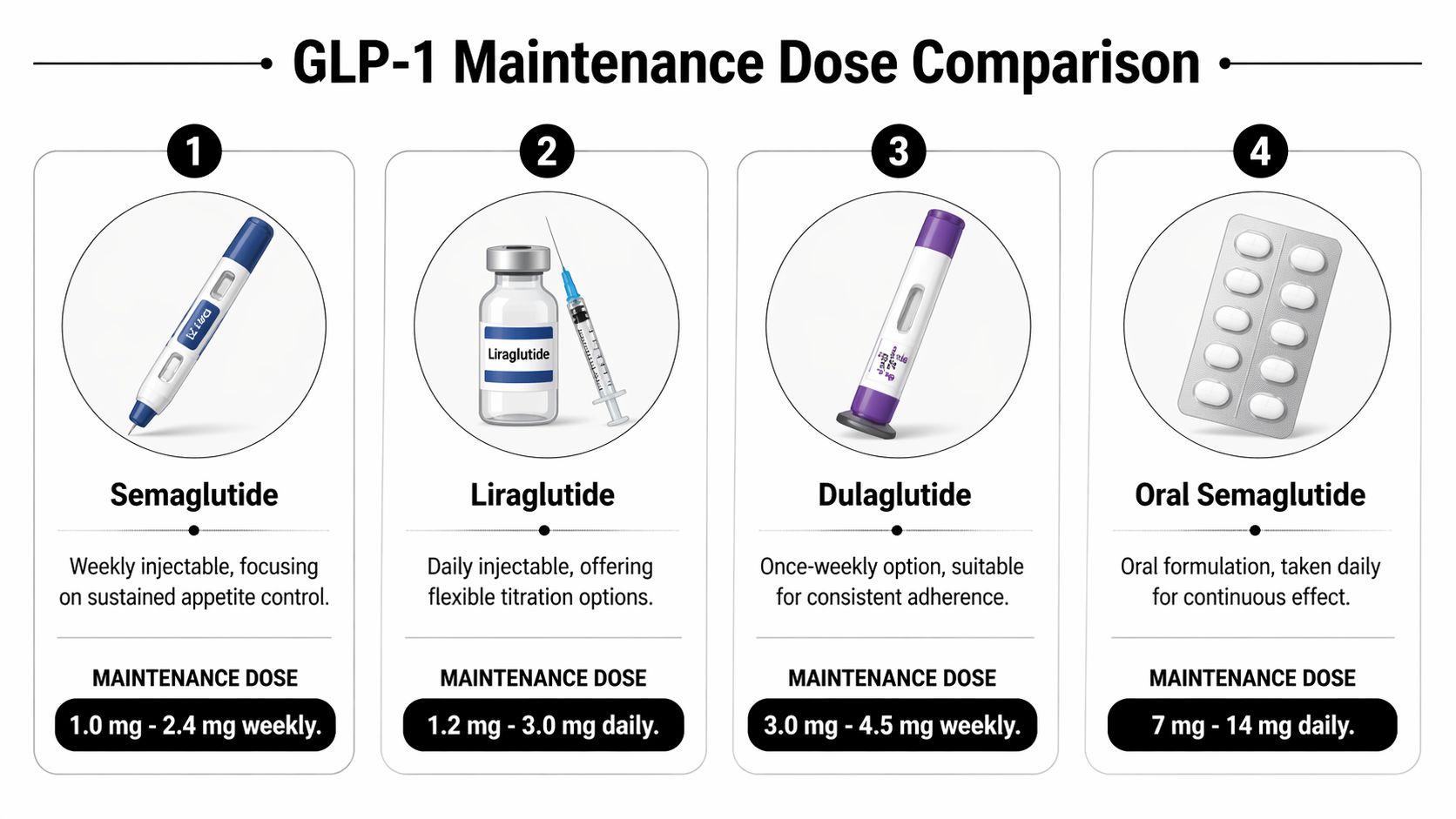
Approved maintenance doses at a glance
For the two medications people ask about most often, approved maintenance doses are:
Medication (Active Ingredient) | Starting Dose | Typical Titration Steps | Approved Maintenance Dose(s) |
|---|---|---|---|
Wegovy (semaglutide) | 0.25 mg weekly | 0.5 mg, 1 mg, then higher as directed | 1.7 mg or 2.4 mg weekly |
Zepbound (tirzepatide) | 2.5 mg weekly | Higher step-up dosing as directed | 5 mg, 10 mg, or 15 mg weekly |
Analysts at Highmark Wholecare also reported that Wegovy and Zepbound have different manufacturer-recommended maintenance targets, and that some patients remain on low titration doses for longer than intended in real-world care, including about one out of every eight patients with more than two consecutive fills in pharmacy claims data who stayed below maintenance dosing levels (Highmark Wholecare’s review of GLP-1 maintenance dosing).
The part that often causes confusion
Titration doses and maintenance doses serve different jobs.
Titration is the ramp. Maintenance is the cruising speed.
Early doses are designed to help your body adjust and reduce side effects while you move upward. A maintenance dose is the level intended to support ongoing treatment benefit over time. So if someone says they are doing well on 0.5 mg of semaglutide, that may describe how they feel right now, but it does not automatically mean they have reached Wegovy’s labeled maintenance dose.
That distinction becomes more important months into treatment, when the goal shifts from getting started to staying steady.
Lower is not always better
A lower dose can be the right choice for some people, especially if side effects are limiting. But “more comfortable” and “effective enough for the long term” are not always the same thing.
This is one of the biggest gaps in standard dosing charts. They show the staircase, but not the ongoing decision-making that happens after you arrive at a higher step. In telemedicine, that follow-up matters. Your clinician can check whether hunger is creeping back, whether side effects are interfering with daily life, and whether your current dose still matches your goals instead of assuming the first tolerable dose will keep working indefinitely.
Clinical reality: A good maintenance dose supports durable results and a quality of life you can live with. If a dose feels easy but stops helping, it may be too low. If it works but causes persistent nausea, constipation, or poor intake, it may need adjustment.
Approved dosing is the starting framework, not the whole plan
FDA-approved maintenance doses give your clinician a clear reference point. Your real-life maintenance plan still needs personalization over time.
That is especially true in long-term care. Weight trends, appetite patterns, exercise, travel, stress, and side effects can all shift how a dose feels from one season to the next. Modern telehealth makes those adjustments easier to handle because follow-up can happen in smaller, more responsive steps instead of waiting until problems build.
If you want a medication-specific overview of the standard Wegovy schedule, this guide to doses of Wegovy explains how escalation typically leads to maintenance.
The key idea is simple. The best maintenance dose is the one that keeps supporting your health goals, remains tolerable, and can be reassessed as your body and routine change.
How Your Clinician Determines Your Ideal Dose
Two people can take the same medication and have very different maintenance experiences. One feels steady and comfortable. Another struggles with nausea, constipation, or a sense that appetite suppression has become too strong. A third starts to notice creeping hunger and a plateau. That’s why the “right” glp-1 maintenance dose is rarely a one-size-fits-all decision.
A good clinician looks at the whole picture, not just the number on the pen.

The three questions behind dose decisions
Most dose adjustments revolve around three practical questions.
Is it still effective?
Are you maintaining progress, still seeing benefit, or starting to feel old patterns return?Is it tolerable?
Mild side effects may be manageable. Persistent symptoms that interfere with eating, work, hydration, or daily function deserve attention.Does it fit your life right now?
Travel, stress, schedule changes, exercise habits, and personal goals can all affect how a dose feels in real life.
Why telemedicine can help
Telemedicine is especially useful during maintenance because this phase often requires smaller, more responsive changes. Instead of waiting a long time to raise a concern, patients can report patterns earlier. That matters when symptoms are subtle and the goal is to fine-tune rather than start over.
According to the obesityandenergetics.org summary, real-world adherence can drop by 50% after the initial titration phase because of issues such as gastrointestinal side effects, and personalized telemedicine-based adjustments may improve patient retention by up to 20%.
Those numbers support something many clinicians already see in practice. Maintenance works better when patients stay connected.
What your check-ins should cover
A productive maintenance follow-up usually includes more than weight alone. It may include:
Appetite changes such as rising hunger, evening snacking, or stronger cravings
Digestive symptoms including nausea, reflux, constipation, or bloating
Energy and hydration because some patients are unintentionally under-eating
Routine changes like travel, exercise shifts, illness, or stress
Personal goals which may move from weight loss to stability, confidence, or metabolic health
Dose adjustment is collaboration
Patients sometimes worry that reporting side effects means they’ve “failed” the medication. It doesn’t. The best maintenance care is collaborative. You bring observations. Your clinician brings pattern recognition, safety judgment, and treatment options.
A useful self-check before an appointment is to ask: Am I avoiding food because I’m satisfied, or because I feel uncomfortable eating? Those are not the same thing.
You can also use tools like a dose calculator discussion page as a starting point for questions, but any actual dose change should come from your prescribing clinician who knows your medical history.
The ideal maintenance dose is the lowest effective dose that keeps treatment helpful, livable, and aligned with your long-term health goals.
Thriving on Your Maintenance Dose A Long-Term Guide
Once you’ve found a workable glp-1 maintenance dose, daily life usually becomes less dramatic and more intentional. That’s a good sign. The goal isn’t to feel like you’re “actively dieting” forever. The goal is to build a routine your body can live in.
Maintenance is where consistency beats intensity.

What to track besides the scale
The scale matters, but it’s not the only useful signal. A stable maintenance phase often shows up in quieter ways first.
Consider watching for:
Your hunger rhythm
Are meals comfortably spaced, or are you suddenly thinking about food all day again?Your eating quality
Are you getting enough protein, fluids, and regular meals, or skipping too much because eating feels difficult?Your physical function
Energy, walking tolerance, strength, and sleep quality often reveal how sustainable your routine really is.Your clothes and body cues
Some people notice body changes before scale changes. That can be helpful when weight naturally fluctuates.
Make lifestyle habits easier, not harsher
Patients often ask whether they need a “perfect” diet on maintenance. They don’t. They need a pattern they can repeat.
A sustainable maintenance routine usually includes:
Regular meals that prevent accidental under-eating followed by rebound hunger later
Protein-forward choices to support fullness and muscle preservation
Movement you can keep doing such as walking, resistance training, or structured exercise you tolerate
Simple hydration habits because dehydration can worsen fatigue and digestive symptoms
Sleep and stress care since poor sleep can make appetite feel louder even when the medication is working
What to do about mild side effects
Some people continue to have low-grade nausea, reflux, constipation, or a “too full” feeling on maintenance. Don’t ignore that just because it seems less dramatic than the early weeks.
Try practical adjustments first:
Slow your meals down if fullness hits quickly
Keep portions modest and add more only if your body wants it
Choose simpler foods temporarily when your stomach feels touchy
Stay ahead on fluids rather than trying to catch up late in the day
If symptoms persist, worsen, or make it hard to eat enough, contact your clinician. Maintenance should be sustainable, not a daily struggle.
Practical rule: If a side effect changes how you live, not just how you feel for an hour, it’s worth discussing with your clinician.
When to ask for a dose review
A maintenance dose should be reassessed when your life or your body changes. Reach out if you notice any of the following:
A clear return of hunger or cravings that feels different from normal appetite
A weight plateau that comes with loss of appetite control, not just a pause on the scale
Digestive symptoms that are sticking around
A new health issue or medication change
A shift in goals, such as wanting to stabilize rather than continue losing
The strongest long-term results usually come from people who stay engaged with their care instead of waiting until things feel unmanageable.
Special Considerations for Your GLP-1 Journey
Some maintenance questions carry more weight than others. Family planning is one of them. If you’re taking a GLP-1 medication and thinking about pregnancy, this isn’t the time for guesswork or internet shortcuts.
A person may feel healthier, lose weight, and notice positive changes in cycle regularity or fertility potential. But that does not mean the medication should be continued through conception planning without a medical discussion.
Family planning needs an early conversation
According to the ObesityWeek poster resource, GLP-1 maintenance dosing for women planning a family requires careful consideration. The same resource notes that while these medications may improve fertility by supporting meaningful weight loss, guidance from organizations such as the Endocrine Society recommends discontinuing them at least two months before trying to conceive because of potential fetal risks.
That timing matters. Many patients wait until they’re already trying to get pregnant before asking about their medication plan. It’s much better to discuss it in advance.
Questions worth bringing to your clinician
If pregnancy may be part of your near-term future, bring specific questions rather than a general “Is this okay?” A more helpful conversation includes:
What’s the safest timeline for stopping my medication before conception?
How should we support appetite and weight stability after stopping it?
Do any of my other medications need review too?
When should we talk about restarting treatment after pregnancy, if needed?
Other moments that deserve extra caution
Family planning isn’t the only special situation. It’s also wise to contact your clinician promptly if you have a major new diagnosis, a big change in eating tolerance, or a medical event that affects hydration or digestion.
These aren’t reasons to panic. They’re reasons to personalize care.
If your goals include pregnancy, your GLP-1 plan should become part of your preconception plan, not an afterthought.
Your GLP-1 Maintenance Dose Questions Answered
People usually reach this stage with practical concerns, not abstract ones. They want to know what to do on a Tuesday when something changes. These answers can help you think clearly and prepare for a conversation with your clinician.
Can my maintenance dose ever go down
Yes, sometimes. Some patients eventually do well on a lower ongoing dose, but that decision should be based on response, side effects, and long-term stability rather than impatience or cost alone. If hunger returns, eating control worsens, or weight starts drifting upward, your prior dose may have been doing more work than you realized.
What if I miss a dose
Don’t improvise by doubling up unless your prescribing clinician has told you exactly how to handle that situation. The safest next step is usually to review the medication instructions you were given and contact your care team if you’re unsure, especially if it has been more than a brief delay.
How long do people stay on maintenance treatment
There isn’t one universal timeline. Some people need longer support than others. The better question is not “How fast can I stop?” but “What keeps my health stable and sustainable?” Your duration should match your biology, your goals, and your medical response.
What if my weight loss plateaus on maintenance
A plateau doesn’t always mean failure. Sometimes your body is stabilizing. What matters is context. If appetite is controlled and your health habits are solid, a plateau may be maintenance doing its job. If the plateau comes with rising hunger, loss of routine, or increasing symptoms, it may be time for a dose review.
Will insurance cover maintenance treatment
Coverage varies by plan and indication. It’s common for people to face questions about prior authorization, ongoing eligibility, or changes in coverage over time. Check your plan details early and keep records of what your prescriber submits. Administrative delays are frustrating, but they’re easier to manage when you’re proactive.
Is maintenance only about the medication
No. The medication helps support appetite regulation and weight stability, but long-term success is stronger when your meals, movement, sleep, and stress patterns are also workable. Think of the medication as one part of the structure, not the entire structure.
Embracing a New Chapter of Sustainable Health
A glp-1 maintenance dose isn’t the end of your progress. It’s the part where progress becomes more secure, more personalized, and more livable. The strongest results usually come from treating maintenance as real medical care, not an afterthought.
You don’t need to steer through this phase by trial and error alone. With the right clinical partnership, thoughtful adjustments, and steady habits, long-term health can feel less fragile and far more achievable.
If you're looking for personalized support for long-term weight management, 10 Rx Home connects you with board-certified physicians who can help you make treatment decisions, monitor progress, and build a plan that fits real life. Their telehealth model makes it easier to stay engaged in care, ask questions early, and move forward with confidence.